
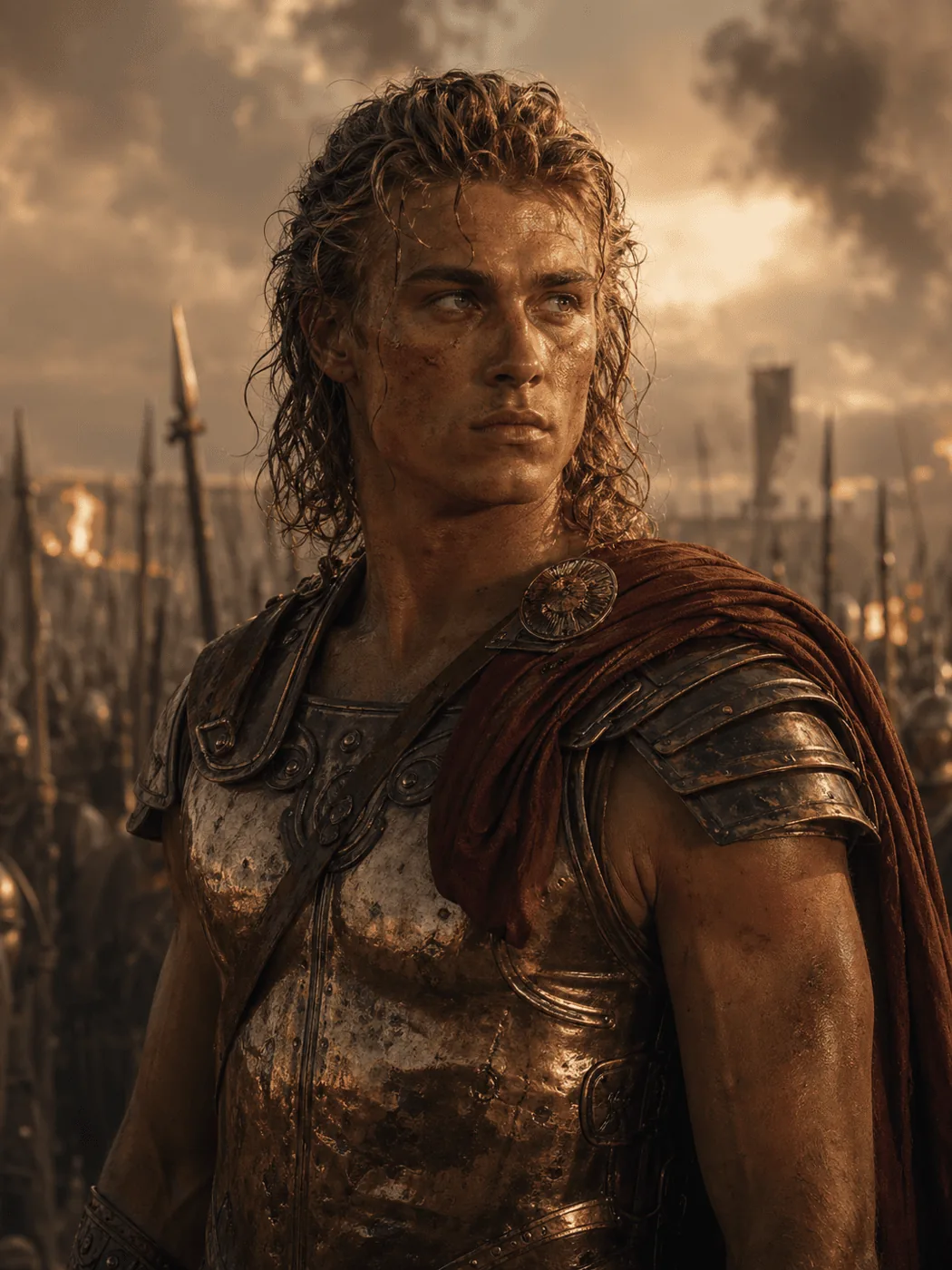
Achilles is the very face of a hero whose greatness depends on the gaze of others. He concentrates the brightest heroic ideal of the Trojan cycle: physical force, speed, anger, the demand for honor and an acute awareness of his own destiny.
His importance goes beyond simple military prowess. Achilles forces the story to ask a brutal question: what is glory worth if it destroys those around it, and what becomes of a hero when personal value conflicts with collective survival?
A short and conditional glory
In The Iliad, his military power seems overwhelming, but that power is tied to the recognition he constantly seeks. The quarrel with Agamemnon is therefore not only a clash of pride: it reveals the political fragility of a coalition built around rival chiefs. Achilles knows that his destiny is stretched between two forms of life. Staying away from combat preserves a long but obscure existence; returning to battle wins an immortal name at the cost of an early death. His whole trajectory is played out in this tension between human duration and heroic memory.
Anger as narrative force
Achilles' anger is not a passing mood. It organizes the story, stops the Greek army, exposes failures of command and turns a symbolic wound into military catastrophe. In him, emotion becomes a historical power. This anger also makes him deeply legible: he refuses to be used as a simple instrument of war. He wants his value recognized publicly. But that refusal, legitimate in the language of honor, endangers all his own people.
The price of honor
Achilles carries the conflict between private honor and collective responsibility. He recalls that personal success can cost the stability of a community, especially in a world where reputation decides almost as much as weapons. He also embodies the terrible beauty of the archaic hero: the one who shines because he accepts burning quickly. That is why his greatness remains ambivalent. It fascinates, but it cannot serve as a durable political model.
His role in The Odyssey
Achilles is not at the center of the story of return, but his shade remains decisive. In the Underworld, he corrects the illusion of glory: better to be alive, even modestly, than to rule among the dead. The scene reverses heroic prestige. Odysseus, who survives by patience and adaptation, appears as another possible answer to the Trojan War. Where Achilles chooses intensity and memory, Odysseus chooses return, house and continuity.
The trace Achilles leaves
Achilles serves as a counterpoint to Odysseus' quieter choices: noisy force answers reasoning cunning. To understand Achilles is to understand what The Odyssey moves beyond. The poem of return does not deny warrior glory; it shows that after Troy, surviving, recognizing one's own people and inhabiting the world again become harder exploits than victory.