
The Iliad and The Odyssey are often presented as intimidating monuments of ancient literature. But once the reader enters the scenes, the marble cracks: chiefs humiliate one another, gods calculate, heroes hesitate, families tremble, kings beg for a body.
The Iliad is not only a poem about the Trojan War. It tells above all Achilles' anger and the deaths that follow. The Odyssey is not only a sequence of marvels: it is a man's inquiry into his own return, where intelligence, lies and patience matter as much as strength.
These are the scenes that let the two poems be read as dramatic chronicles rather than distant summaries.
The aim here is not to replace a full reading of Homer, and not to reduce the poems to a checklist of famous moments. Each passage below is chosen because it changes the direction of the story: a leader loses authority, a hero doubts glory, a family becomes visible inside war, a trick saves lives, or a recognition scene proves that homecoming is never automatic.
Read the Iliad passages as a tightening circle around anger and grief. Read the Odyssey passages as a chain of tests around identity and return. The two poems answer one another: the war creates the wound, and the voyage asks whether a man can carry that wound back into a house, a marriage and a political order.
The important passages of The Iliad
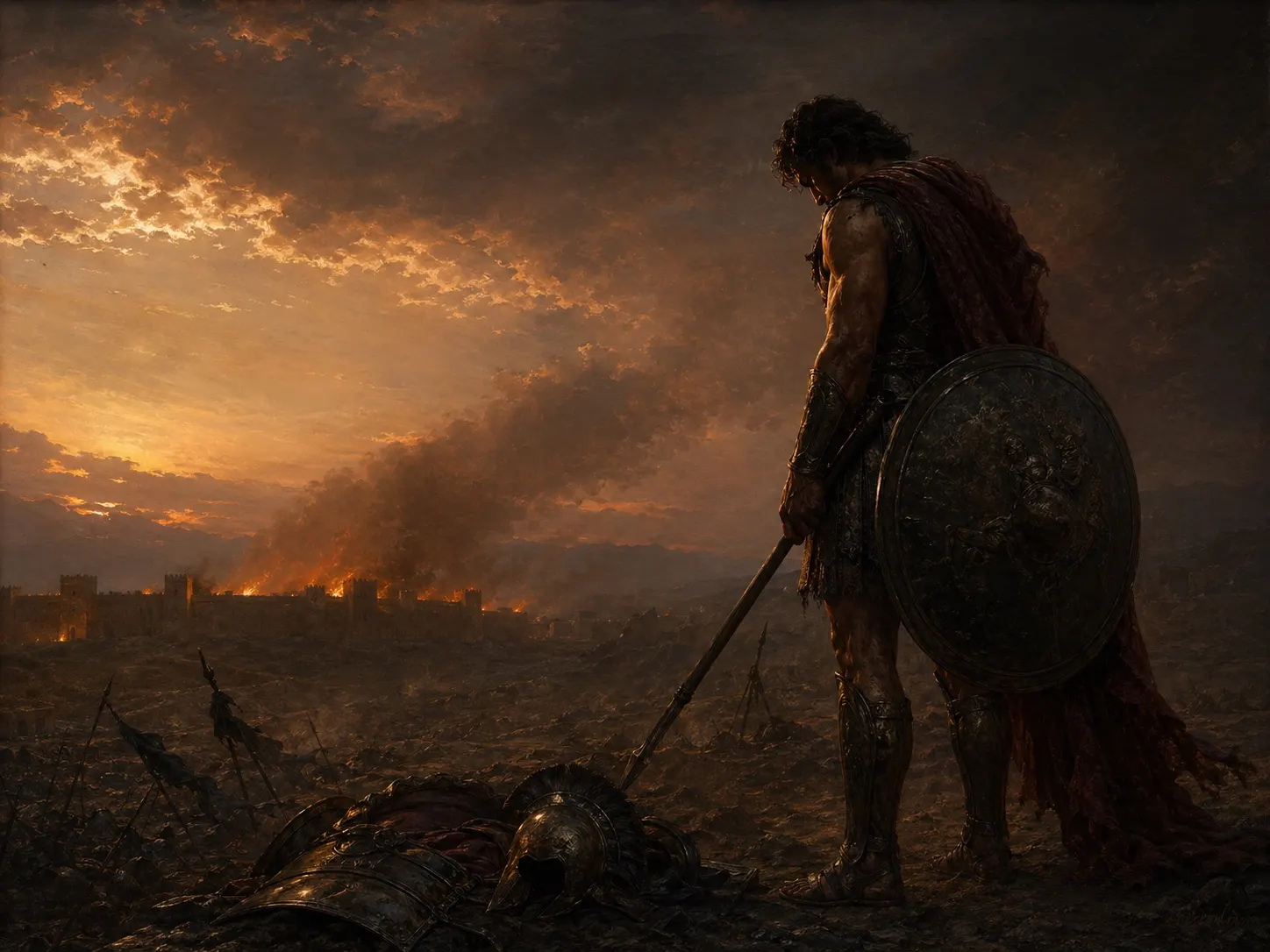
The Iliad advances by crises: wounded honor, anger, loss, then compassion. The image should serve as a threshold, not interrupt the reading.
Achilles' anger against Agamemnon
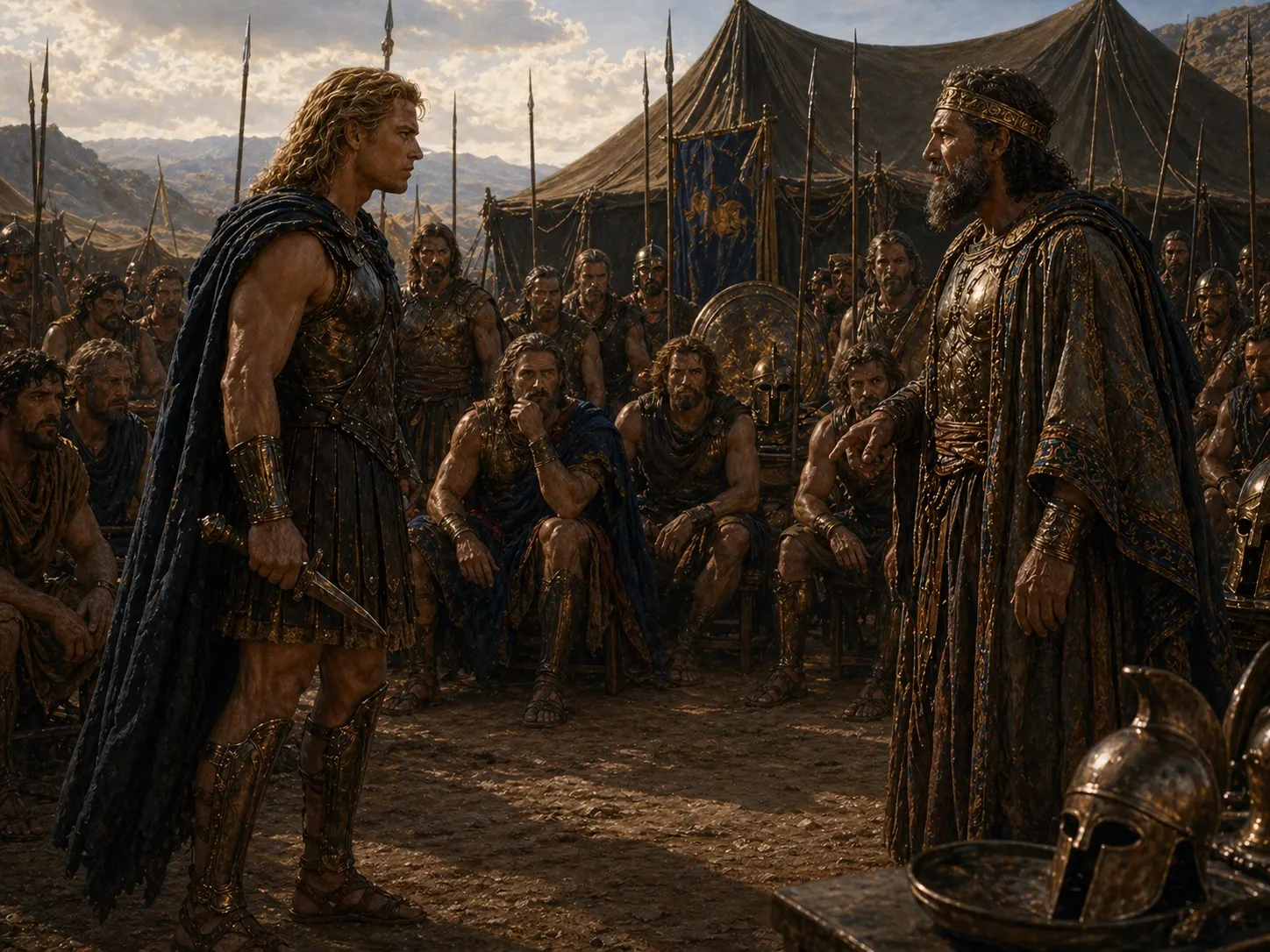
The Iliad opens not with Troy's fall, nor with the horse, but inside the Greek camp, where two chiefs quarrel over honor. Agamemnon takes Briseis from Achilles; Achilles withdraws. From that wound of pride, thousands of men will suffer. Homer announces at once that war is fed not only by courage, but by rank, humiliation and decisions that cannot be recalled.
The point is not a private tantrum added before the real war begins. The quarrel exposes the political grammar of the Achaean camp: gifts, captives, prestige and public speech are the visible currency of honor.
That is why the opening matters for every later death. Achilles' withdrawal turns a personal insult into a collective disaster, and the poem never lets the reader forget how quickly elite humiliation becomes ordinary men's suffering.
Read this passage as a hinge inside The Iliad rather than as an isolated famous scene: it changes the pressure between honor, command, divine intervention and grief. Each episode prepares the next wound, so the poem keeps making heroic brilliance answer for what it costs.
Thersites, the ill-received voice of the camp
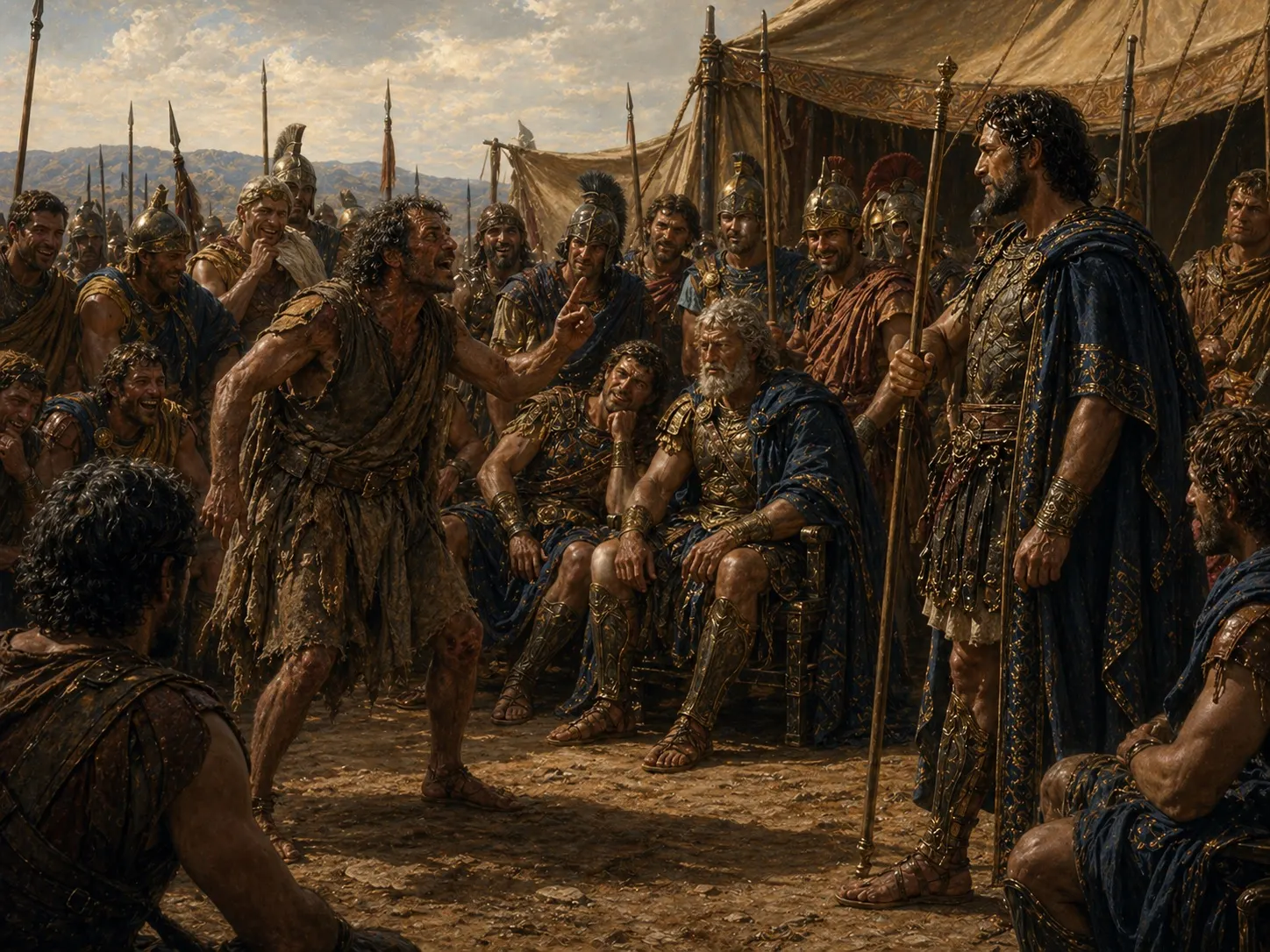
Thersites is neither king nor great warrior. He attacks Agamemnon's greed before the army and is struck down by Odysseus under the laughter of the Greeks. The scene is cruel because the lowly soldier is not entirely wrong. It reveals a hard aristocratic order: a king may challenge a king; a common soldier must know his place.
The scene is uncomfortable because it asks who is allowed to speak the truth. Thersites is mocked by the narrative surface, but his complaint points toward real greed and exhaustion inside the army.
Odysseus restores order by force, not by answering the argument. The laughter of the assembly therefore feels double: comic on the spot, but politically brutal once the reader sees what has been silenced.
Read this passage as a hinge inside The Iliad rather than as an isolated famous scene: it changes the pressure between honor, command, divine intervention and grief. Each episode prepares the next wound, so the poem keeps making heroic brilliance answer for what it costs.
Helen on the walls of Troy
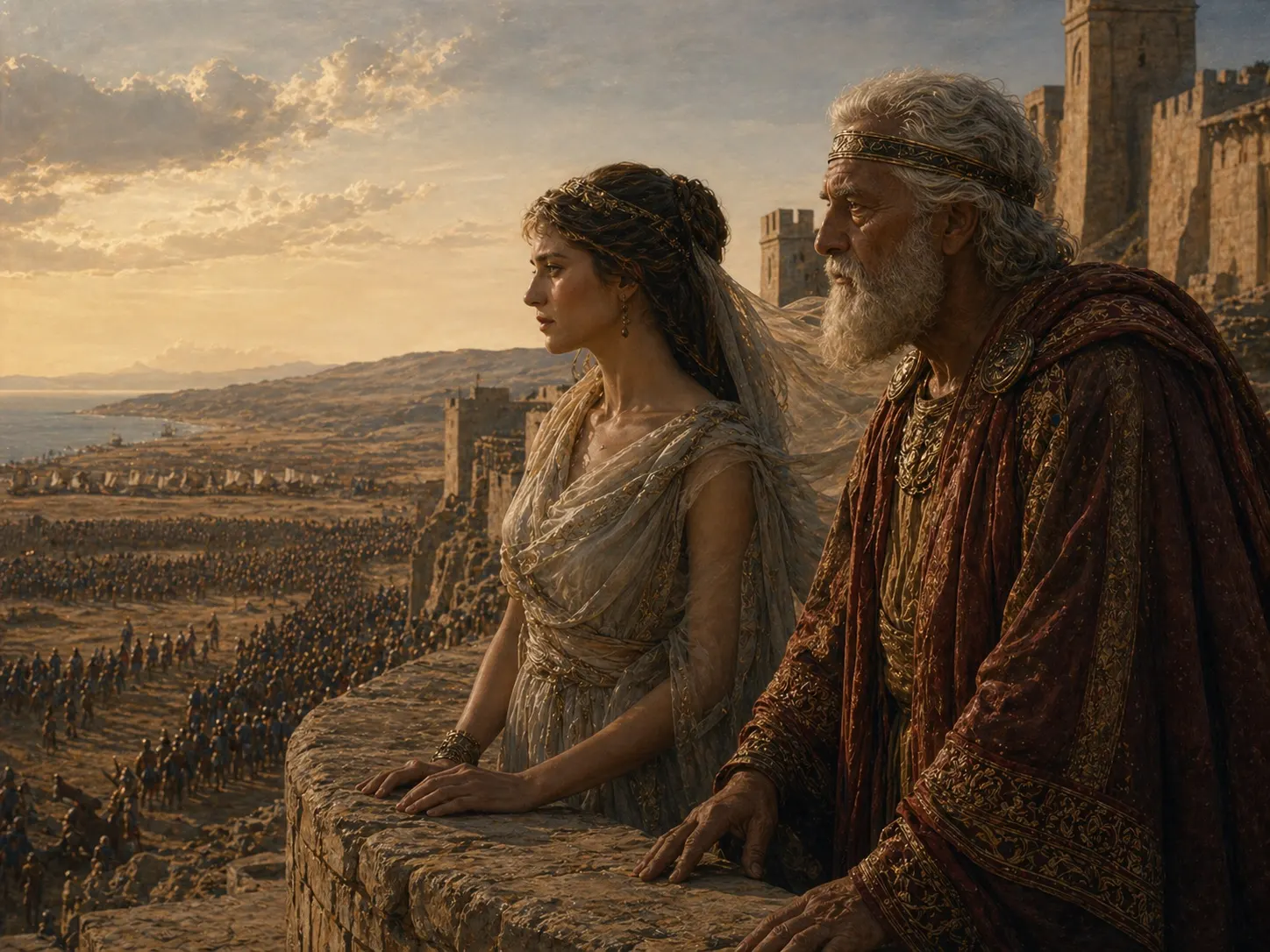
Beside Priam, Helen looks down from Troy's walls and names the Greek warriors. She is not only the cause of war. She sees the disaster gathered around her and feels shame, sadness and lucidity. Behind the epic grandeur, a lighter prince and a woman who understands the ruin stand at the center of a conflict too large for them.
Helen's position on the wall is already a form of judgment. She sees both camps, names the Greek heroes and becomes the living link between domestic desire and international catastrophe.
The passage gives Troy interior depth. The city is not only the target of a siege; it is a place where people know what is being lost and where guilt can speak before the final ruin arrives.
Read this passage as a hinge inside The Iliad rather than as an isolated famous scene: it changes the pressure between honor, command, divine intervention and grief. Each episode prepares the next wound, so the poem keeps making heroic brilliance answer for what it costs.
Diomedes wounds the gods
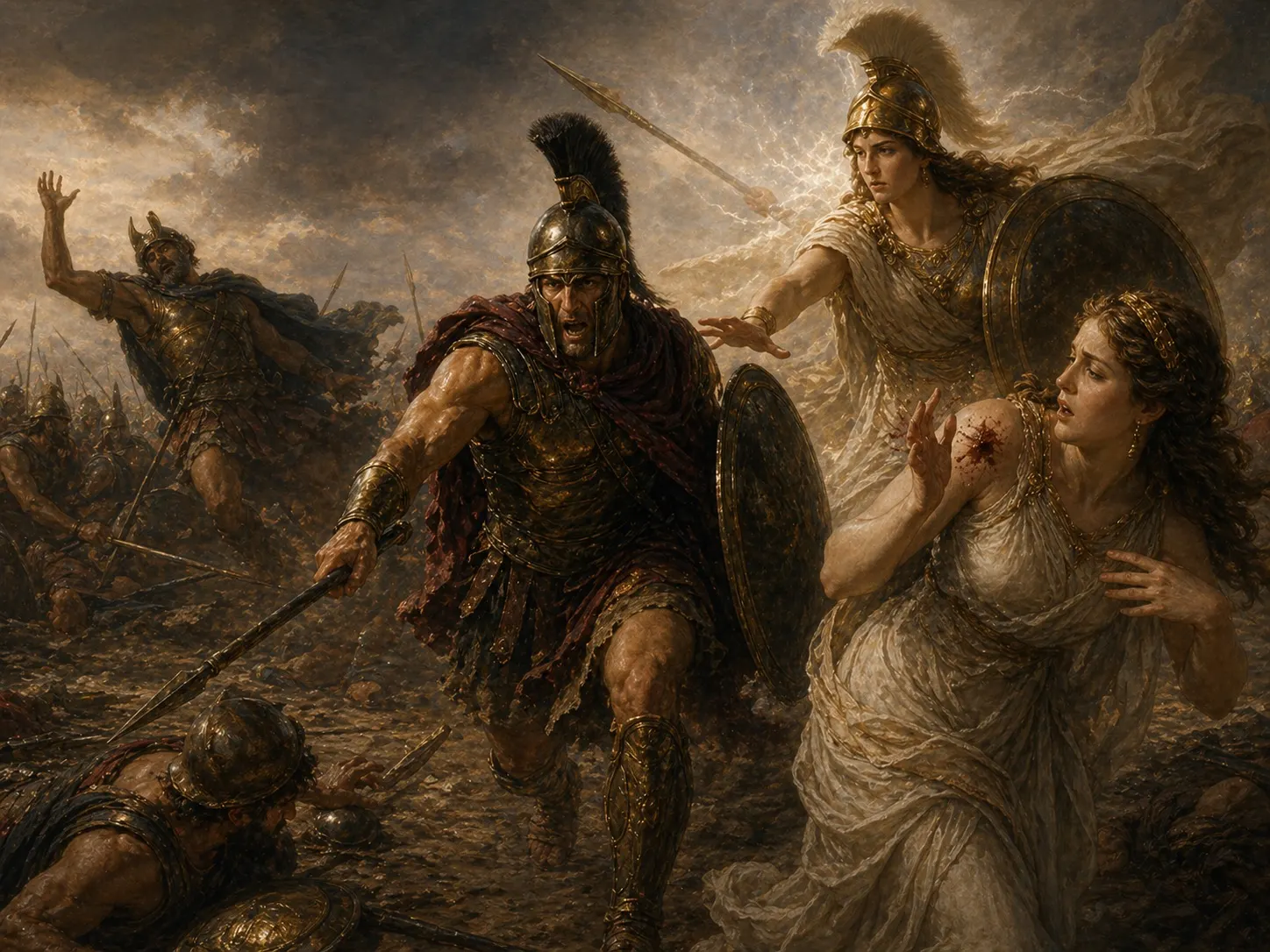
Supported by Athena, Diomedes becomes almost invincible and wounds Aphrodite, then Ares himself. The gods are powerful, but not serene statues. They complain, take sides, suffer offenses and carry rivalries into the human battlefield. Men die; the gods play with a war that never quite consumes them.
This episode expands the battlefield vertically. Mortals and immortals are not sealed in separate worlds; Athena can make a man frightening enough to wound the powers that usually govern him.
At the same time, the wounded gods reveal the strange comedy of Olympus. Divine grandeur remains real, but it is mixed with irritation, favoritism and theatrical complaint.
Read this passage as a hinge inside The Iliad rather than as an isolated famous scene: it changes the pressure between honor, command, divine intervention and grief. Each episode prepares the next wound, so the poem keeps making heroic brilliance answer for what it costs.
Hector, Andromache and Astyanax
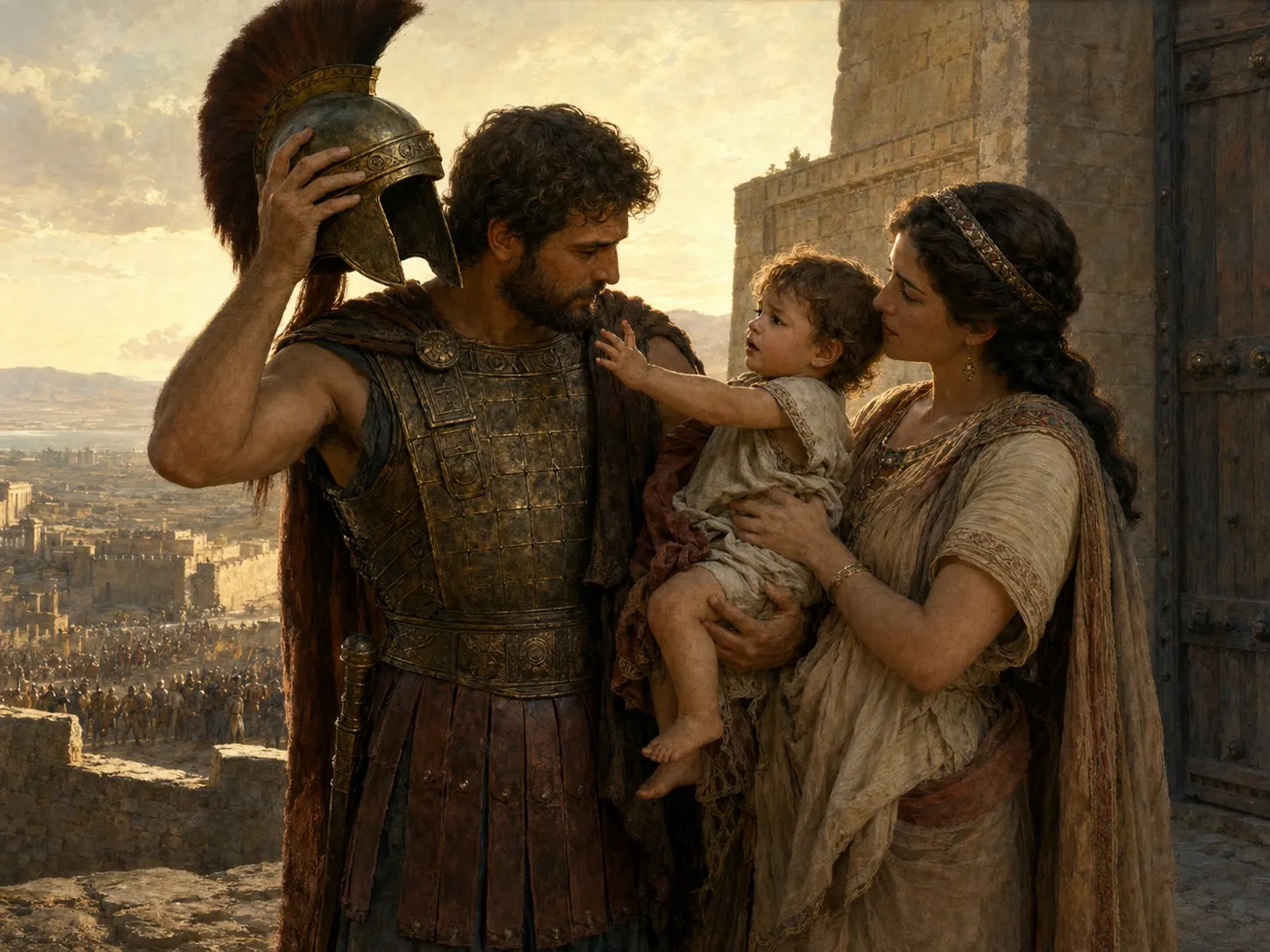
Hector meets Andromache and their young son on the walls. She begs him not to return to battle; he cannot renounce his public role. When the child fears the helmet, Hector removes it and smiles. In the middle of war, Homer gives Troy a home, a father, a wife and a child. Hector's future death becomes more tragic because he is so plainly human.
The helmet scene matters because it pauses the heroic machine. Hector is still the defender of Troy, yet the poem lets him be a husband and father before it returns him to the public role that will kill him.
That private tenderness is not decorative. It makes the coming fall morally heavier: when Hector dies, a political city, a household and a child's future all lose their central support.
Read this passage as a hinge inside The Iliad rather than as an isolated famous scene: it changes the pressure between honor, command, divine intervention and grief. Each episode prepares the next wound, so the poem keeps making heroic brilliance answer for what it costs.
The embassy to Achilles
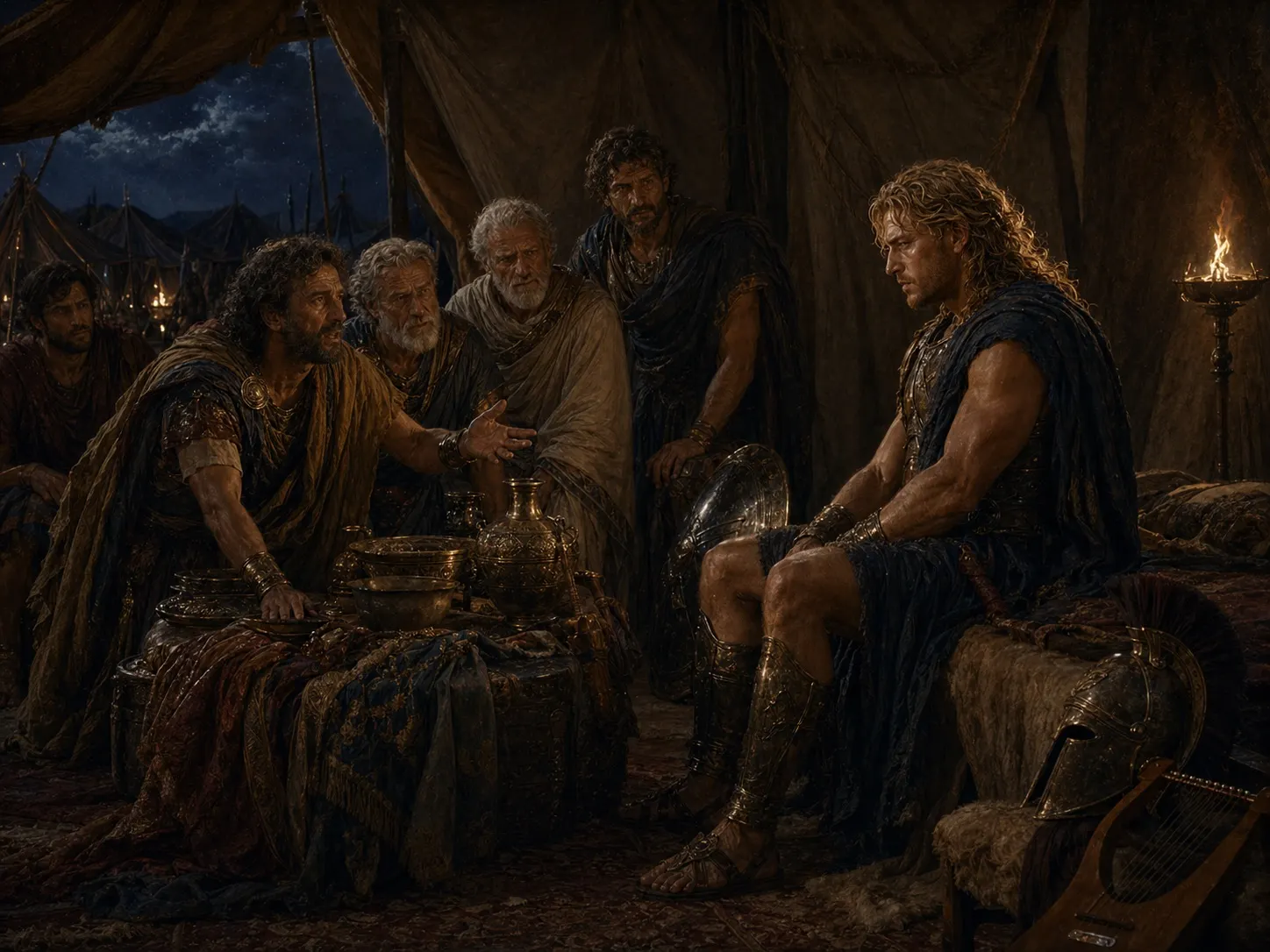
The Greeks need Achilles and send gifts, promises and honors. Achilles refuses. His anger has become more than wounded vanity: he questions the heroic bargain itself. What is glory worth if it leads to a short life under a chief who dishonors his best man? The poem does not merely praise heroism; it shows its cost.
The gifts offered to Achilles are enormous, but they cannot repair what he now doubts. He has begun to see that the heroic economy may ask for a life and return only a song.
The scene is quieter than a duel, yet it is one of the poem's deep crises. Achilles is no longer merely angry at Agamemnon; he is questioning the value system that makes Agamemnon possible.
Read this passage as a hinge inside The Iliad rather than as an isolated famous scene: it changes the pressure between honor, command, divine intervention and grief. Each episode prepares the next wound, so the poem keeps making heroic brilliance answer for what it costs.
The Doloneia: Odysseus and Diomedes by night
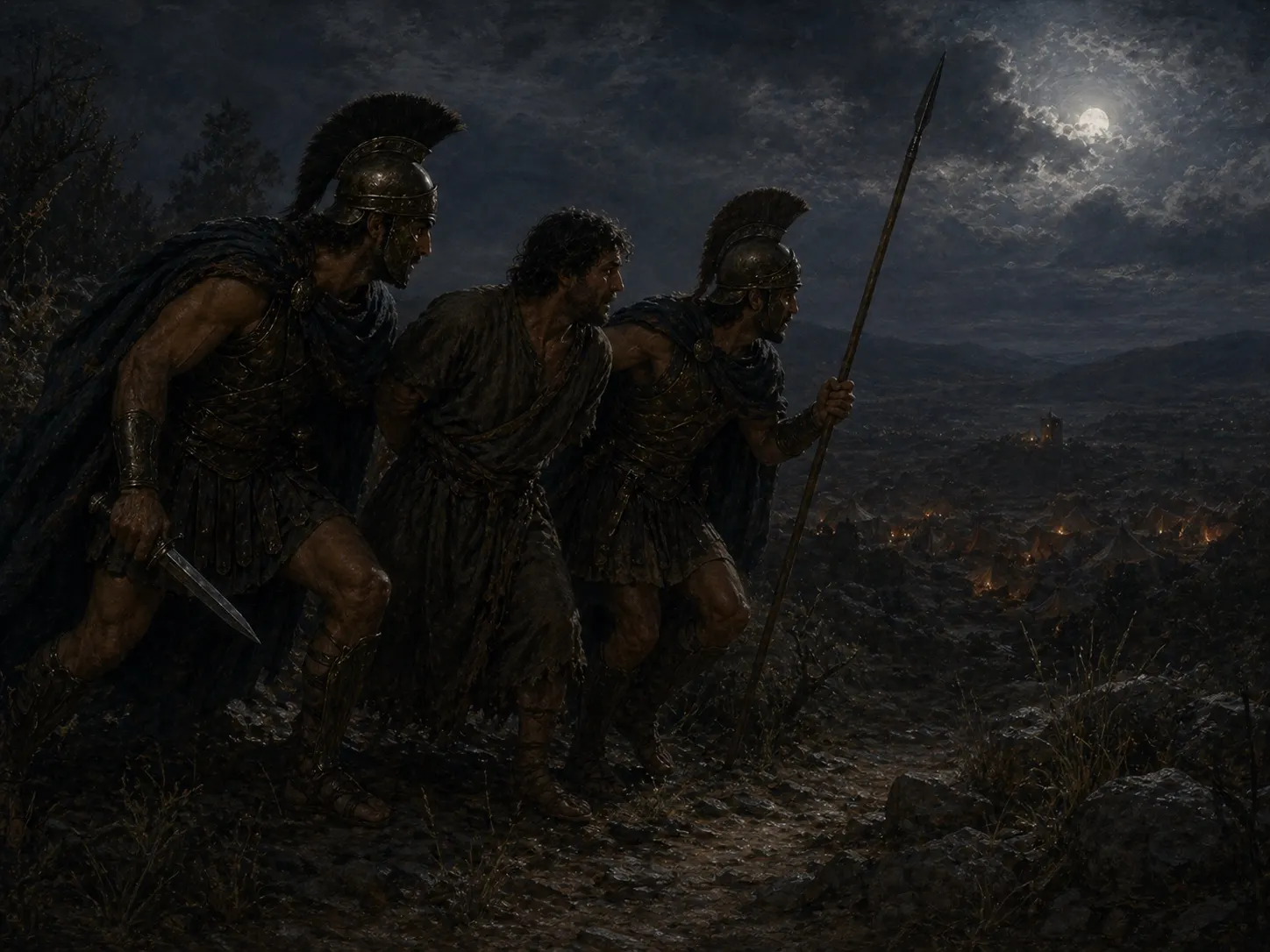
The tenth book leaves the bright duel for darkness, spying and silent movement between tents. Odysseus and Diomedes capture Dolon, extract information, kill him, then raid sleeping warriors. This is war without ceremony: intelligence, execution, opportunistic violence. Epic glory has an underside.
The night raid is useful because it complicates any clean idea of Homeric glory. Odysseus and Diomedes are admirable in efficiency, but the scene belongs to intelligence, ambush and the exploitation of sleep.
For a reader preparing The Odyssey, this is also a key Odysseus moment. His metis is already military, practical and morally gray before it becomes the survival intelligence of the return.
Read this passage as a hinge inside The Iliad rather than as an isolated famous scene: it changes the pressure between honor, command, divine intervention and grief. Each episode prepares the next wound, so the poem keeps making heroic brilliance answer for what it costs.
Hera seduces Zeus to bend the war
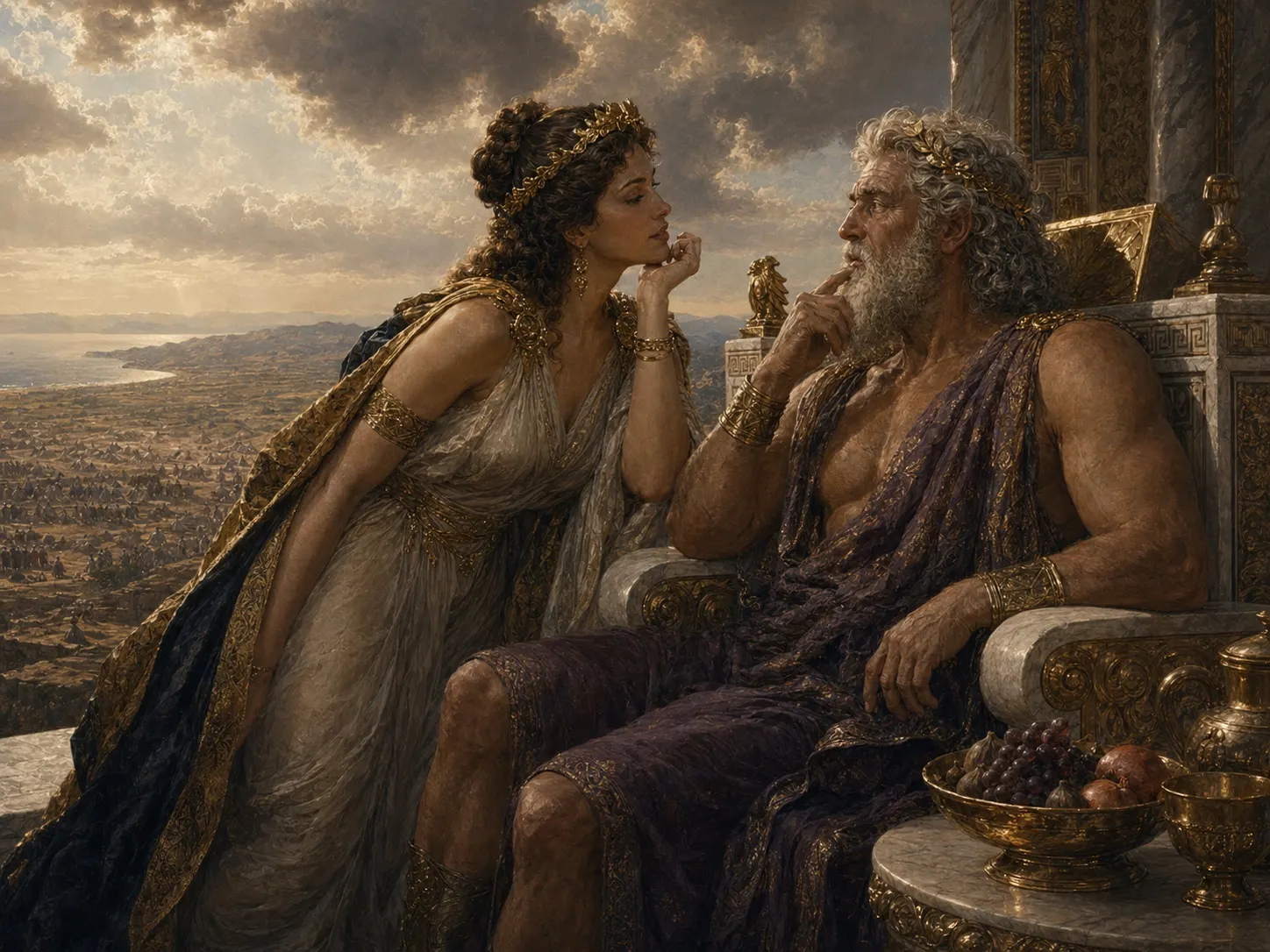
Hera wants to help the Greeks while Zeus favors the other side. She borrows Aphrodite's power, prepares herself and distracts the sovereign god. The scene has the irony of an ancient court: divine politics passes through desire, jealousy and maneuver. The human tragedy is played beneath a divided sky.
The passage makes divine intervention feel like court politics. The fate of men below can pivot on seduction, distraction and rivalry among gods who are themselves full of desire and calculation.
It also prevents a simple reading of fate. The war is not moved by one clean will from above, but by a divided Olympus whose private tensions spill into human history.
Read this passage as a hinge inside The Iliad rather than as an isolated famous scene: it changes the pressure between honor, command, divine intervention and grief. Each episode prepares the next wound, so the poem keeps making heroic brilliance answer for what it costs.
The death of Patroclus
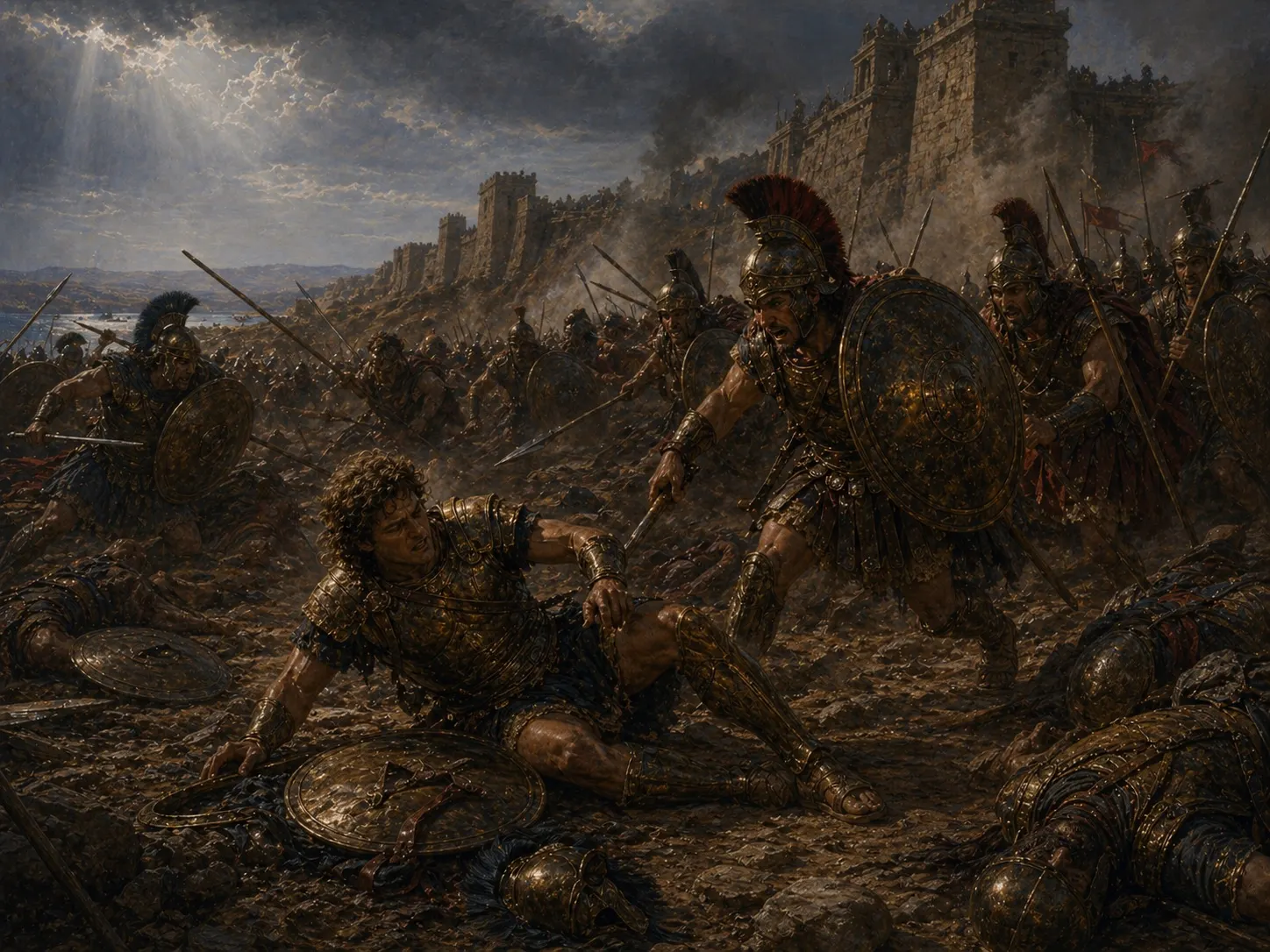
Patroclus wears Achilles' armor to save the Greeks and drives the Trojans back, but he goes too far. Apollo weakens him, Euphorbus wounds him, Hector finishes him. His death turns Achilles' anger into vengeance. It is not a clean heroic duel, but a progressive collapse, with god and men sharing the blow.
Patroclus' fall is constructed as a chain, not a clean blow. A god strips him, one warrior wounds him, another finishes him, and Hector receives a glory already shared by unseen powers.
The result is devastating because Patroclus dies while borrowing Achilles' place. The armor extends Achilles' absence onto the battlefield until the loss becomes personal enough to drag him back.
Read this passage as a hinge inside The Iliad rather than as an isolated famous scene: it changes the pressure between honor, command, divine intervention and grief. Each episode prepares the next wound, so the poem keeps making heroic brilliance answer for what it costs.
The shield of Achilles
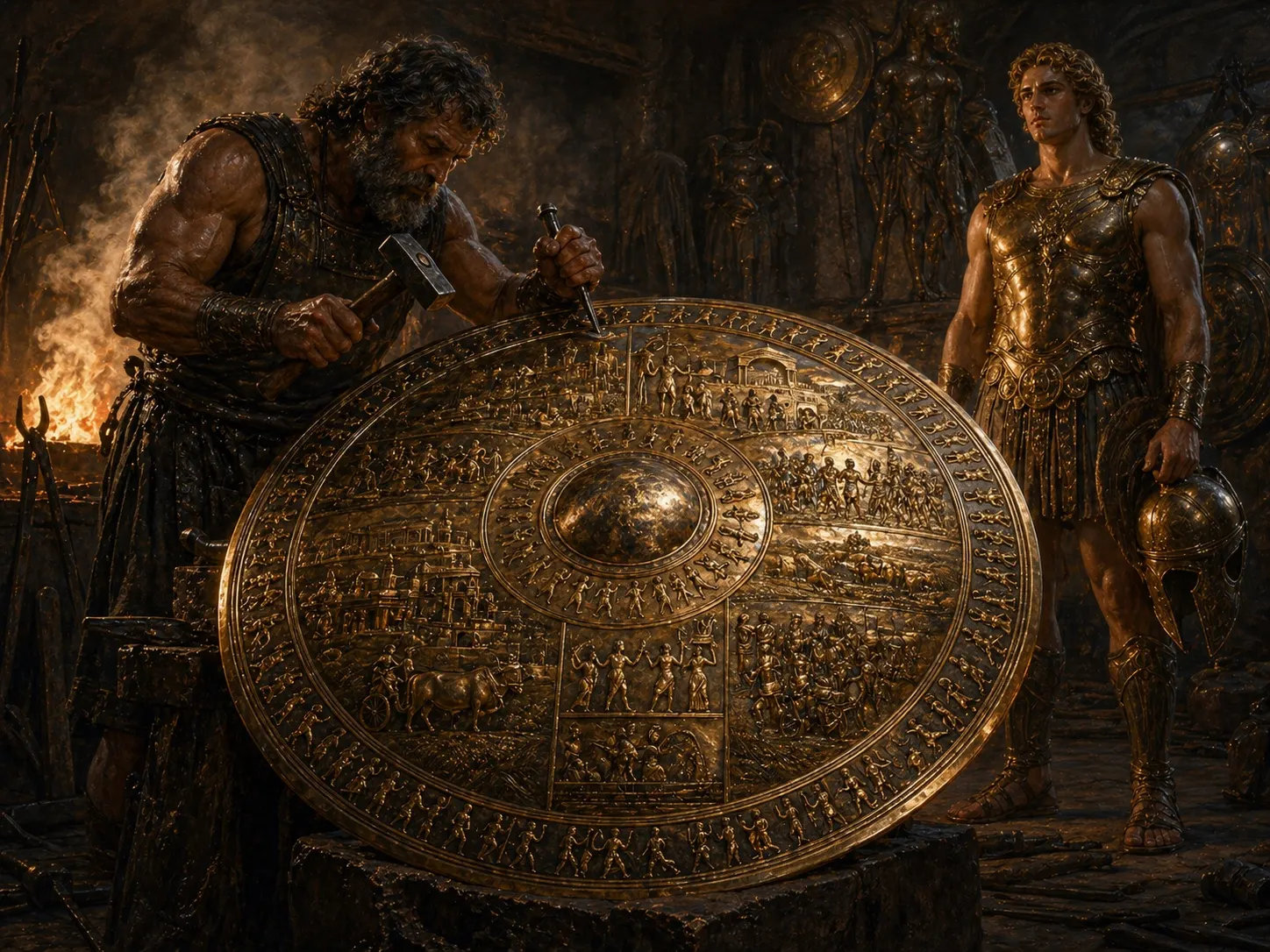
After Patroclus dies, Hephaestus forges Achilles a new shield. Upon it appear cities, marriages, trials, fields, dances, herds, peace and war. Achilles is about to become almost inhuman in destruction, yet he carries on his arm the image of the full human world that war threatens to erase.
The shield is a world placed on the arm of a man returning to slaughter. Its cities, fields, dances and disputes show what war surrounds and threatens, not only what war interrupts.
This is why the description never feels like ornament. Before Achilles becomes the poem's most terrifying force, Homer makes him carry the image of ordinary human fullness.
Read this passage as a hinge inside The Iliad rather than as an isolated famous scene: it changes the pressure between honor, command, divine intervention and grief. Each episode prepares the next wound, so the poem keeps making heroic brilliance answer for what it costs.
Achilles against the river Scamander
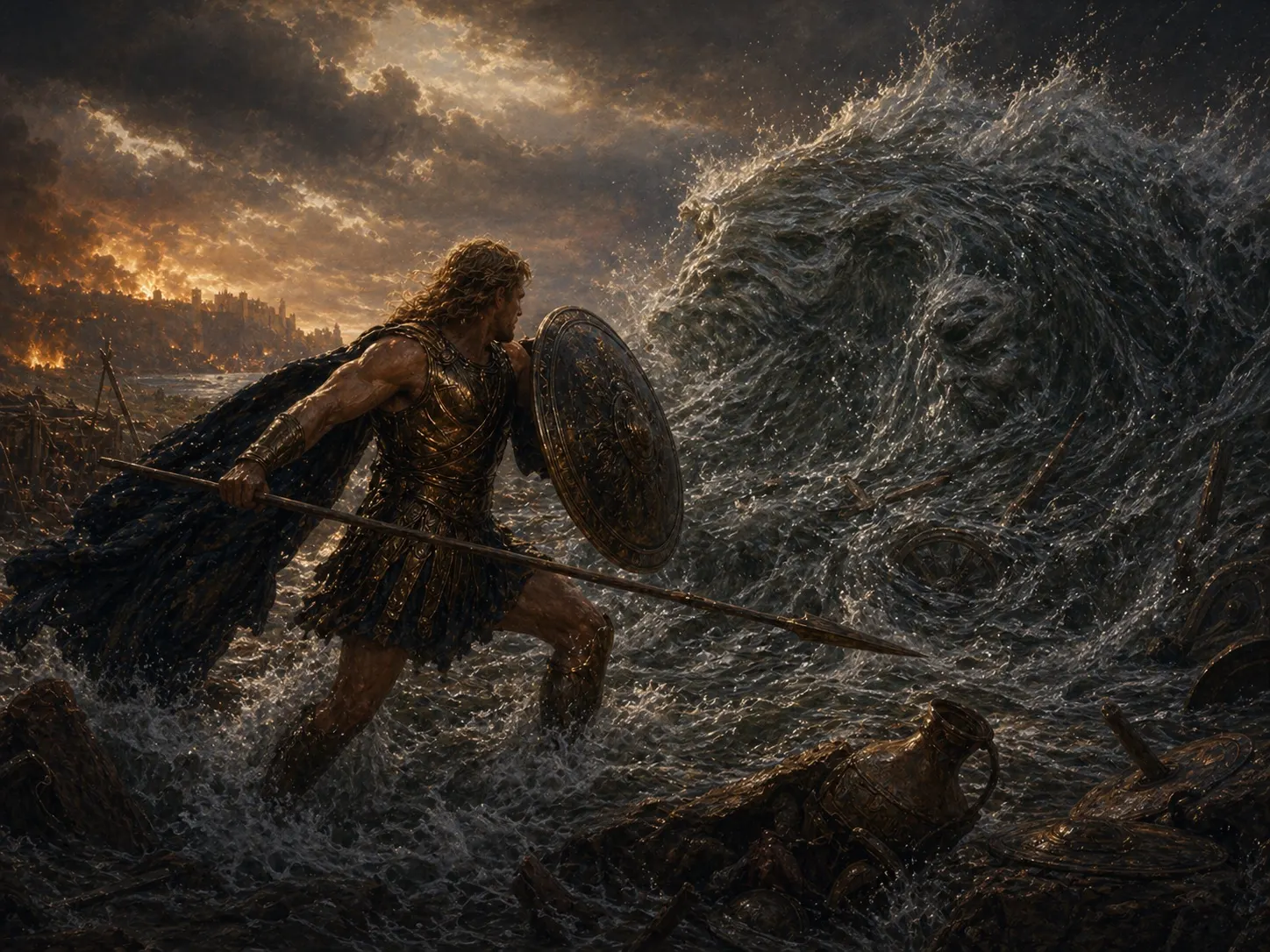
Achilles kills so many Trojans that the river Scamander, choked with bodies, rises against him. He no longer fights only men, but a divine natural force. His revenge has disturbed the order of the world. Human violence contaminates even the waters that should carry life.
The river's revolt turns excess into landscape. Achilles' killing is so intense that nature itself appears unable to process the bodies, and the battlefield becomes an ecological and divine crisis.
The scene therefore measures vengeance by its overflow. Achilles is victorious, but his victory has begun to look like pollution, something the world must resist before it swallows everything.
Read this passage as a hinge inside The Iliad rather than as an isolated famous scene: it changes the pressure between honor, command, divine intervention and grief. Each episode prepares the next wound, so the poem keeps making heroic brilliance answer for what it costs.
The death of Hector
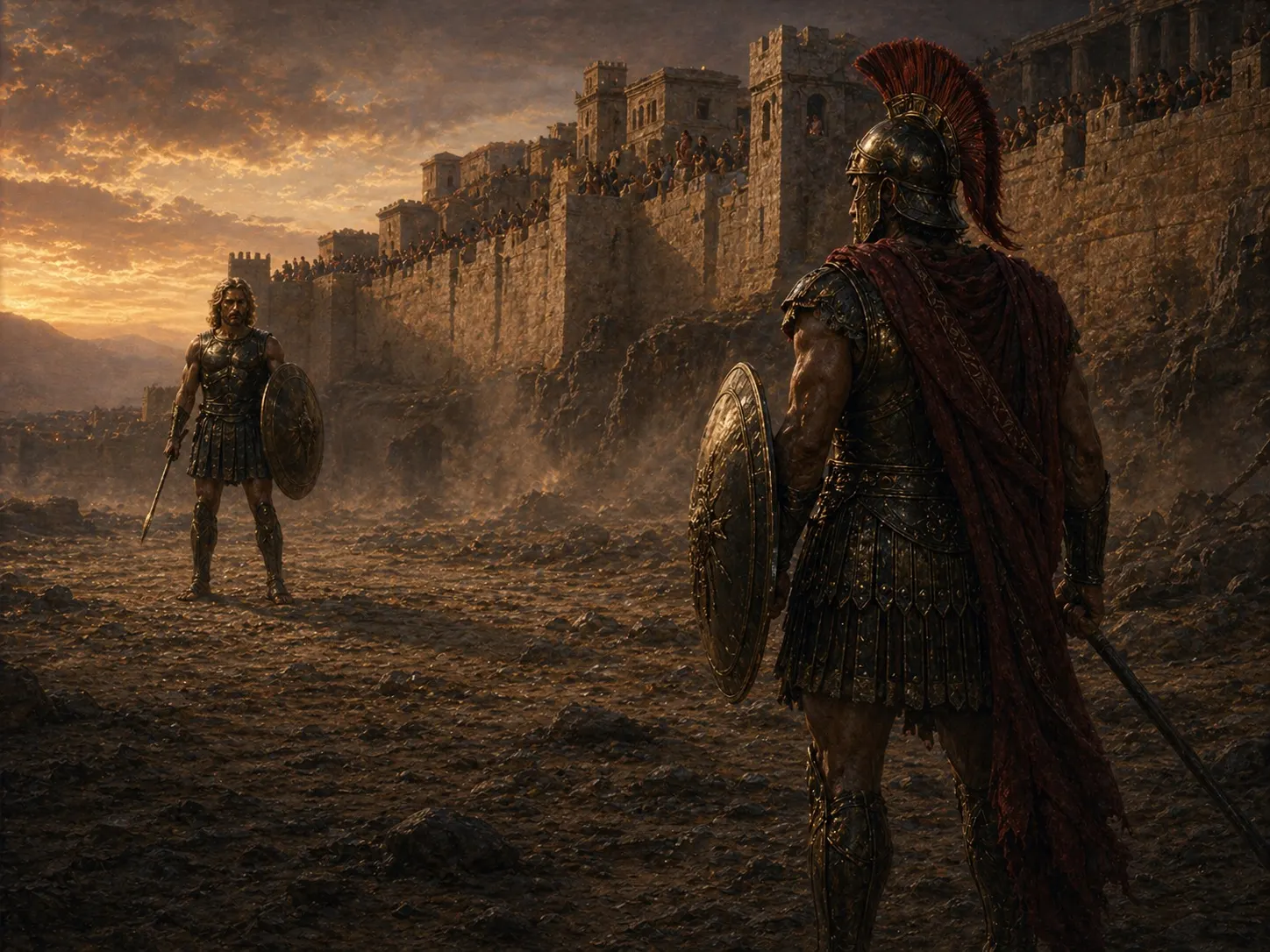
Hector sees Achilles and first runs around the walls. This matters: he is brave, but not invulnerable. Deceived by Athena, abandoned by the gods, he fights and dies. Achilles wins, then drags the body in rage. Hector, defeated, remains human; Achilles, victorious, becomes frightening.
Hector's fear is essential, not shameful. Homer makes him noble precisely by refusing to make him marble: he runs, hesitates, hopes and only then accepts the impossible combat.
Achilles' triumph is equally double. He wins the duel, but the treatment of the body shows how grief has turned him away from the limits that make heroism human.
Read this passage as a hinge inside The Iliad rather than as an isolated famous scene: it changes the pressure between honor, command, divine intervention and grief. Each episode prepares the next wound, so the poem keeps making heroic brilliance answer for what it costs.
The funeral games for Patroclus
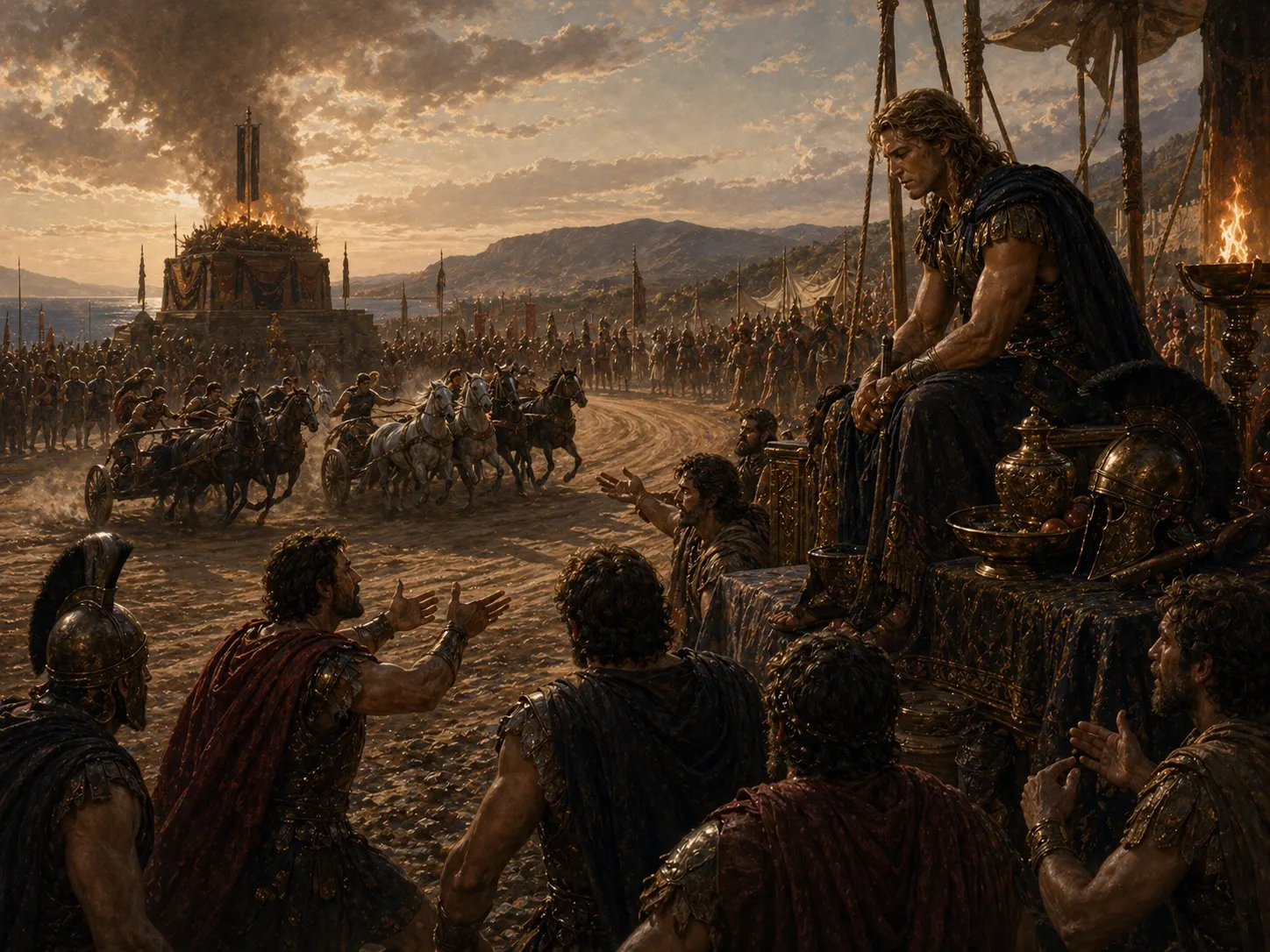
Achilles organizes games for Patroclus. Chariot race, wrestling, running, combat, throwing, archery: violence returns under rules, prizes and ritual. Yet vanity survives. The heroes argue, rankle, contest results. Order is restored, but human pride keeps its share.
The games translate violence into rule-bound competition. The warriors still seek rank and victory, but ritual gives grief a structure and prevents the camp from dissolving entirely into rage.
Even here, Homer keeps the human scale. The heroes compete, quarrel and demand recognition; mourning does not erase pride, it temporarily gives pride a permitted arena.
Read this passage as a hinge inside The Iliad rather than as an isolated famous scene: it changes the pressure between honor, command, divine intervention and grief. Each episode prepares the next wound, so the poem keeps making heroic brilliance answer for what it costs.
Priam comes to beg Achilles
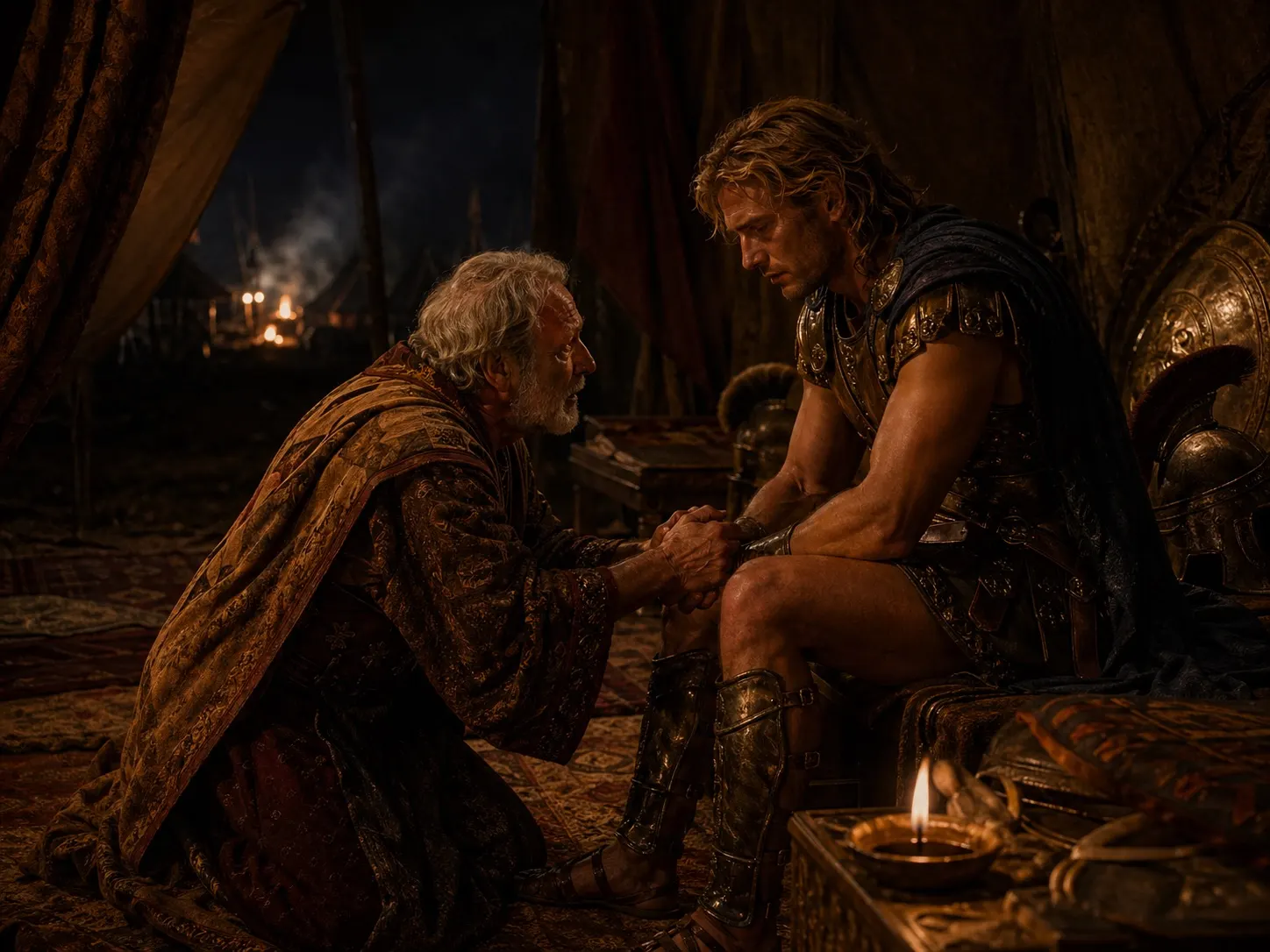
By night, Priam enters the Greek camp and kisses the hands that killed Hector. He asks Achilles to remember his own father. The two enemies weep together: father and killer, victor and defeated, grief and pity in the same tent. The Iliad does not end with military victory, but with a suspension of violence.
Priam's gesture breaks the logic of enemy camps. By kissing the hands that killed his son, he makes Achilles see not a Trojan king but a father standing where Peleus might stand.
The ending matters because it stops before Troy falls. The poem closes on a body returned, a meal shared and grief recognized: not peace, but a pause in the machinery of hatred.
Read this passage as a hinge inside The Iliad rather than as an isolated famous scene: it changes the pressure between honor, command, divine intervention and grief. Each episode prepares the next wound, so the poem keeps making heroic brilliance answer for what it costs.
The important passages of The Odyssey
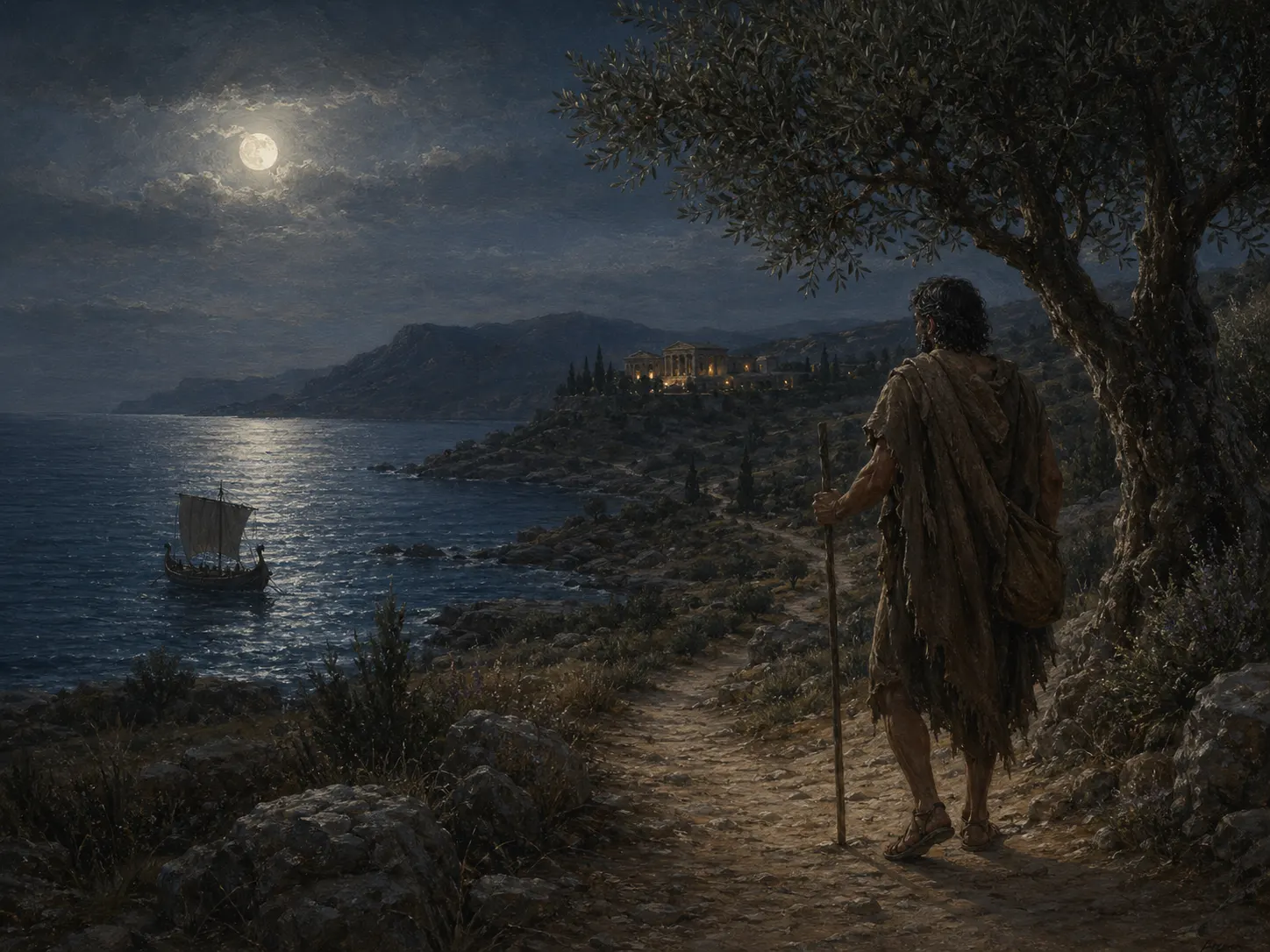
The Odyssey changes register: less frontal duel, more patience, disguise, speech and difficult return.
Telemachus before the suitors
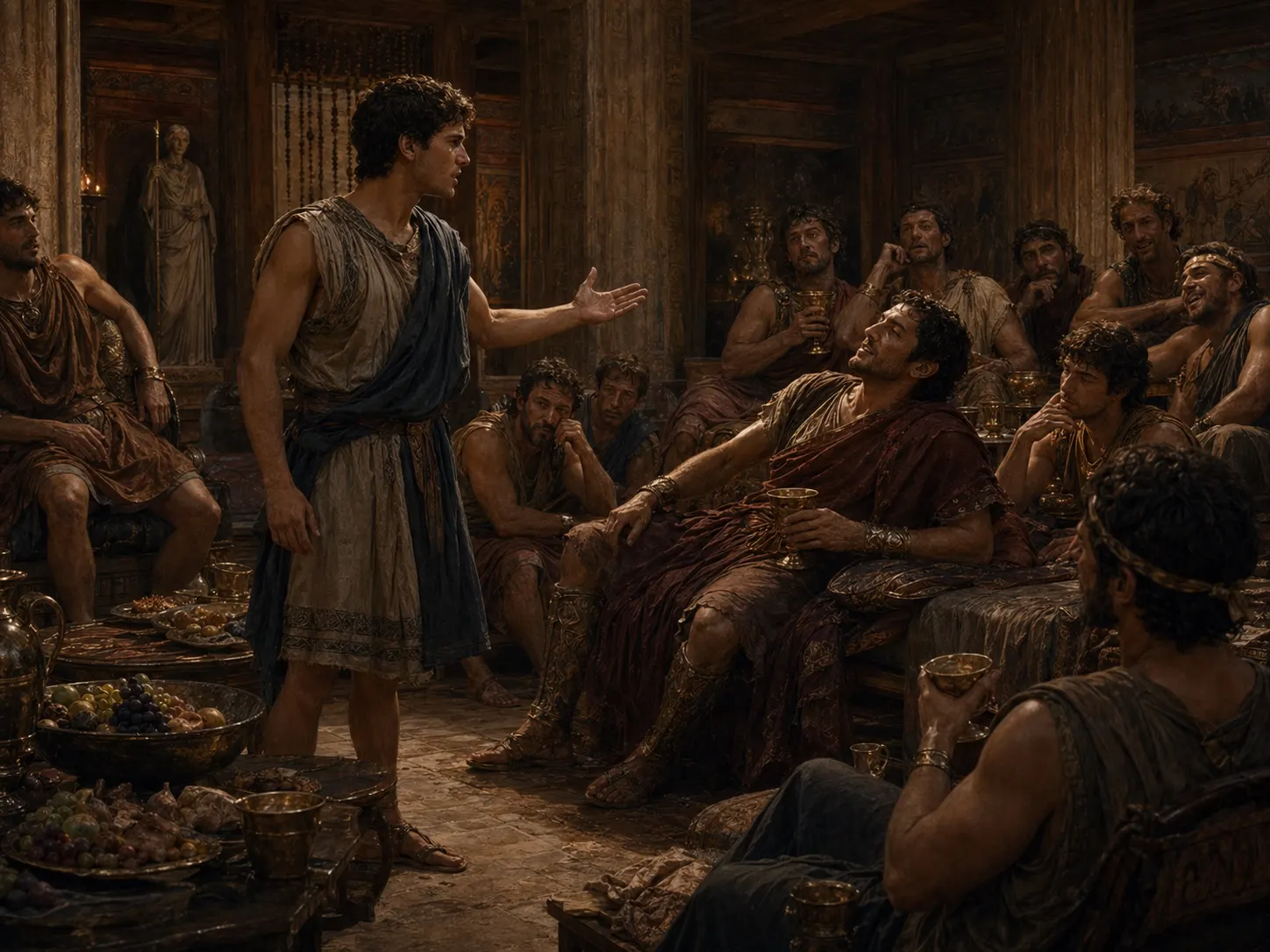
The Odyssey begins in Ithaca, in a house occupied by men who consume Odysseus' wealth and press Penelope. Telemachus grows in the shadow of an absent father. Athena pushes him to speak, resist and seek news. The return will not only restore a man; it must rebuild a house.
The first crisis of The Odyssey is domestic and political. Ithaca is not simply waiting; it is being consumed, and Telemachus has to become visible before his father can be restored.
Athena's intervention therefore begins with speech and posture. The son must learn to stand in the house so that the father's eventual return has someone to meet.
Read this passage as a hinge inside The Odyssey rather than as a detachable adventure: it changes the pressure around return, identity, speech and recognition. Each episode tests whether Odysseus can remain himself while becoming someone else long enough to survive.
Helen and Menelaus tell of Odysseus
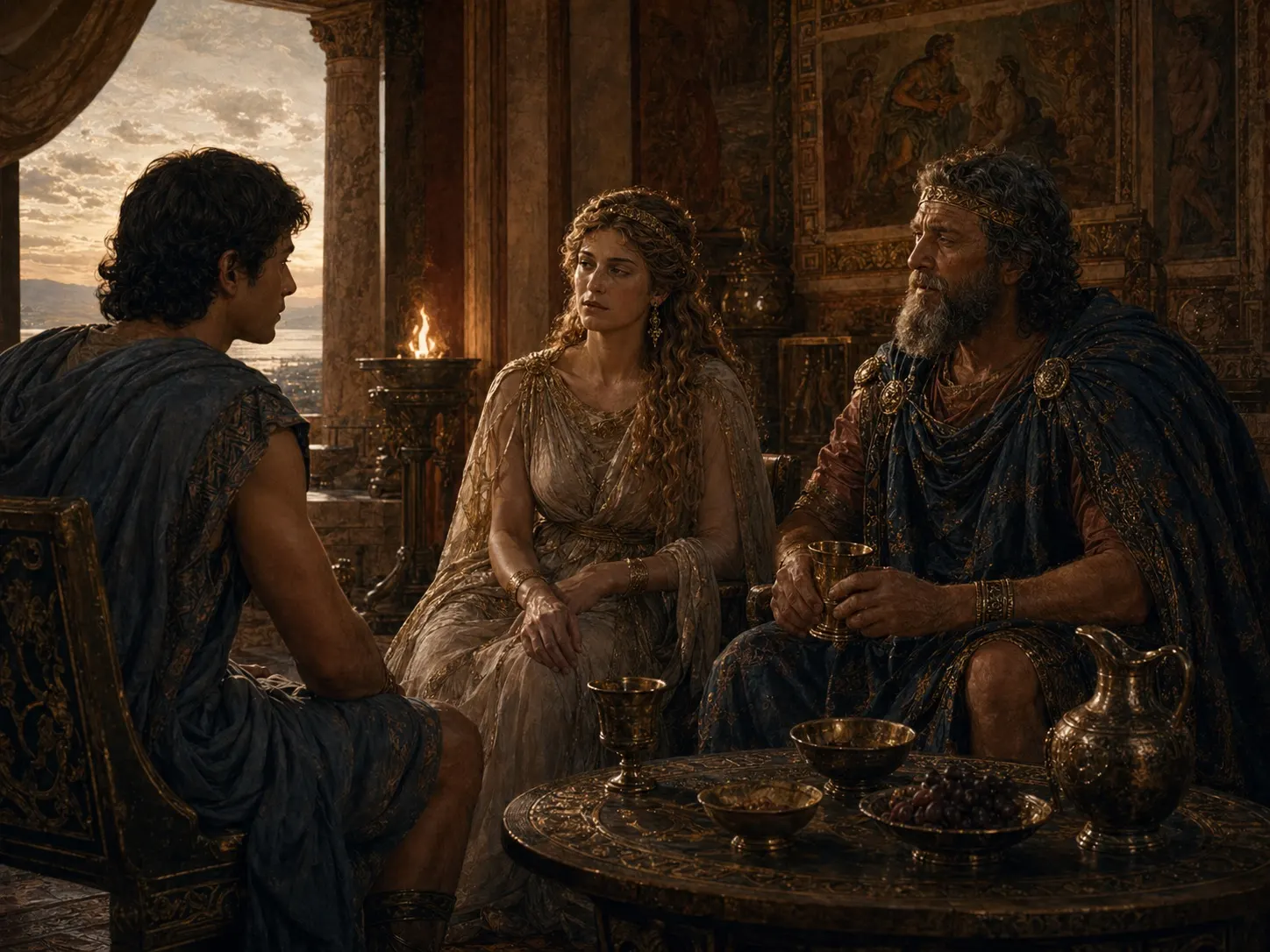
In Sparta, Telemachus hears survivors of Troy remember his father. Helen recognizes him, pours a drug against grief, and appears as queen, guilty witness and lucid survivor. Before Odysseus returns in person, his name already lives in other mouths. Reputation walks ahead of the man.
Sparta gives Telemachus a version of his father before the reader sees the man fully. Odysseus exists as memory, rumor and admiration, already split between public fame and private absence.
Helen's presence keeps the Trojan past complicated. She is no simple prize or cause; she is a survivor who knows how stories, guilt and recognition continue after the war.
Read this passage as a hinge inside The Odyssey rather than as a detachable adventure: it changes the pressure around return, identity, speech and recognition. Each episode tests whether Odysseus can remain himself while becoming someone else long enough to survive.
Calypso and the refusal of immortality
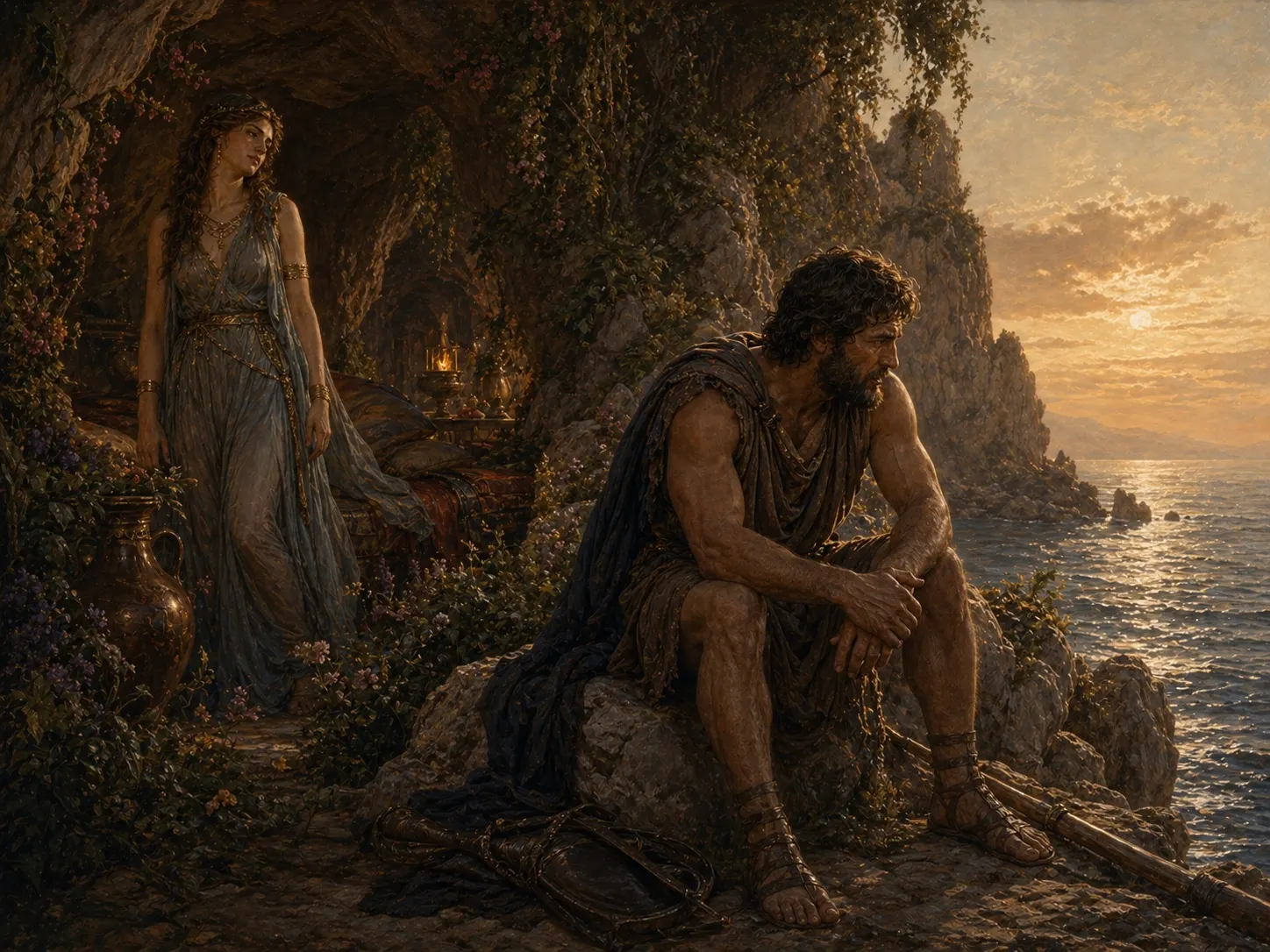
Odysseus first appears not in battle, but on Calypso's island, weeping toward the sea. She offers comfort and immortality; he wants Ithaca, Penelope, his son and his house. He chooses a finite human life over a divine existence without return. Comfort can be another shipwreck.
Calypso's island is a soft prison because it offers what heroic culture often desires: escape from death. Odysseus' refusal makes the poem's values sharper than a simple adventure plot.
He chooses a finite, damaged human life because it contains memory, marriage, age and place. Return matters precisely because it is not perfect.
Read this passage as a hinge inside The Odyssey rather than as a detachable adventure: it changes the pressure around return, identity, speech and recognition. Each episode tests whether Odysseus can remain himself while becoming someone else long enough to survive.
Odysseus naked before Nausicaa
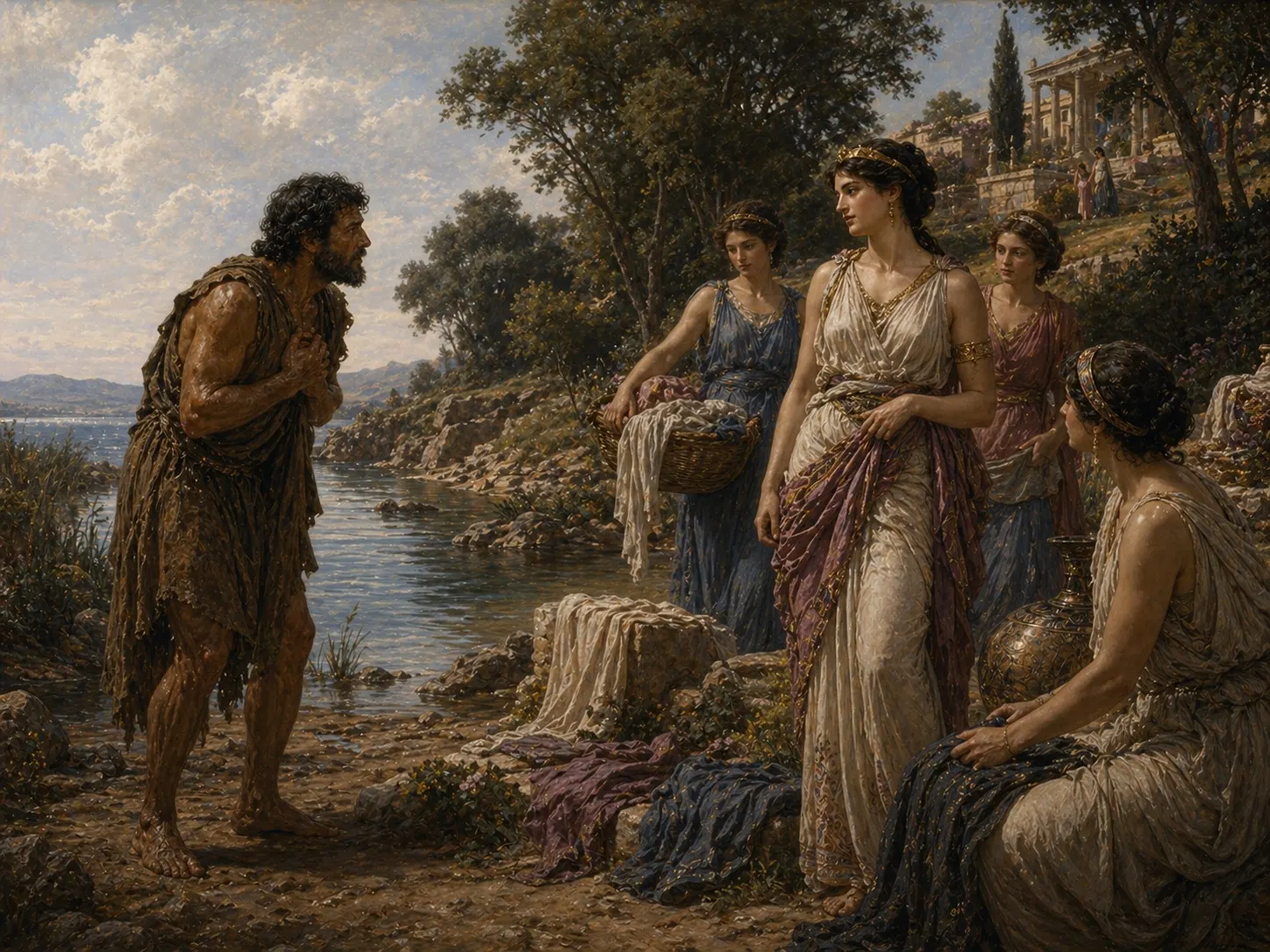
Shipwrecked among the Phaeacians, Odysseus is naked, dirty and powerless before Nausicaa. He has no visible rank left, only speech. He chooses his words with care, flatters without excess, and survives through social intelligence. Even reduced almost to nothing, he remains Odysseus.
The scene strips Odysseus of the usual signs of heroism. Without armor, ship, companions or wealth, he must rebuild safety through language alone.
That makes Nausicaa's encounter a test of xenia and tact. Odysseus survives because he knows how to ask without threatening and praise without losing control.
Read this passage as a hinge inside The Odyssey rather than as a detachable adventure: it changes the pressure around return, identity, speech and recognition. Each episode tests whether Odysseus can remain himself while becoming someone else long enough to survive.
Demodocus sings Troy, and Odysseus weeps
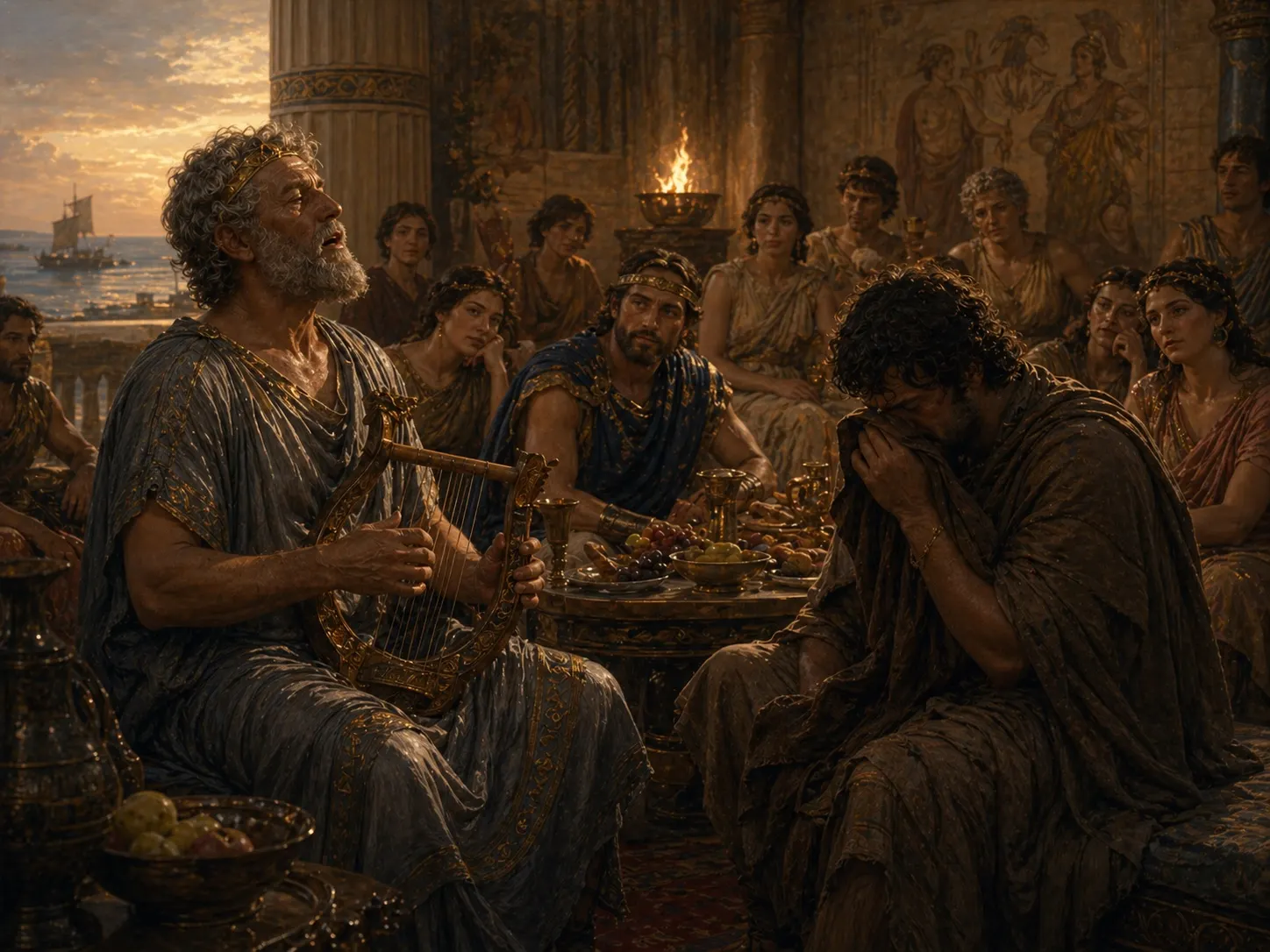
At the Phaeacian banquet, Demodocus sings the war. For the guests, Troy is already epic material; for Odysseus, it is lived pain. The same event can be public glory and private wound. Poetry builds heroic fame, but it can also reopen what fame conceals.
The song divides public memory from private trauma. What the Phaeacians hear as beautiful epic is, for Odysseus, the reopening of lived catastrophe.
This scene makes poetry itself part of the story. Fame preserves the hero, but it can also trap him inside the event everyone else is ready to celebrate.
Read this passage as a hinge inside The Odyssey rather than as a detachable adventure: it changes the pressure around return, identity, speech and recognition. Each episode tests whether Odysseus can remain himself while becoming someone else long enough to survive.
The Cyclops Polyphemus
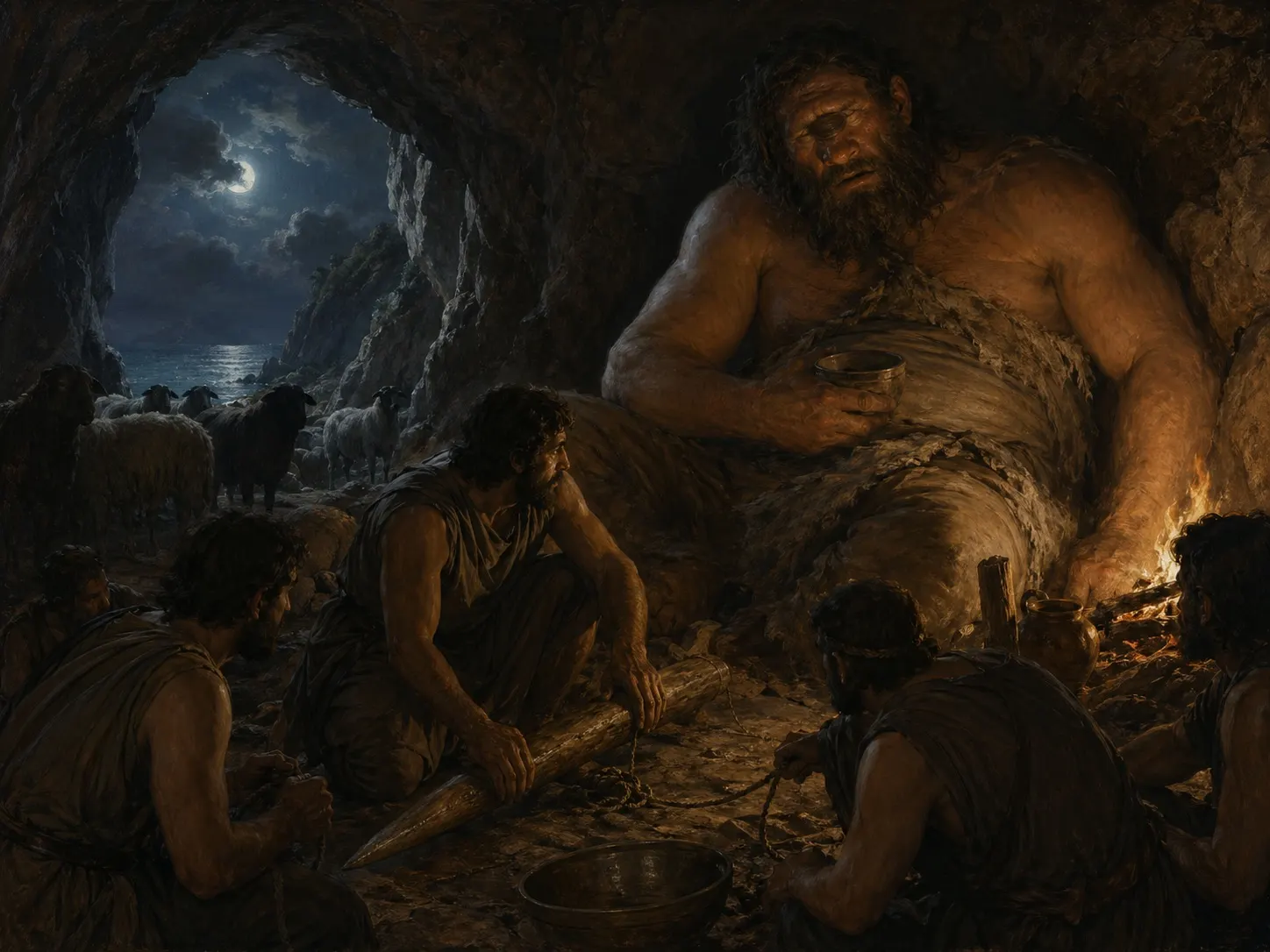
In the cave of Polyphemus, brute force is useless. Odysseus makes the Cyclops drunk, calls himself Nobody, blinds him, and escapes beneath the rams. It is a triumph of language and timing. Then pride ruins prudence: Odysseus reveals his name, and Poseidon's revenge begins.
The Cyclops' cave is an anti-house: no law, no welcome, no mutual obligation. That is why the episode is about xenia as much as about a monster.
Odysseus' victory depends on words, timing and disguise. His failure comes from the same source: the need to attach his real name to the triumph.
Read this passage as a hinge inside The Odyssey rather than as a detachable adventure: it changes the pressure around return, identity, speech and recognition. Each episode tests whether Odysseus can remain himself while becoming someone else long enough to survive.
Aeolus, the bag of winds and mistrust
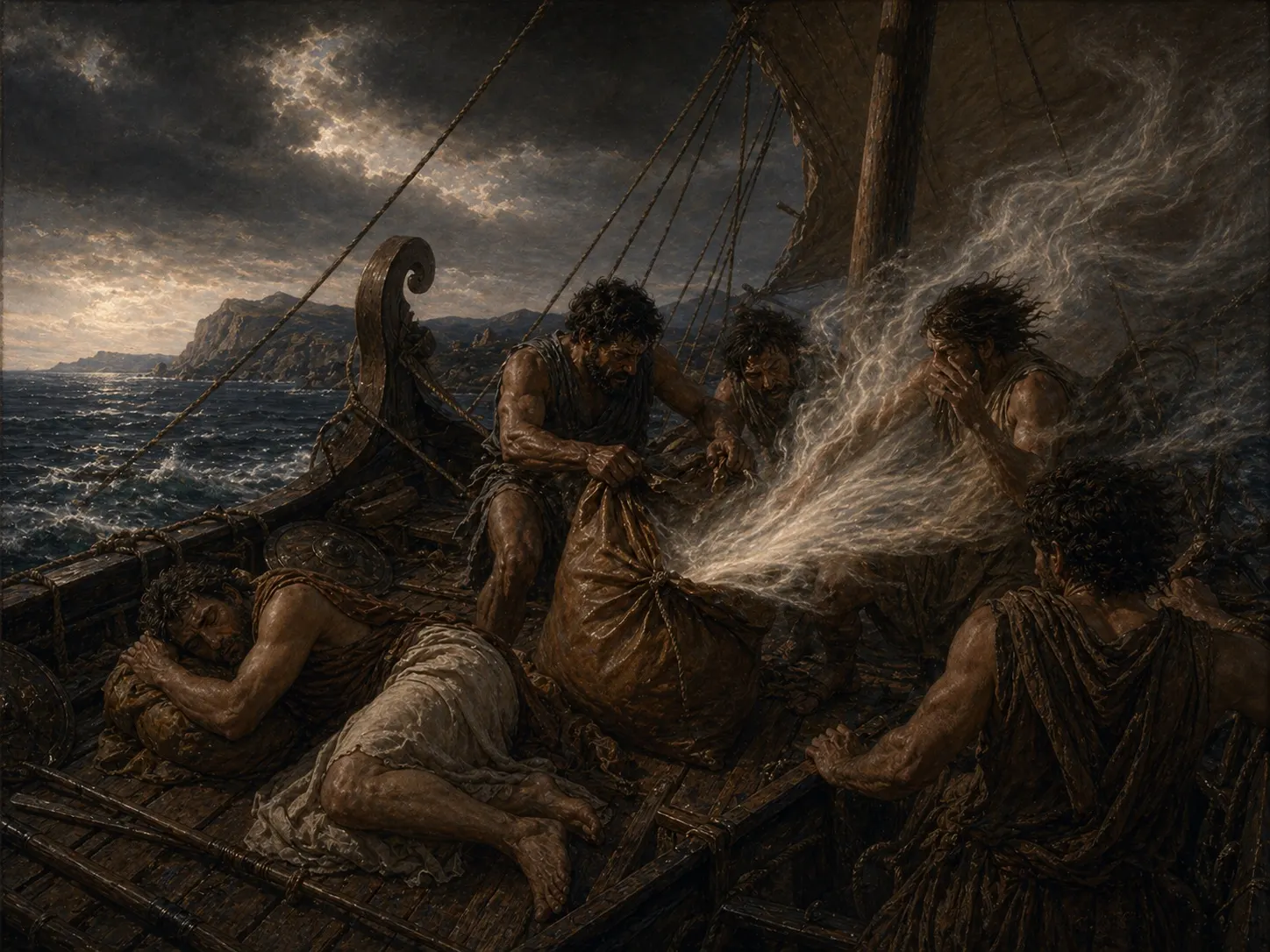
Aeolus gives Odysseus the winds that could bring him home. Ithaca is near, but the crew opens the bag, suspecting treasure. A prepared route is lost because trust has failed. A leader may be brilliant and still lose when the ship no longer believes him.
The bag of winds turns the ship into a political community. The return is technically within reach, but suspicion makes the crew sabotage the gift they do not understand.
This is one of the poem's clearest lessons about leadership. Odysseus can win divine help and still lose if human trust collapses before arrival.
Read this passage as a hinge inside The Odyssey rather than as a detachable adventure: it changes the pressure around return, identity, speech and recognition. Each episode tests whether Odysseus can remain himself while becoming someone else long enough to survive.
Circe turns the companions into swine
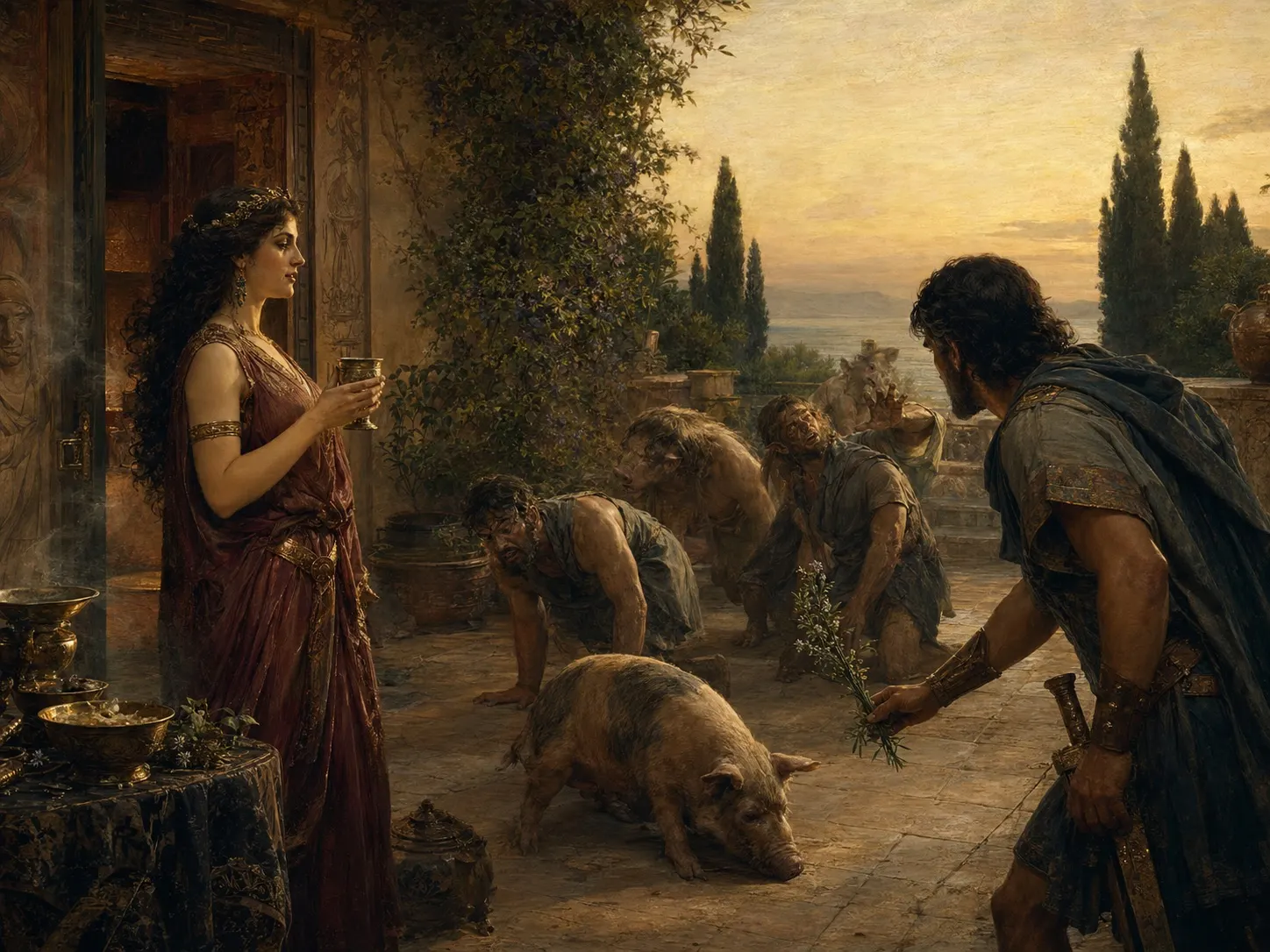
Circe transforms part of the crew into pigs. Hermes helps Odysseus resist her charm, and the men regain human form. The episode is spectacular, almost grotesque, yet grave: the danger is metamorphosis, appetite, passivity and the temptation to stop where one should only pass.
The metamorphosis is grotesque, but it is also precise. The companions' bodies reveal a danger already present in appetite, passivity and the wish to stop moving.
Circe later becomes an instructor, which prevents the episode from staying simple. The Odyssey often turns danger into knowledge once Odysseus learns the rules of the threshold.
Read this passage as a hinge inside The Odyssey rather than as a detachable adventure: it changes the pressure around return, identity, speech and recognition. Each episode tests whether Odysseus can remain himself while becoming someone else long enough to survive.
The descent to the Underworld
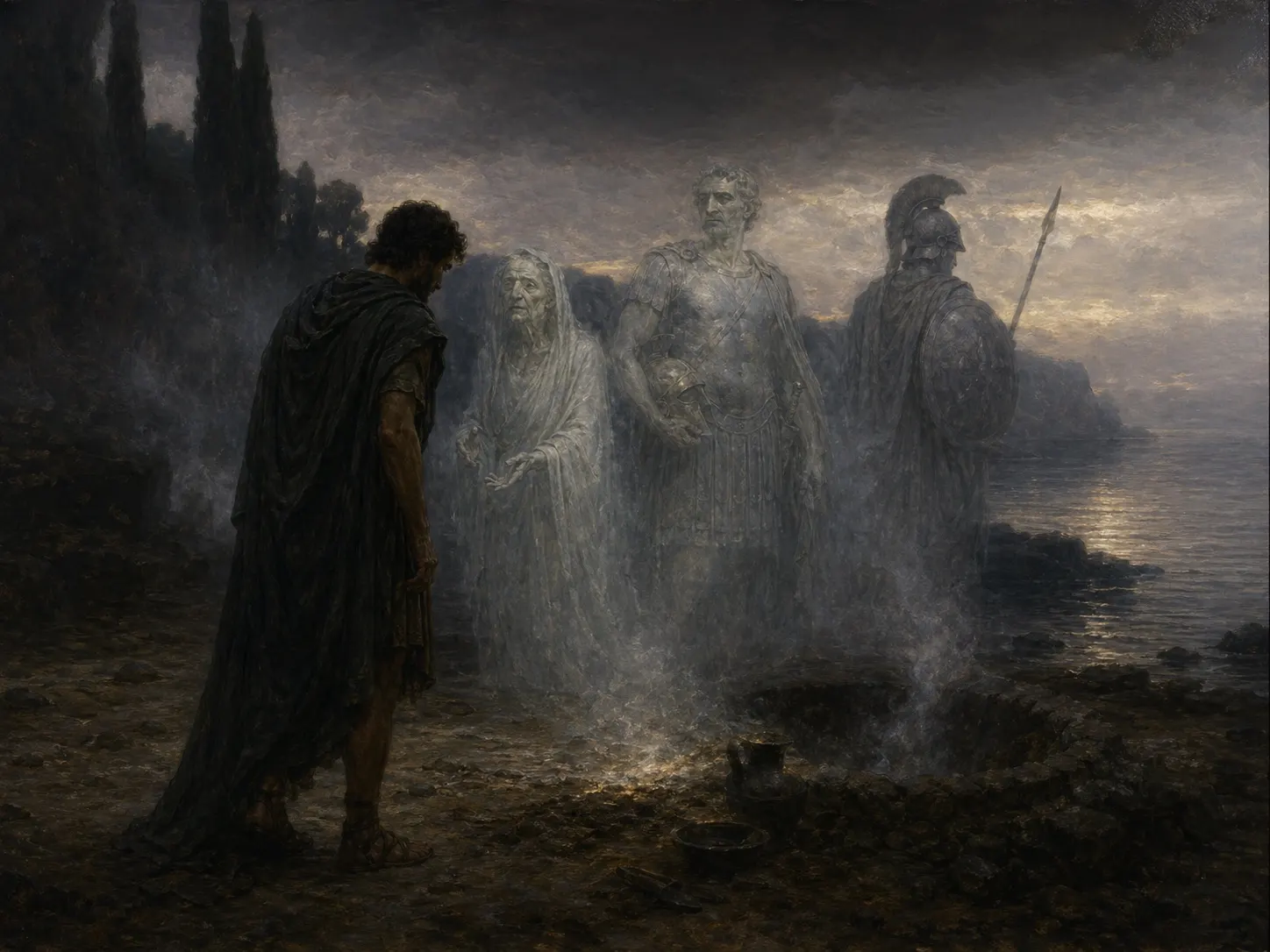
Among the dead, Odysseus meets his mother, Tiresias, Agamemnon, Achilles and Ajax. He learns that return cannot restore everything. Achilles, once the hero of short glory, now says life is worth more than kingship among shadows. The journey becomes a reckoning with loss.
The Underworld interrupts the adventure logic. Odysseus goes there for directions, but the scene gives him memory, grief and a revised understanding of glory.
Achilles' speech changes the heroic scale of the poem. A man who possessed supreme kleos now values ordinary life over splendor among the dead.
Read this passage as a hinge inside The Odyssey rather than as a detachable adventure: it changes the pressure around return, identity, speech and recognition. Each episode tests whether Odysseus can remain himself while becoming someone else long enough to survive.
The Sirens
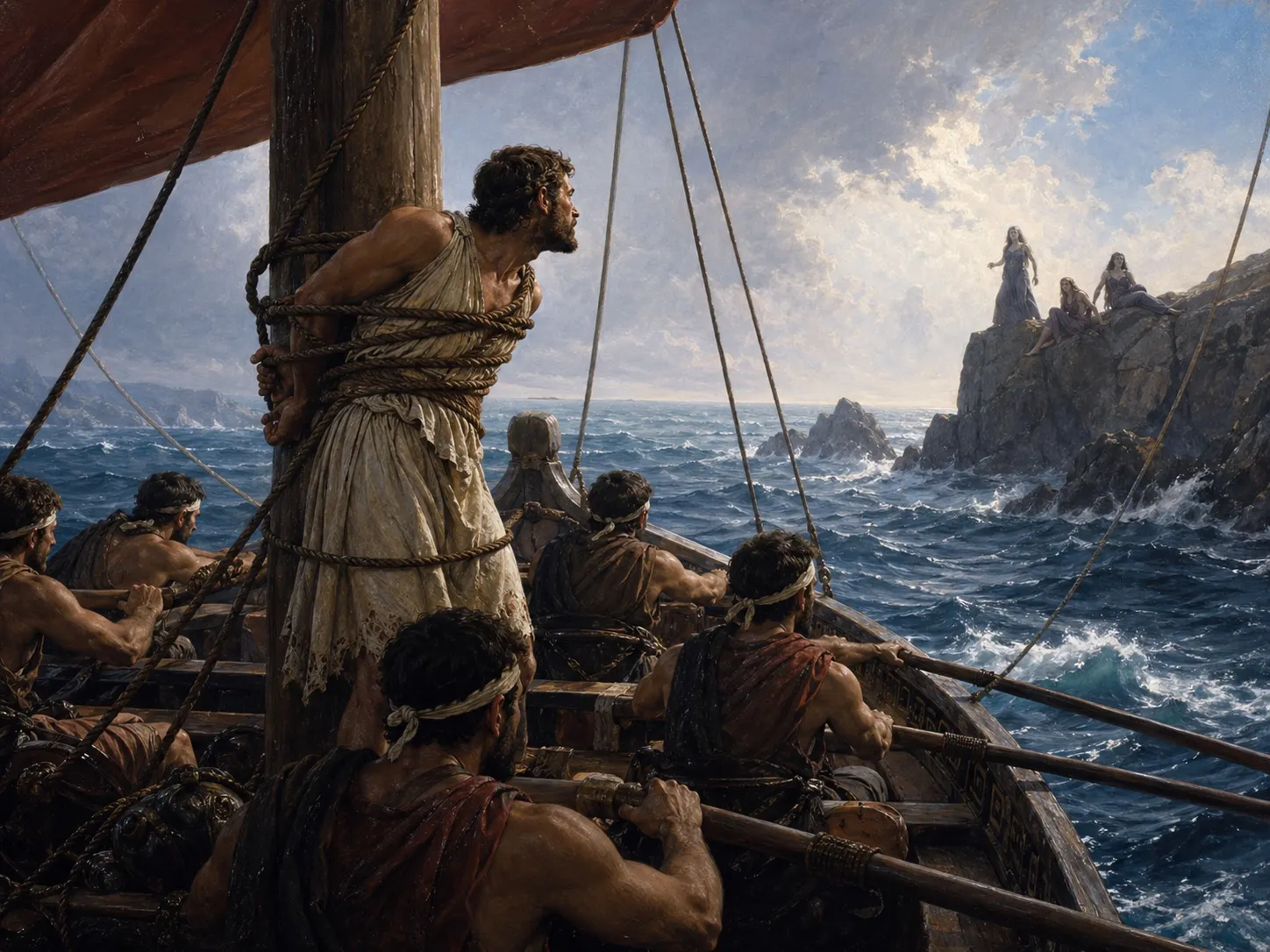
The Sirens promise knowledge, not merely pleasure. Odysseus wants to hear them because he wants to know. He plugs his men's ears and has himself bound to the mast. His lucidity lies in organizing a limit against his own desire.
The Sirens are dangerous because they speak to Odysseus' intelligence. Their lure is not just sensual beauty; it is the fantasy of hearing everything and mastering the story.
His solution is a masterpiece of self-command. He does not trust willpower in the crisis; he arranges ropes, wax and crew beforehand.
Read this passage as a hinge inside The Odyssey rather than as a detachable adventure: it changes the pressure around return, identity, speech and recognition. Each episode tests whether Odysseus can remain himself while becoming someone else long enough to survive.
Scylla, Charybdis and the lesser evil
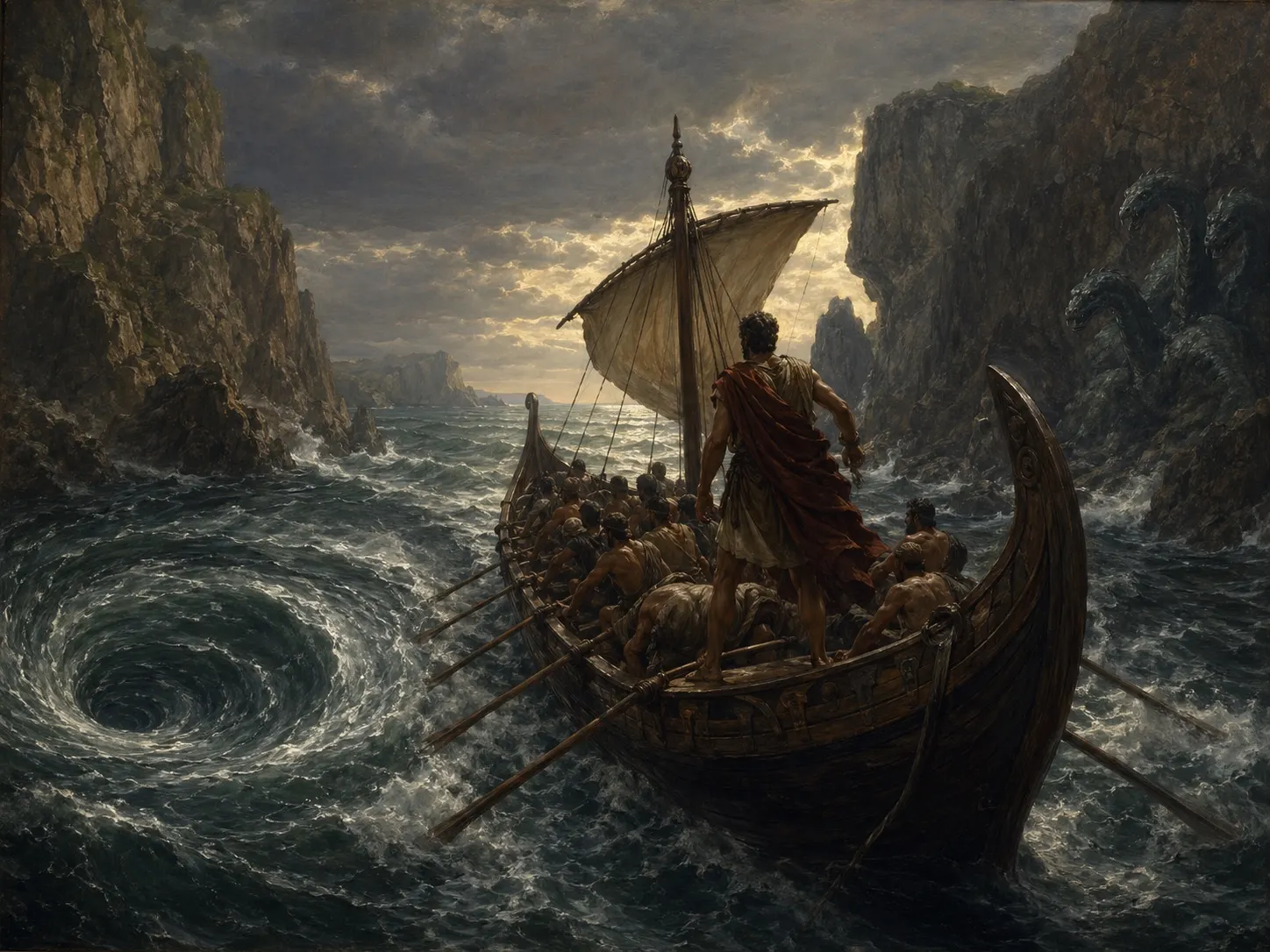
Odysseus must pass between a whirlpool that could swallow all and a monster who will devour a few. Circe advises the limited loss. Command becomes morally hard: saving the greatest number may mean hiding the whole truth from some and accepting their deaths.
This is not a heroic victory scene. Odysseus cannot destroy the danger; he can only choose the catastrophe that leaves a future possible.
The passage is therefore one of command's hardest images. Leadership can mean carrying guilt for a decision that was necessary but never innocent.
Read this passage as a hinge inside The Odyssey rather than as a detachable adventure: it changes the pressure around return, identity, speech and recognition. Each episode tests whether Odysseus can remain himself while becoming someone else long enough to survive.
The cattle of the Sun
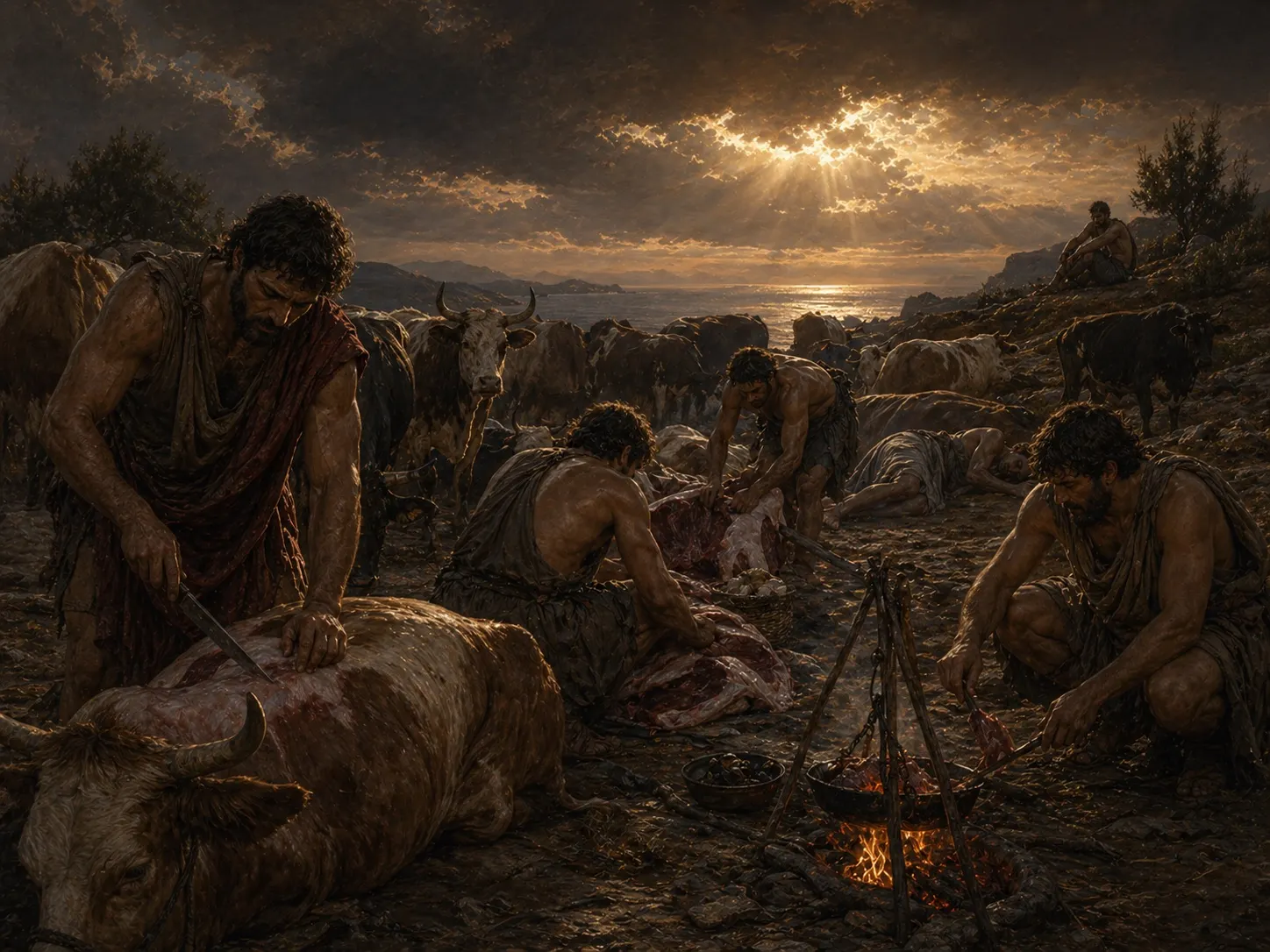
Hungry and trapped, the companions kill the sacred cattle of Helios while Odysseus sleeps. Zeus destroys the ship; Odysseus alone survives. The long sequence of collective faults ends there. The hero will return home, but without his men.
The companions' fault is understandable and unforgivable at the same time. Hunger creates the pressure, but the sacred prohibition remains clear.
The destruction of the ship marks the end of the collective journey. From here on, Odysseus' return is also the story of everyone who did not return.
Read this passage as a hinge inside The Odyssey rather than as a detachable adventure: it changes the pressure around return, identity, speech and recognition. Each episode tests whether Odysseus can remain himself while becoming someone else long enough to survive.
Odysseus reaches Ithaca and lies at once
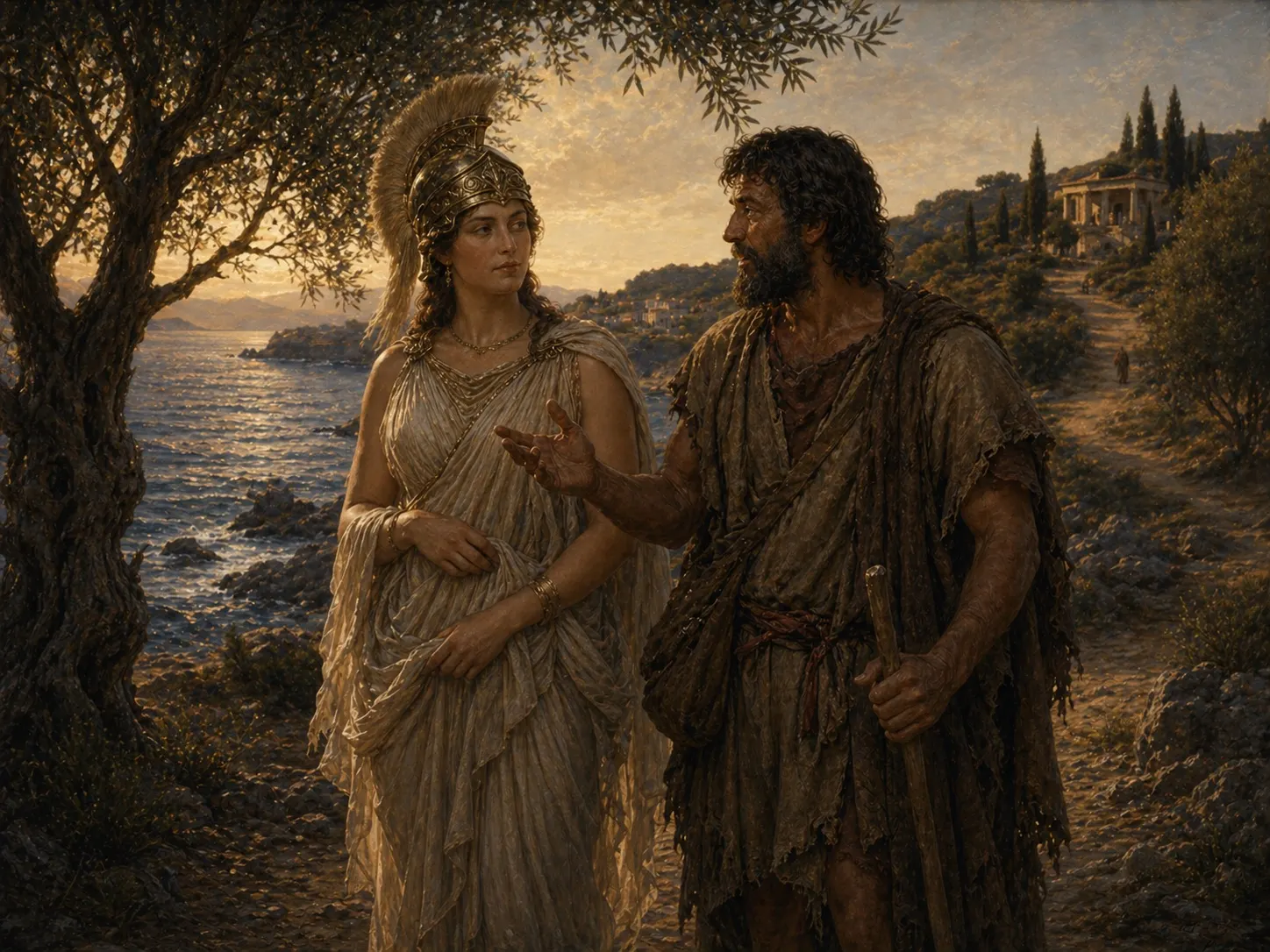
Back in Ithaca, Odysseus does not rush into his palace. Athena disguises him, and he continues to invent identities. In The Odyssey, lying is not merely vice: it is a weapon of survival, a shield until truth can safely strike.
The lie on Ithaca shows that return is not the same as arrival. Odysseus has reached the island, but not yet the social truth that will let him reclaim it.
Athena's delight in his fiction also matters. The goddess recognizes in him not honesty in the simple sense, but strategic intelligence under pressure.
Read this passage as a hinge inside The Odyssey rather than as a detachable adventure: it changes the pressure around return, identity, speech and recognition. Each episode tests whether Odysseus can remain himself while becoming someone else long enough to survive.
Eumaeus, the faithful swineherd
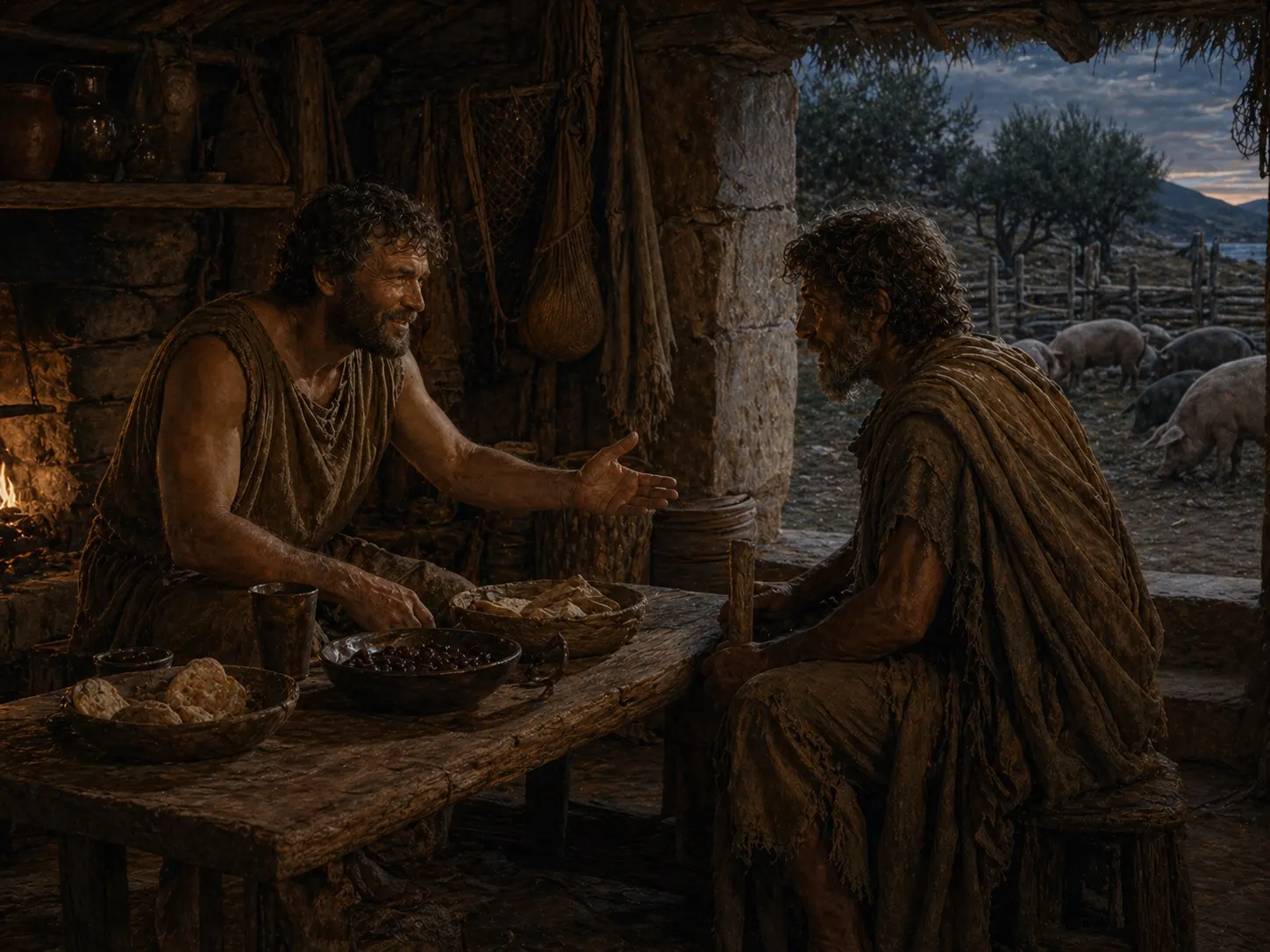
Eumaeus receives the disguised Odysseus without knowing his master has returned. His fidelity has no battlefield glory, but it carries a deep moral nobility. In his hut, father and son recognize each other and begin planning the recovery of the house.
Eumaeus gives the poem a form of loyalty without spectacle. He has no great heroic song, yet his hut preserves the moral order the palace has lost.
That makes recognition possible. Odysseus can return through the humble household before he returns through royal violence.
Read this passage as a hinge inside The Odyssey rather than as a detachable adventure: it changes the pressure around return, identity, speech and recognition. Each episode tests whether Odysseus can remain himself while becoming someone else long enough to survive.
The fight with Irus
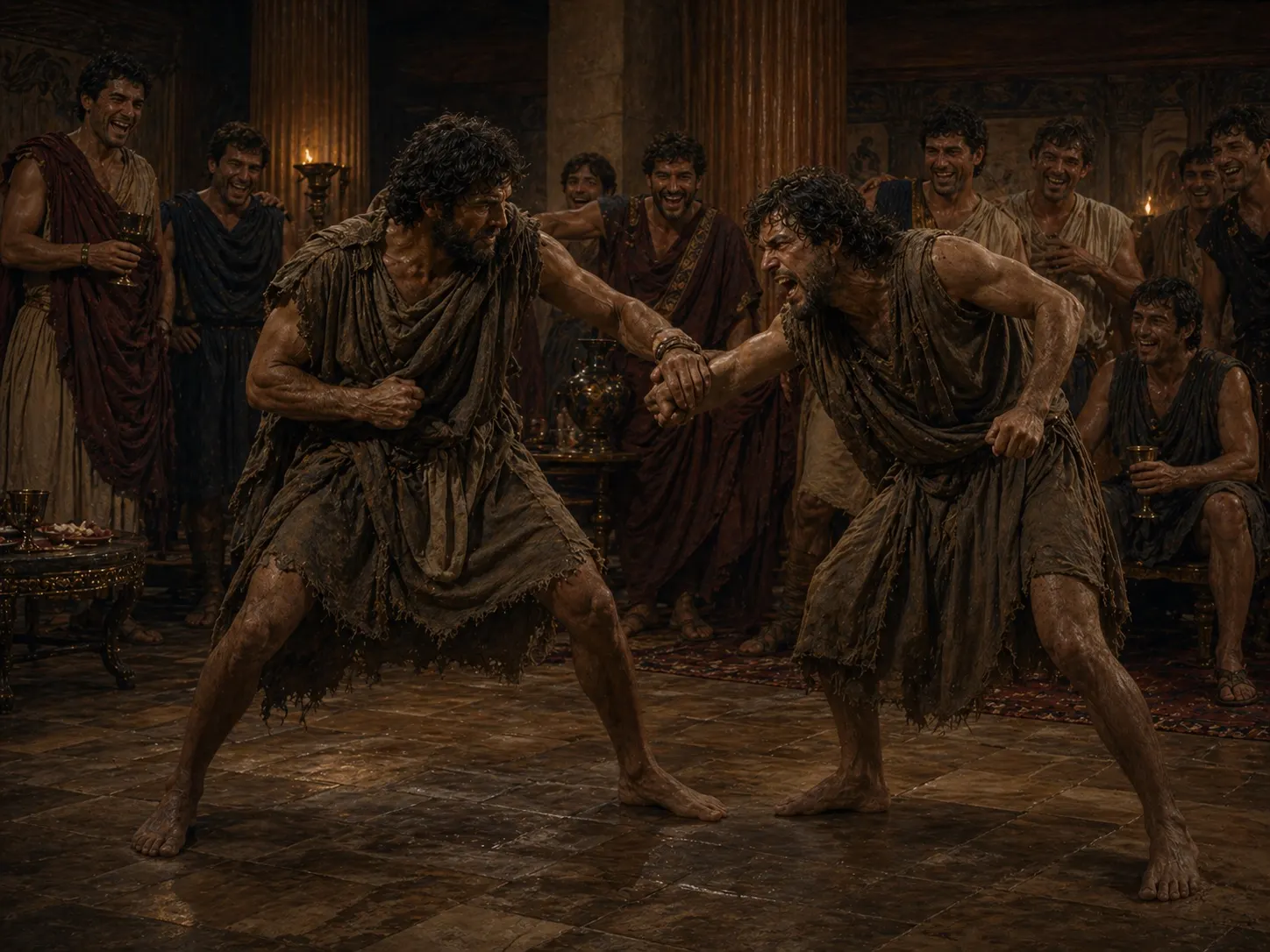
Disguised as a beggar, Odysseus is provoked by Irus. He must win without revealing too much strength. The scene seems low, but it is tense: the king measures his violence while the suitors laugh. Beneath the mockery, the blood of the palace is already gathering.
The scene looks comic and low, but it is another test of concealment. Odysseus must prove strength while hiding the full measure of who he is.
The suitors' laughter makes them misread the situation. They think they are watching entertainment; the reader sees the disguised king calibrating the violence to come.
Read this passage as a hinge inside The Odyssey rather than as a detachable adventure: it changes the pressure around return, identity, speech and recognition. Each episode tests whether Odysseus can remain himself while becoming someone else long enough to survive.
The scar recognized by Eurycleia
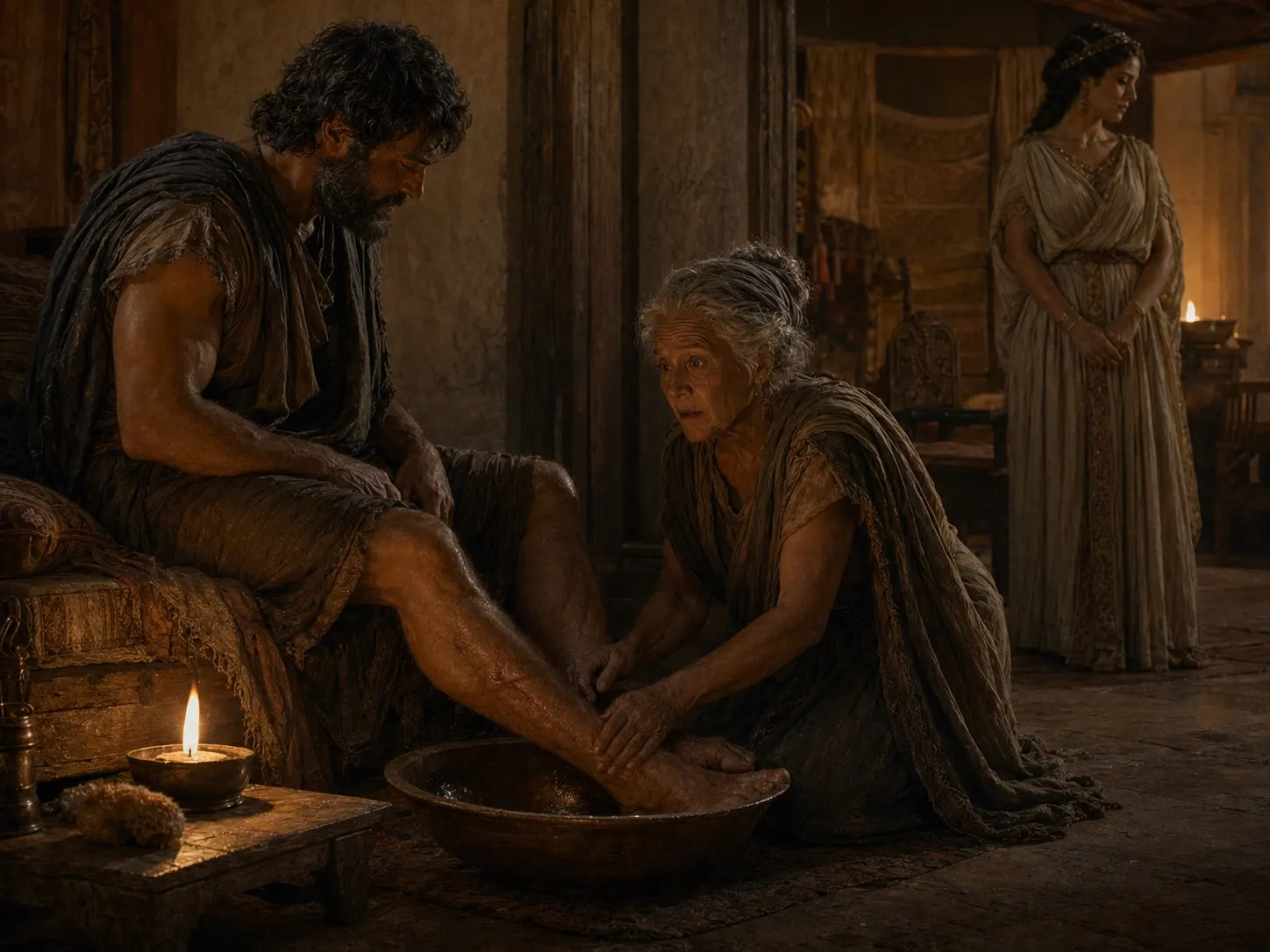
The old nurse washes Odysseus' feet and recognizes an ancient scar. The body keeps a truth that disguise cannot erase. Recognition, normally joy, becomes danger: if she speaks too soon, the plan collapses.
The scar is memory written into the body. Disguise can alter clothing, status and face, but it cannot remove the history carried by flesh.
Recognition becomes dangerous because truth arrives before the plan is ready. The scene holds joy and threat in the same gesture.
Read this passage as a hinge inside The Odyssey rather than as a detachable adventure: it changes the pressure around return, identity, speech and recognition. Each episode tests whether Odysseus can remain himself while becoming someone else long enough to survive.
The trial of the bow
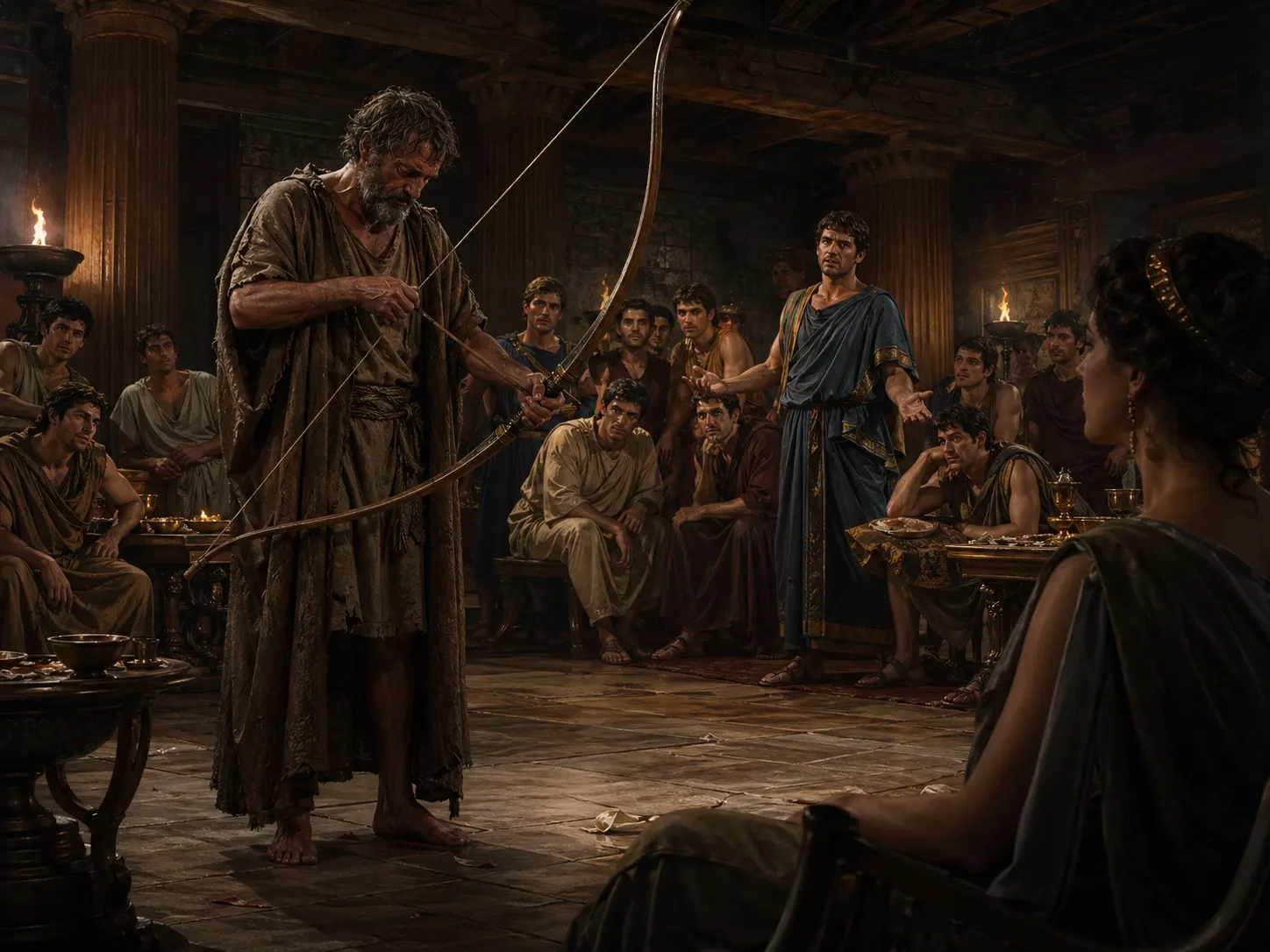
Penelope proposes the bow test. The suitors fail; the beggar bends the bow with ease. Before Odysseus proclaims his name, the object speaks for him. The suitors have occupied the space, but not the legitimacy.
The bow is a political object before it is a weapon. The suitors cannot master it because they have occupied the house without inheriting its real authority.
When the beggar strings it, identity begins to return through action rather than announcement. The object recognizes the king before the room does.
Read this passage as a hinge inside The Odyssey rather than as a detachable adventure: it changes the pressure around return, identity, speech and recognition. Each episode tests whether Odysseus can remain himself while becoming someone else long enough to survive.
The slaughter of the suitors
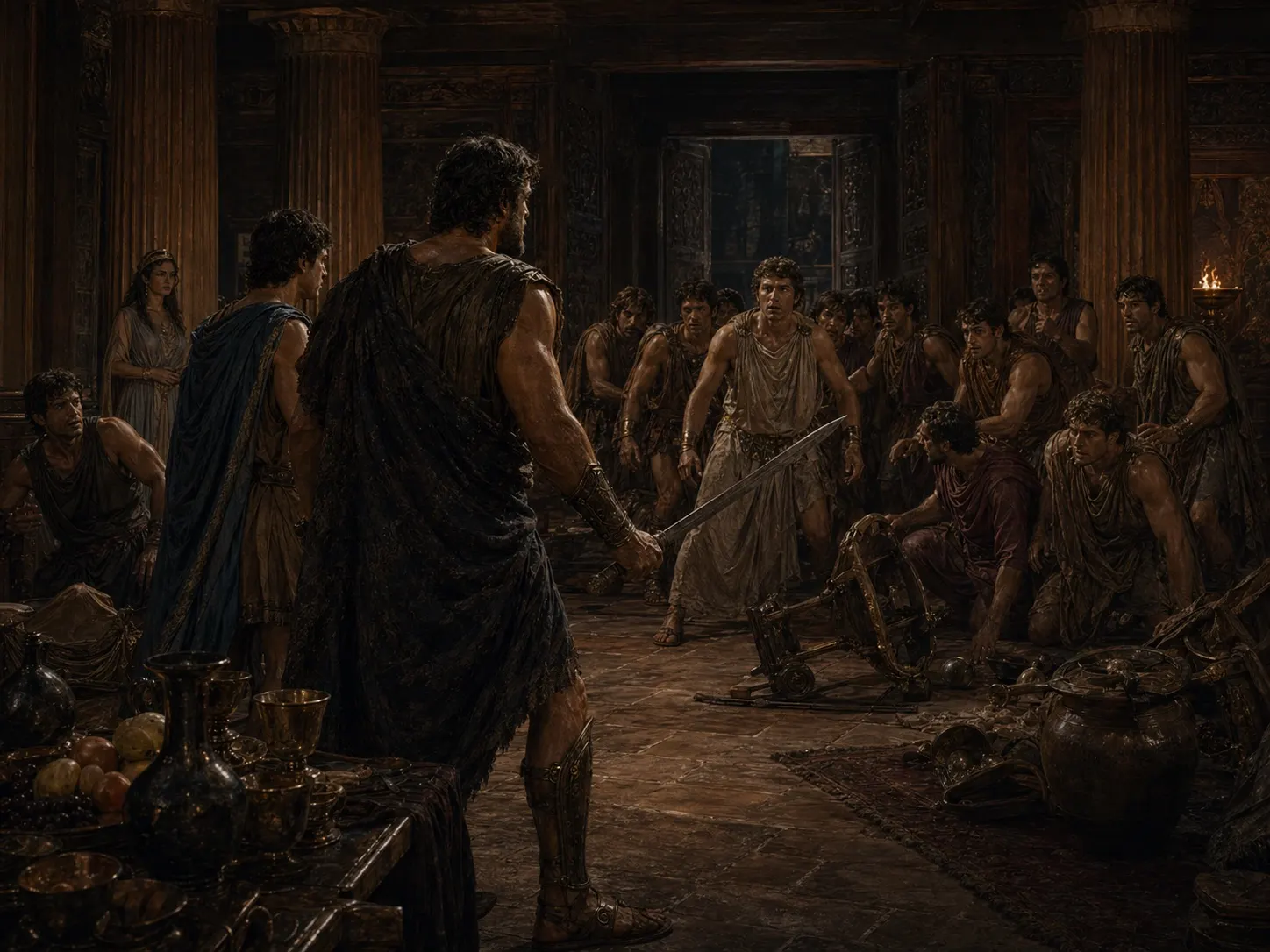
Odysseus reveals himself and kills the suitors with Telemachus and the faithful servants. The scene is harsh: not abstract justice, but domestic, aristocratic vengeance. The violated house is restored through blood.
The massacre is deliberately hard to soften. The poem frames it as justice, but it is justice inside a violent aristocratic world where household order is restored through killing.
That discomfort is part of the ending. Odysseus' intelligence has brought him home, yet homecoming still requires a final eruption of war inside the house.
Read this passage as a hinge inside The Odyssey rather than as a detachable adventure: it changes the pressure around return, identity, speech and recognition. Each episode tests whether Odysseus can remain himself while becoming someone else long enough to survive.
The bed of Odysseus and Penelope
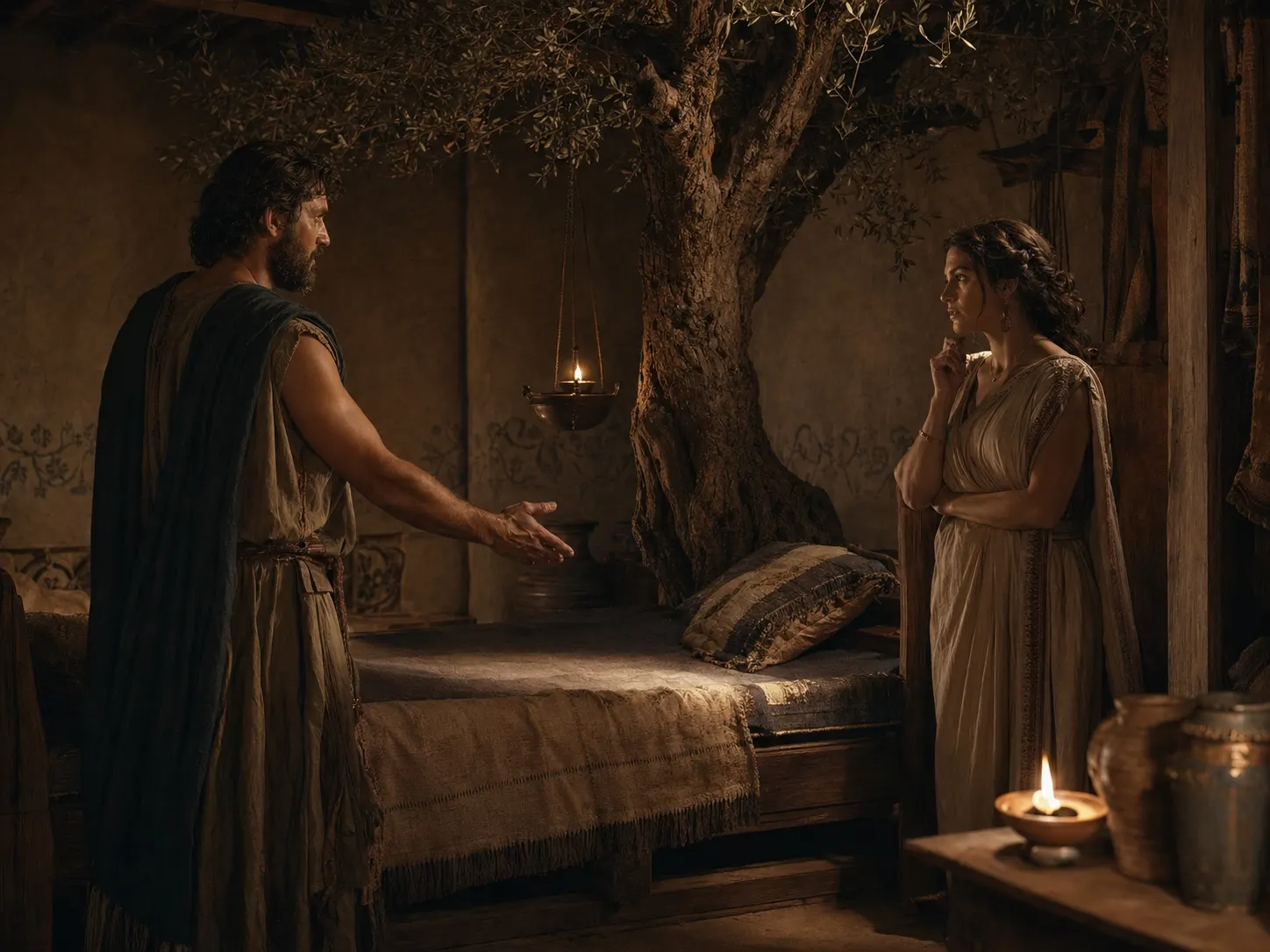
Penelope tests the returned man with the secret of their bed, built around a rooted olive tree. Odysseus reacts; she knows him. After so much wandering, the man of movement is recognized by what cannot move.
Penelope's test is as intelligent as any of Odysseus' tricks. She does not accept appearance; she uses a private fact no impostor can possess.
The rooted bed makes the symbol perfect. After all the movement of the poem, recognition rests on something built into the earth of the house.
Read this passage as a hinge inside The Odyssey rather than as a detachable adventure: it changes the pressure around return, identity, speech and recognition. Each episode tests whether Odysseus can remain himself while becoming someone else long enough to survive.
The end and the halt of vengeance
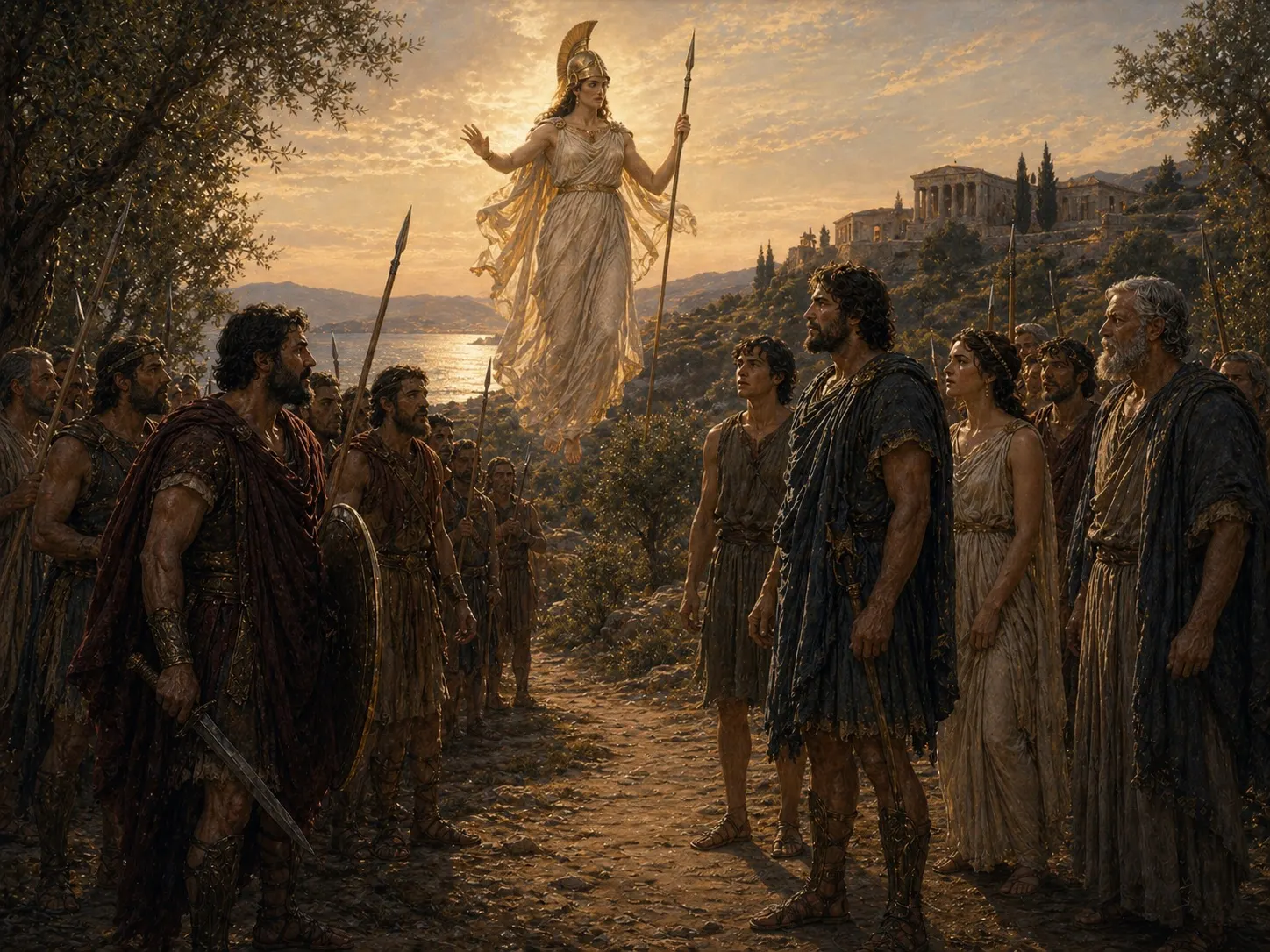
The families of the dead suitors want revenge. Ithaca risks civil war. Athena stops the escalation. Odysseus has recovered his place, but order can last only if vengeance stops somewhere.
The final danger is not a monster at sea, but civil escalation at home. The families of the suitors can turn justice into the next vendetta.
Athena's intervention closes the pattern. Return is only complete when violence is not merely successful, but stopped.
Read this passage as a hinge inside The Odyssey rather than as a detachable adventure: it changes the pressure around return, identity, speech and recognition. Each episode tests whether Odysseus can remain himself while becoming someone else long enough to survive.
The most ironic passages
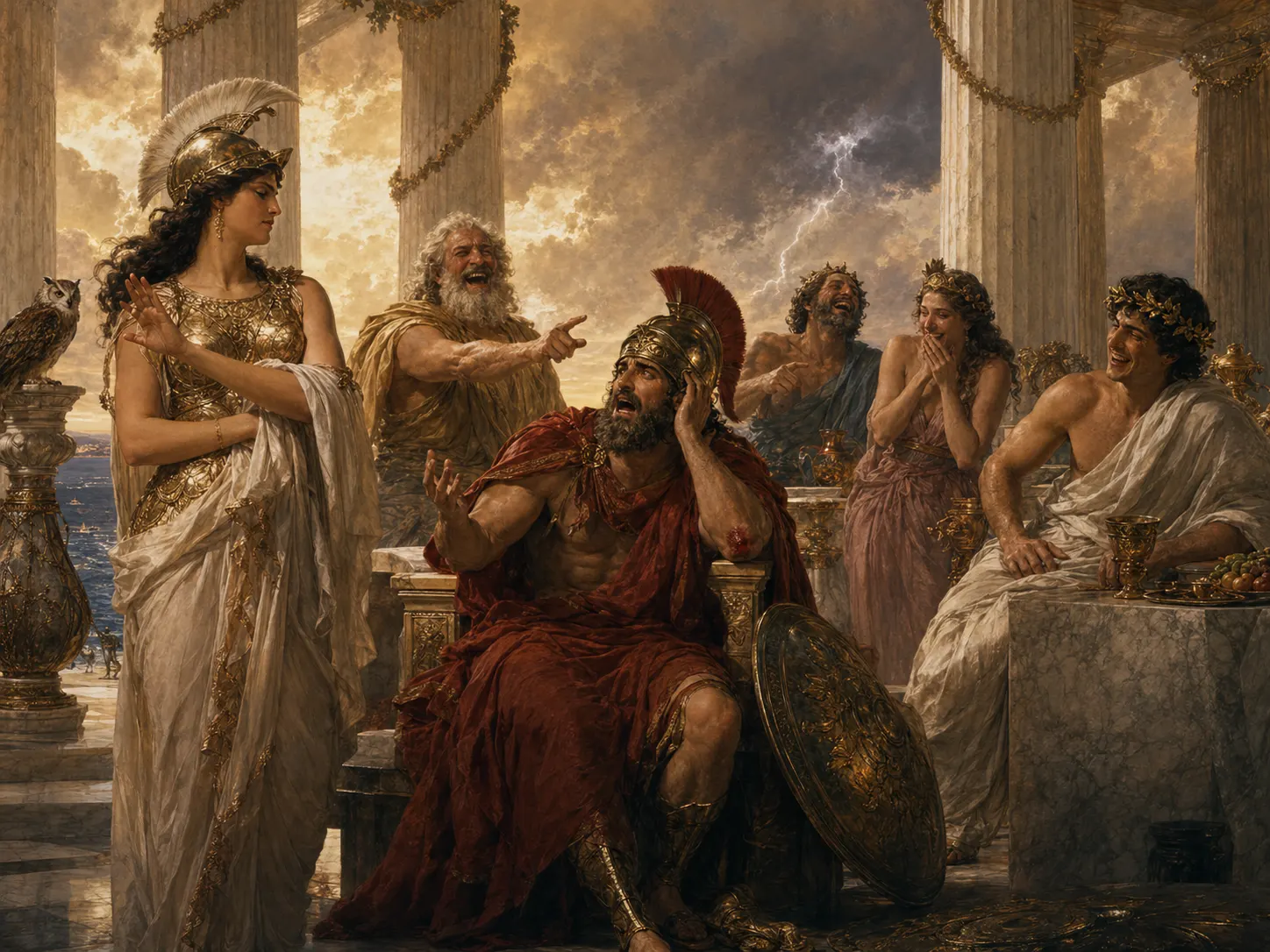
In The Iliad, irony often comes from the gods. Aphrodite wounded by Diomedes, Ares humiliated, Hera seducing Zeus to bend the war: Olympus has the majesty of a court, but also its vanities and ridiculous moments.
Thersites belongs to a crueler laughter. He says embarrassing things, then is beaten by Odysseus under the army's laughter. The scene amuses, but it mostly reveals the social brutality of the camp.
In The Odyssey, Polyphemus and the name Nobody remain the great model. The trick is simple, visual and perfect; then Odysseus' pride makes it dangerous. The story of Ares and Aphrodite trapped by Hephaestus likewise shows how shame can enter even divine palaces.
The fight between Odysseus and Irus adds a darker irony. The king of Ithaca, disguised as a beggar, must measure his strength so he does not betray his identity. Beneath the almost low scene, palace blood is already gathering.
The most surprising passages
In The Iliad, several scenes surprise because they break the image of a purely heroic epic. Diomedes can wound gods. Achilles can be attacked by a river. The gods themselves are divided, touchy and sometimes unworthy. War appears less idealized than destabilizing: a machine of suffering, wounded honor and imbalance.
The most surprising moment may be the ending. The Iliad does not end with Troy's fall, but with Priam and Achilles weeping together. For a war poem, ending on compassion rather than victory is a powerful choice.
In The Odyssey, what surprises most is the place given to lying. Odysseus lies often, and the poem does not simply condemn him for it. His ability to invent a story, disguise himself and wait for the right moment belongs to his heroism.
Another surprise: Odysseus' return is not immediately happy. He comes back alone, disguised, suspicious, into an occupied house. He must observe, test, punish and rebuild. Return is not a romantic scene; it is a domestic and political operation.
What remains
The Iliad and The Odyssey are not only two old stories to know from afar. They are works of crisis, crossed by grandeur, weakness, choices and debts.
The Iliad shows martial greatness, but also its human price. Achilles is admirable, yet his anger becomes monstrous. Hector is defeated, yet remains one of the poem's noblest figures. The gods are powerful, but often petty. War produces glory, but above all dead men, widows, broken fathers and bodies in the rivers.
The Odyssey values another heroism: cunning, endurance, adaptation, self-command. Odysseus survives because he can speak, lie, wait, listen, disguise himself and understand situations. But intelligence has its shadows. He manipulates, conceals, sometimes sacrifices, and returns home through extreme violence.
That is why the key passages should not be treated as decorative highlights. They are the places where Homer changes the reader's judgment. Achilles becomes more than a fighter when he refuses the heroic bargain. Hector becomes more than an enemy when his child fears the helmet. Odysseus becomes more than a clever survivor when his lies, scars, bow and bed all become competing forms of truth.
For a reader coming through Nolan's film, this matters because spectacle alone cannot explain the poems. The horse, the Cyclops, the Sirens or the slaughter of the suitors become powerful only when they are tied to honor, hospitality, memory, command, grief and recognition. The myth is large because every image carries an ethical pressure.
The Iliad is the poem of anger and glory beginning to crack; The Odyssey is the poem of return, cunning and identity recovered.
One shows what honor costs. The other shows what must be lost, endured and hidden in order to come home.
In short
The essential Iliad passages are the quarrel between Achilles and Agamemnon, Hector's farewell to Andromache, Patroclus' death, Achilles' shield, Hector's death and the meeting between Priam and Achilles. They open the poem's major themes: anger, honor, war, pity and human fragility.
The essential Odyssey passages are Calypso, Nausicaa, the Cyclops, Circe, the Underworld, the Sirens, Scylla and Charybdis, the bow test, the slaughter of the suitors and the recognition between Odysseus and Penelope. They show another type of hero: not the frontal warrior, but the cunning, patient man who survives by speech and intelligence.