
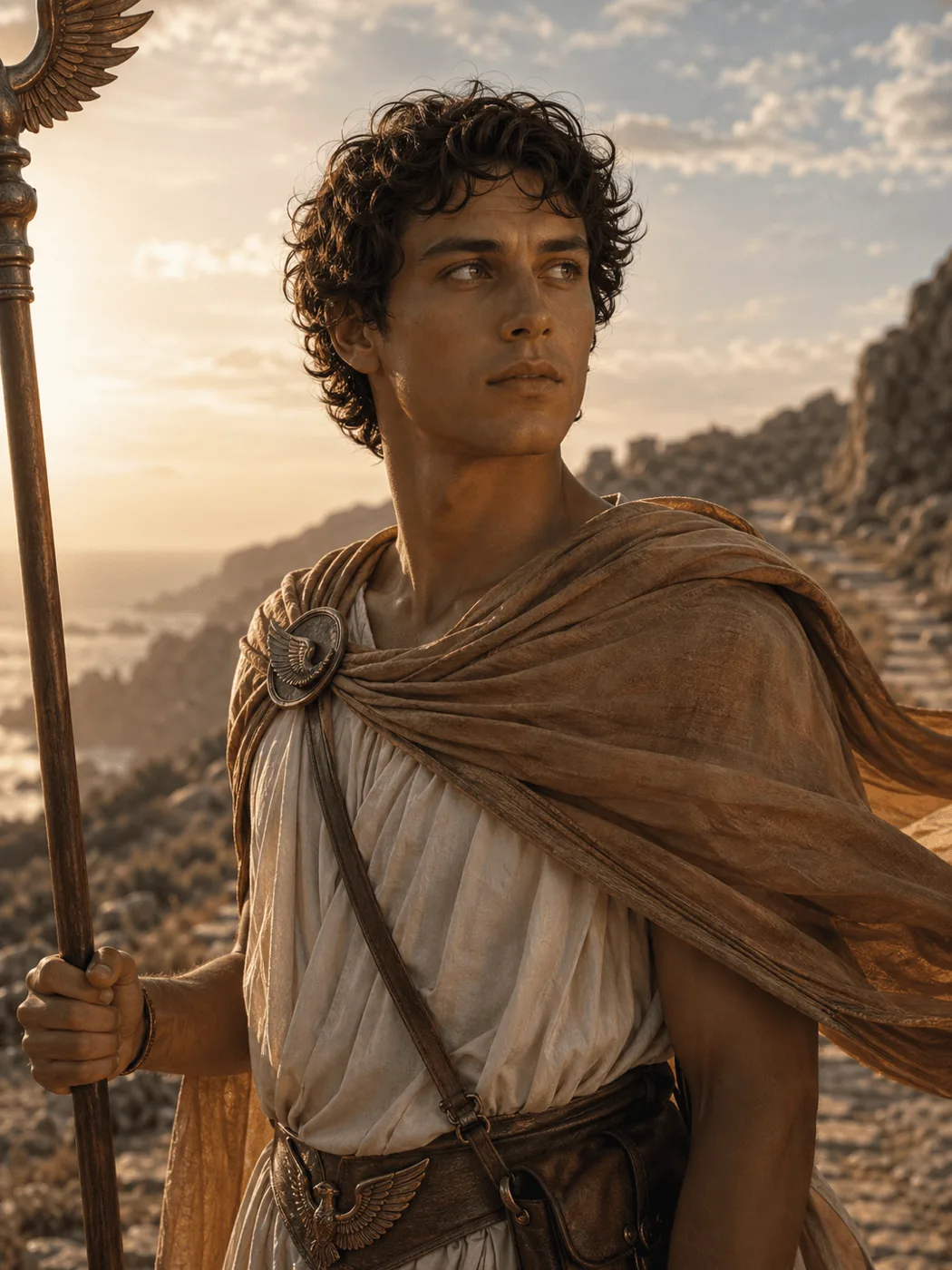
Hermes is the continuity between a divine decision and a human situation. He does not dominate The Odyssey through anger or constant protection, but through a more discreet office: making what must circulate pass through.
Messenger, guide and god of thresholds, he appears when the story needs to cross a limit. He turns the distant order of the gods into a concrete event for mortals.
The role of the passer
Hermes links, without spectacle, the moments when the human world becomes blocked. His interventions are punctual, but decisive. He belongs to doors, roads, transitions, messages and dangerous passages. In a poem of return, that role is essential: every departure supposes that a threshold opens again.
The discreet god of passages
Because he does not decide destiny, Hermes administers it: he allows passage, but does not guarantee it. This nuance matters. Hermes is not the one who saves everything; he transmits, accompanies, authorizes and unblocks. The rest remains in the hands of Odysseus, the other gods and circumstance.
Facing Circe
In the Circe episode, Hermes gives Odysseus the means to resist magic. He does not fight in his place, but gives him the instrument needed to enter the trial without being reduced to powerlessness. This help reveals a deep logic of the poem: human cunning sometimes needs knowledge from elsewhere. Odysseus remains intelligent, but his intelligence must accept a divine relay.
In Odysseus' return
Hermes also intervenes when the gods' decision must be brought to Calypso. The scene is crucial: a word from Olympus forces the immobile island to become a point of departure again. He thus transforms an impasse into a trajectory. The voyage can resume because a message has crossed the distance between gods, nymph and captive hero.
Why he matters
Without mediation, the journey can become inert. With Hermes, the story shows that return is also a matter of connections and delays. He recalls that a mythological world is not made only of powers that confront one another. It also depends on those who carry orders, open routes and make movement possible.