
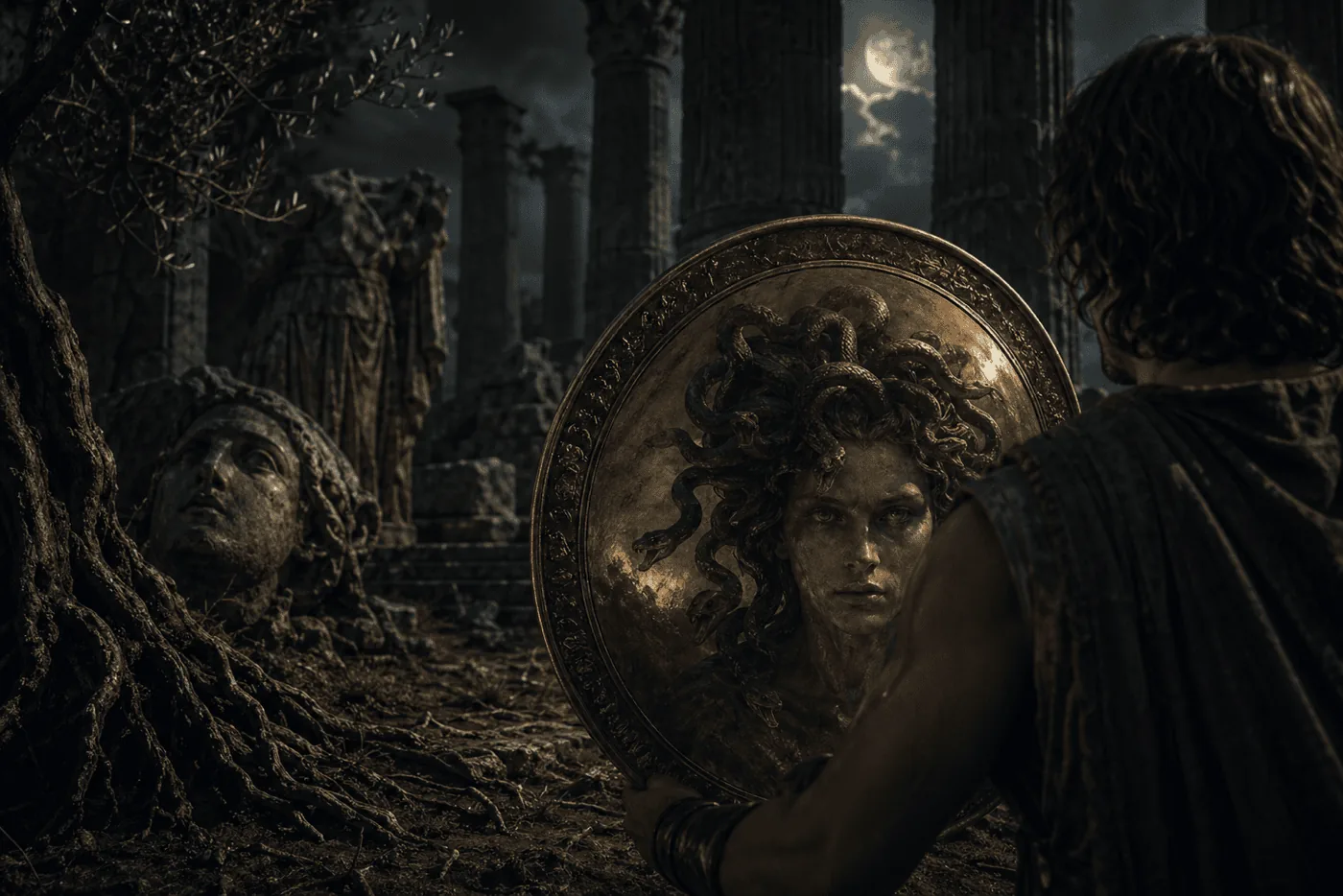
Medusa has become the icon of an absolute danger: to see is to die, unless the gaze is diverted, framed or mediated by human ingenuity. She concentrates a very ancient fear: a world in which perception itself can kill.
In the universe of Troy, Odysseus and Greek myth, she appears as a threshold figure. She does not belong to the narrative heart of The Odyssey, but she illuminates the same imagination: survival requires learning to see otherwise.
A figure that speaks of limits
In the Greek imagination, the serpent-headed monster imposes a threshold trial. The journey is no longer only geographical: it becomes a question of scale, attention and method. Medusa belongs to the world of dangerous borders. She stands on the side of what humans cannot look at directly: monstrosity, death, divine power, fault and archaic violence.
Medusa and the politics of the gaze
The dangerous passage is not an isolated scene. Medusa marks the border between passive perception and perception governed by experience. Whoever advances without a rule is petrified; whoever understands the rule turns danger into passage. The myth therefore values not frontal bravery, but mediation: shield, reflection, detour, strategy.
A story of transformation
Medusa is also a figure of metamorphosis. Depending on the tradition, she may be imagined as a monster born as such or as a being transformed by violent divine logic. This plasticity makes her presence especially strong in the ancient imagination. She recalls that the monster is not only an external adversary. It can be the result of a rupture of order, a punishment, an excess or a story of which heroes see only a fragment.
What her gaze reveals
Her story opens toward a central idea of The Odyssey: survival is not always victory. It is accepting that a hostile world requires cultural instruments, knowledge, strategy and mediation more than force. In that sense, Medusa indirectly dialogues with Odysseus. Both show that the intelligence of detour can be worth more than direct confrontation. The hero who understands the shape of danger is already ahead.
Her place around Odysseus
Even if her episode is not central in the main story of return, Medusa represents exactly the kind of obstacle that does not obey pure trickery: one must redefine the very way of looking. She therefore enriches the gallery of characters and creatures by recalling that Greek mythology does not only tell battles. It also tells regimes of perception: what must be seen, what must be avoided and what must be learned through detour.