
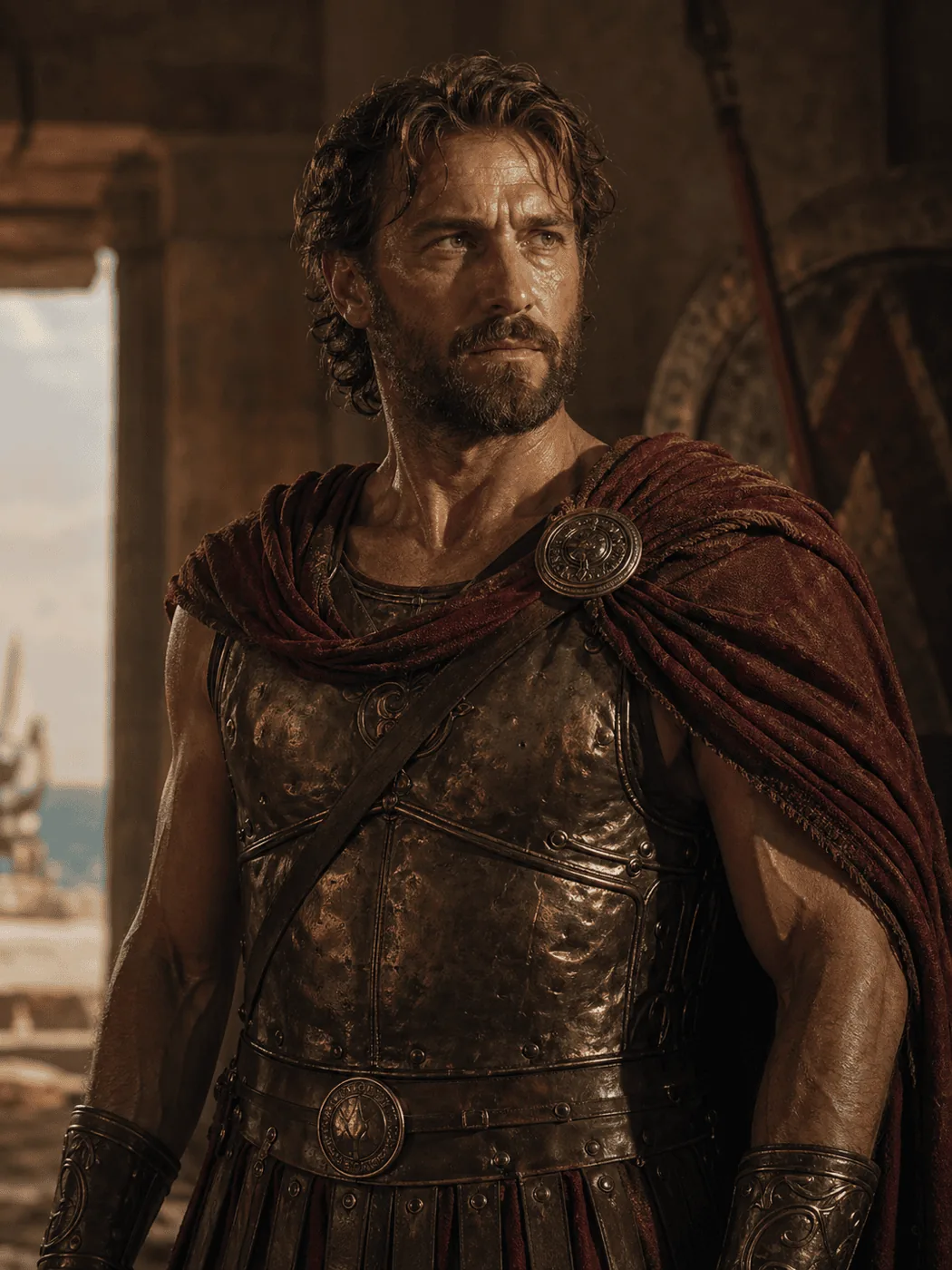
Menelaus shows how a private offense can become a public war. King of Sparta, husband of Helen and brother of Agamemnon, he stands at the exact point where a conjugal wound becomes a diplomatic crisis.
His role can seem less spectacular than that of Achilles, Odysseus or Hector. Yet without Menelaus, the Trojan War loses its most legible spring: the humiliation of a king becomes the affair of a coalition.
A king tied to collective honor
His initial crisis, the departure or abduction of Helen according to the versions, becomes a pretext to reactivate obligations between kingdoms and acts of vengeance. Menelaus does not defend only his marriage. He defends an image of aristocratic order: oaths must be kept, alliances respected, offenses repaired. His personal honor thus becomes a shared political problem.
An image of political restoration
The story gives him a unifying role in principle: without him, the Greeks would not have the same diplomatic coherence for setting out together. The war can then present itself as an operation of restoration. It is not only a matter of taking back a woman, but of reestablishing a violated norm. This justification gives the Achaeans a common cause, even if each adds his own ambitions to it.
Brother of Agamemnon
The relationship with Agamemnon gives Menelaus dynastic thickness. The Atreids do not carry only a conjugal quarrel; they carry a powerful house, crossed by old debts and persistent family violence. Menelaus often appears less dominating than his brother, but his humiliation makes Agamemnon's command possible. The two figures advance together: one supplies the cause, the other the military apparatus.
What Menelaus reveals about Troy
Menelaus embodies the junction between desire, prestige and alliance. He is not a minor figure, but an institutional hinge. He helps explain why Troy becomes an affair for the whole Greek world. The initial wound circulates from one house to another, then becomes shared story, shared oath and shared fleet.
The king behind the offense
The evolution of his return, in film and epic, remains a useful barometer for the difference between vengeance and political management. Menelaus asks a simple and durable question: when honor is restored, what remains to be rebuilt? His presence recalls that victory does not automatically repair what conflict has exposed.