
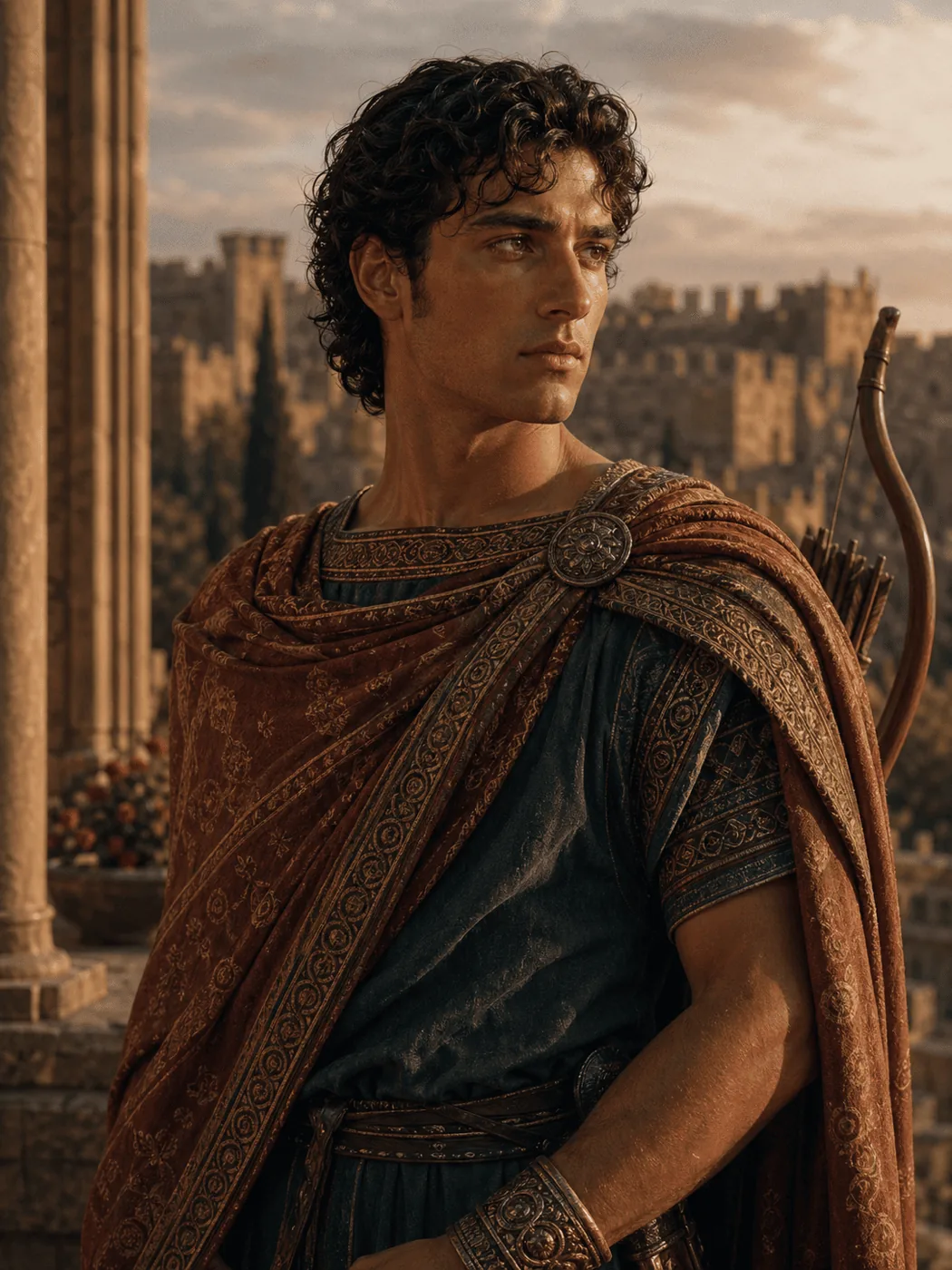
Paris crystallizes the chain of choices linking personal desire, divine commitment and historical catastrophe. Prince of Troy, brother of Hector and lover of Helen, he occupies a paradoxical place: he triggers an immense conflict without always seeming able to carry its full weight.
He is often read as the figure of the initial fault. But that fault is caught in a wider network: divine rivalries, prestige of royal houses, erotic desire, Greek oaths and the political vulnerability of Troy.
A choice that exceeds the person
The famous judgment of Paris is an individual event that tips the balance of kingdoms. Greek narrative makes it the junction between intimacy and collective destiny. By choosing Aphrodite, Paris also chooses a promise of possession and beauty. But this choice already no longer belongs only to his will: goddesses, rewards and Olympian rivalries displace responsibility toward the world of men.
His weight in the war
By choosing according to desire, Paris tips the balance between houses and opens an irreversible trajectory toward Troy and its fall. His position strongly contrasts with Hector's. Where Hector carries the consequences of war on the front and inside the city, Paris appears as the one whose initial gesture forces others to defend an order he has endangered.
Desire, prestige and political weakness
Paris is not only a lover. He represents the political force of desire when it touches royal houses. Loving or abducting Helen is not a private act: it moves a center of prestige from one kingdom to another. This confusion between desire and diplomacy makes his character essential. He shows how a decision experienced as personal can become legible as insult, rupture of pact and declaration of war.
The shadow cast over The Odyssey
Paris helps us understand that fault is not an instant, but a network: an affective gesture can become the matrix of a conflictual order. Even when he is no longer central, his choice continues to produce effects. The Odyssey begins after Troy's fall, but the world it describes remains marked by the chain opened by Paris.
The figures around him
His trajectory also illuminates the way the gods displace responsibility onto humans. Paris is therefore not only the prince guilty of a dangerous romance. He is the character who shows that, in myth, a divine promise can become a human catastrophe.