
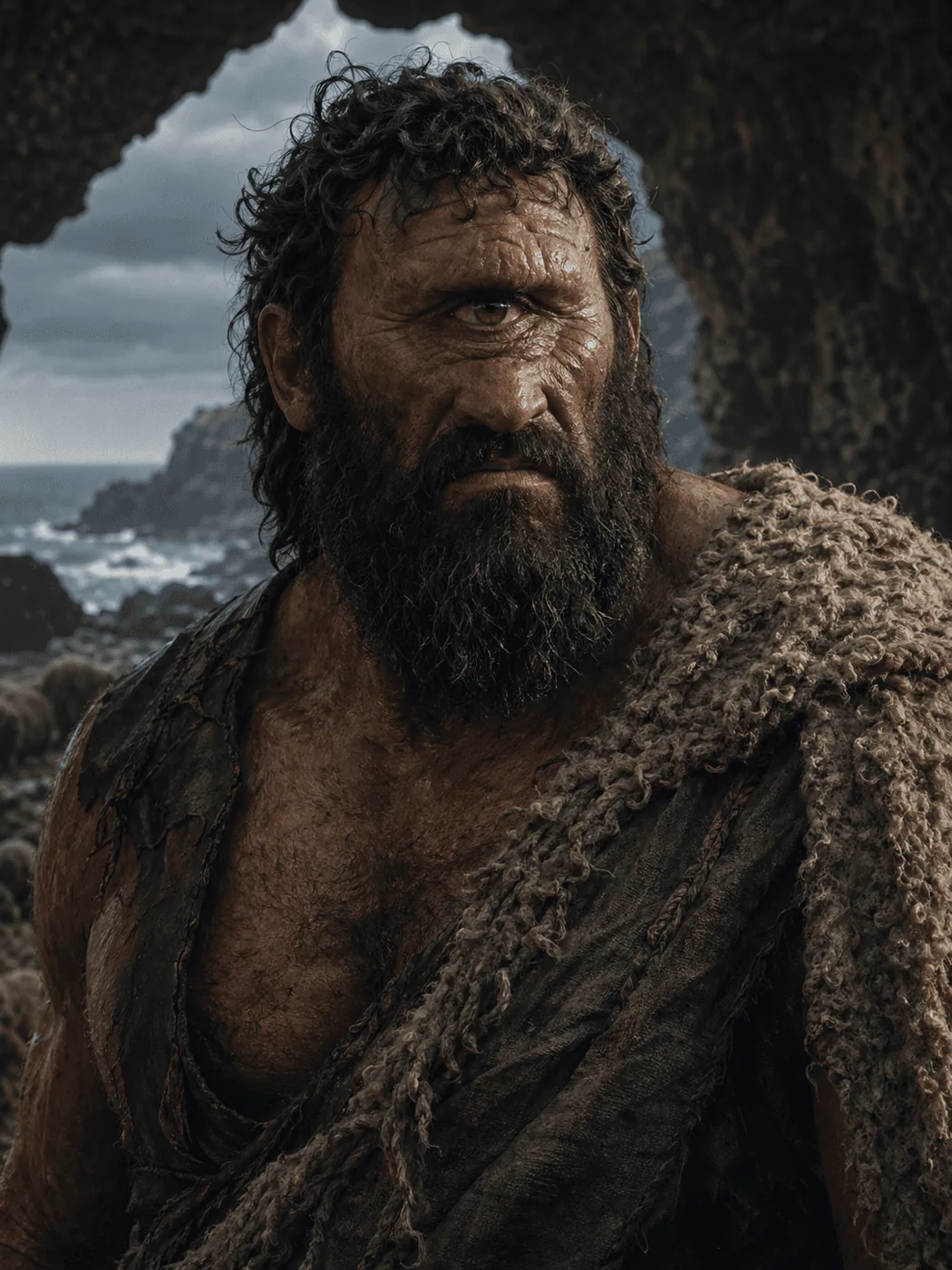
Polyphemus stages the brutal rupture of hospitality. The Cyclops is not only an impressive monster: he is the being who refuses the elementary rules that allow travelers to survive in a fragmented world.
His episode is one of the most famous in The Odyssey because it combines terror, intelligence and fault. Odysseus wins there through cunning, but he also opens the chain of vengeance that will make his return much longer.
The original violation
The episode is not only a scene of violence: it exposes the founding rule of crossing, the obligation to receive the stranger. In the Greek universe, hospitality is not a secondary politeness. It protects travelers, suppliants and unknown people under the gaze of Zeus. By devouring his guests, Polyphemus places himself outside this order.
A monster without a city
Polyphemus lives apart from human institutions. He does not deliberate in assembly, does not respect shared customs and does not recognize divine authority in the same way as civilized men. This marginality makes him frightening. He is not only strong; he is unpredictable because he does not seem subject to the same codes. Facing him, Odysseus must invent an answer adapted to a world without common rule.
The cunning of Nobody
The name "Nobody" is one of Odysseus' most brilliant gestures. It turns language into a weapon, reverses the Cyclops' force against him and makes identity a strategic tool. But this victory has a flaw. Odysseus cannot bear to remain anonymous. By revealing his true name after escaping, he reintroduces pride into a success that could have remained perfect.
The offense and the causal chain
By wounding the order of xenia, Polyphemus provokes a divine answer that reconfigures the sea itself against Odysseus. Poseidon's revenge is born from this wound. The Cyclops is a monster, but he is also a son. The episode recalls that even the margins of the world are linked to family and divine powers.
Political consequences
Poseidon's revenge is not arbitrary: it is born from a precise transgression. The story shows that the cosmic world is juridical. Odysseus' act does not remain local. A gesture committed in a distant cave affects the whole sea. In The Odyssey, no victory is completely isolated from its consequences.
The monster who opens revenge
Polyphemus recalls that monstrous margins are not merely decorative; they reveal the logic of the hero's responsibility. He is at once adversary, partial victim and trigger. Through him, the poem shows that cunning can save a crew, but the pride attached to cunning can condemn the return.