
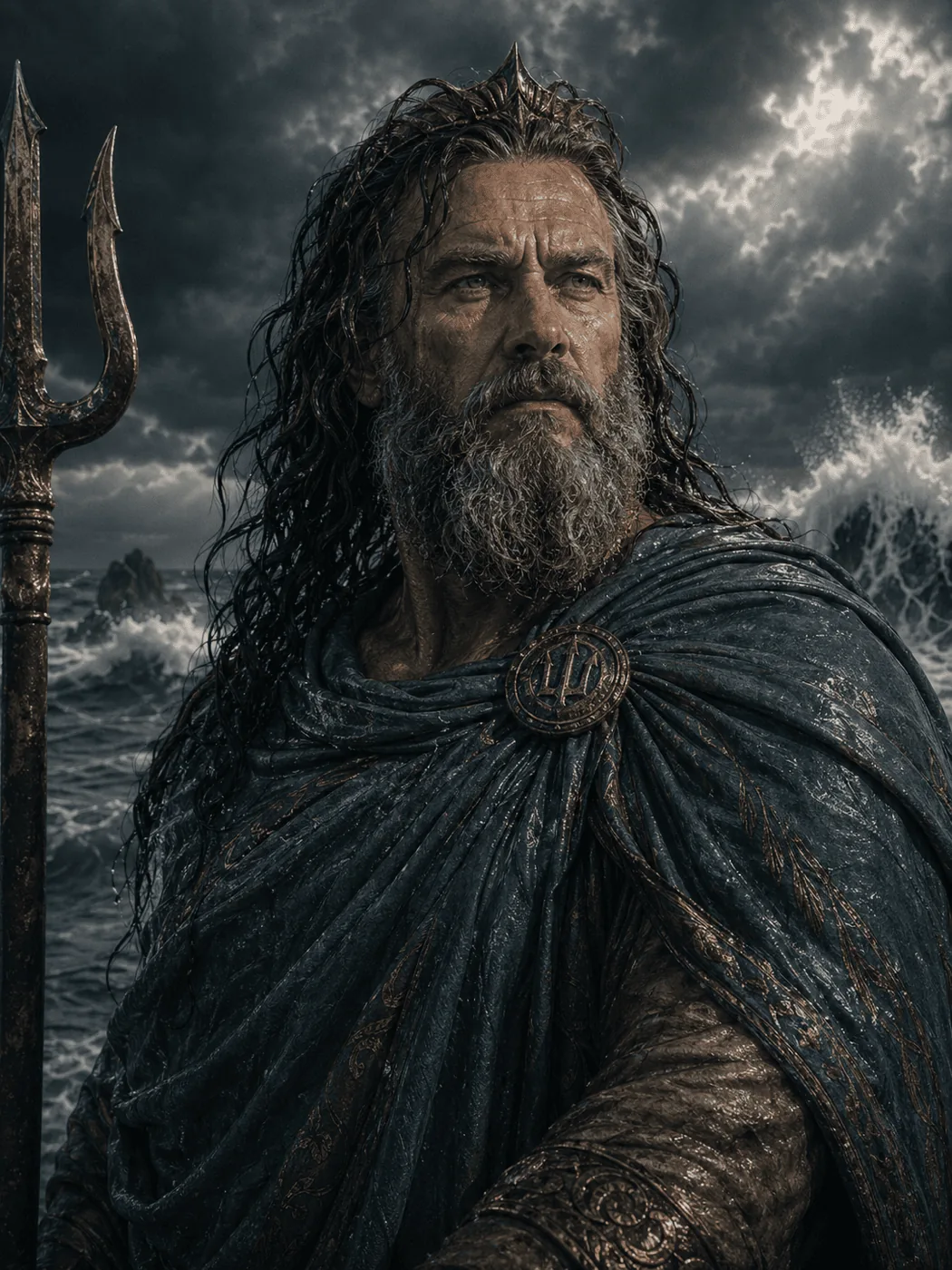
Poseidon is the most durable answer to the hubris of Odysseus and his men. In The Odyssey, he is not only the god of the sea: he is the power that makes return unstable, long, costly and morally charged.
His anger gives the voyage a judicial dimension. The sea is not a neutral setting; it becomes the space where an old fault repeatedly returns to demand repair.
A god of borders
Poseidon is not simply the maritime obstacle. He regulates the passage between the world of mortals and that of unpaid debts. The sea, with him, is never only liquid. It is threshold, route, threat, memory and sanction. To cross his domain is to depend on a power that can delay, scatter or break human projects.
Why his anger lasts
The Cyclops episode installs a debt that is not individual: his son has been struck, and therefore Poseidon's familial and political order has been reached. Odysseus did not merely blind Polyphemus. He proclaimed his name after the act, turning a successful escape into a public challenge. That speech gives Poseidon a clear target and inscribes revenge into duration.
An opposition to Athena
Poseidon and Athena draw two poles of the story. Athena accompanies Odysseus' mobile intelligence; Poseidon recalls that intelligence cannot abolish consequences. Their opposition makes the return complex. Odysseus is not simply helped by the gods or punished by them: he advances inside an unstable balance between protection, delay, arbitration and anger.
The sea as judgment
Poseidon turns the route into a judicial crossing: each storm is not chance, but a reminder of responsibility. His presence prevents return from being a simple road home. It forces Odysseus to lose time, men, certainties and sometimes prestige. The sea strips the hero before giving him back to Ithaca.
What his anger reveals
Poseidon's anger shows that the mythological world has a long memory. Acts do not disappear because the hero has survived. They return in other forms, in other places, through other powers. This logic gives the poem its gravity: Odysseus is not pursued by divine whim, but by a debt that clings to his name.
The god who makes return last
In film as in myth, to follow the sea with Poseidon is to follow a sanction that does not seek pure destruction, but proof that the past weighs. Poseidon recalls that return is not only a matter of courage. One must cross what one has provoked, and sometimes accept that the world recognizes you less as victor than as debtor.