
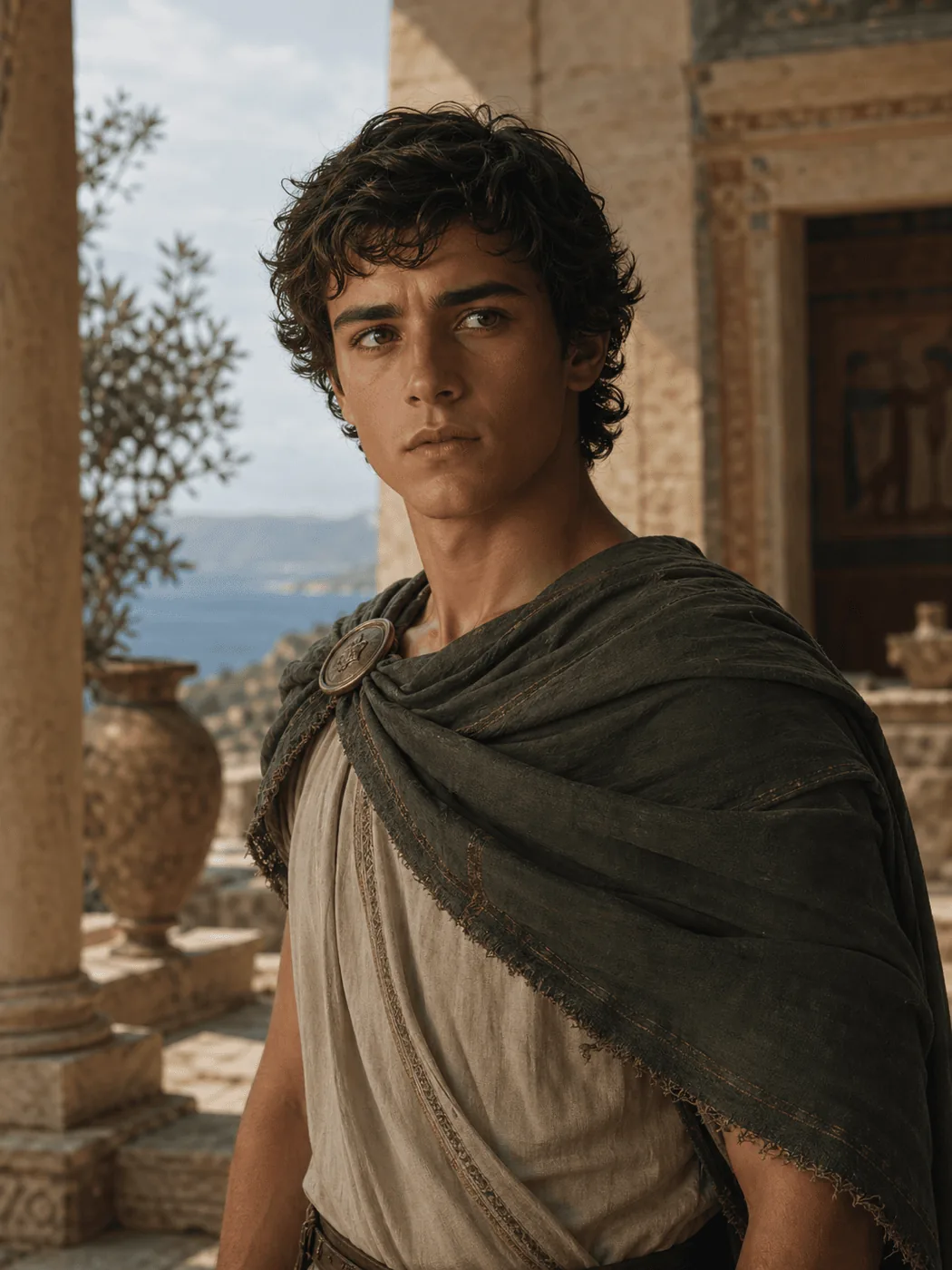
Telemachus is the first human consequence of Odysseus' departure: a youth forced to grow up in a house without a father. He has barely known the king whose inheritance he carries, yet he must answer for his absence.
His story opens The Odyssey even before Odysseus' return. The poem therefore begins with a lack: Ithaca is not only waiting for a hero, it is waiting for a son to learn how to become worthy of a name he has not yet truly received.
A political apprenticeship
Telemachus inherits a kingdom without effective authority, must recognize the suitors and invent a relation to uncertainty. The suitors threaten not only his mother. They threaten his place, his family memory and his political future. As long as Odysseus is absent, Telemachus is both legitimate heir and a young man still powerless.
The passage into adulthood
Telemachus' journey is not secondary: it builds the moral frame that will make the final version of return acceptable. By setting out to seek news of his father, he leaves passivity. He meets other kings, listens to stories of Troy, measures what a well-kept or badly returned house looks like. His movement is an education by comparison.
Relationship to Athena
The divine help he receives does not suppress his effort; it orients it. His act of departure is both a search and the acceptance of responsibility. Athena gives him the necessary impulse, but not ready-made maturity. Telemachus must learn to speak publicly, mistrust, hope without naivety and take his place beside his mother.
Absent father, son to be built
The relation between Odysseus and Telemachus is first a relation to a story. The son mostly knows the father's reputation: the hero of Troy, the vanished king, the man everyone awaits or already replaces. When recognition comes, it does not magically repair the lost years. It allows absence to become alliance. Telemachus ceases to be only the abandoned son; he becomes an actor in the reconquest.
The son who makes return necessary
Through him, The Odyssey also speaks of transmission: the absent king must be replaced without the city falling apart. Telemachus gives return a generational dimension. Odysseus comes back not only to a wife and a throne, but to a son who has grown up inside the void left by his departure.