
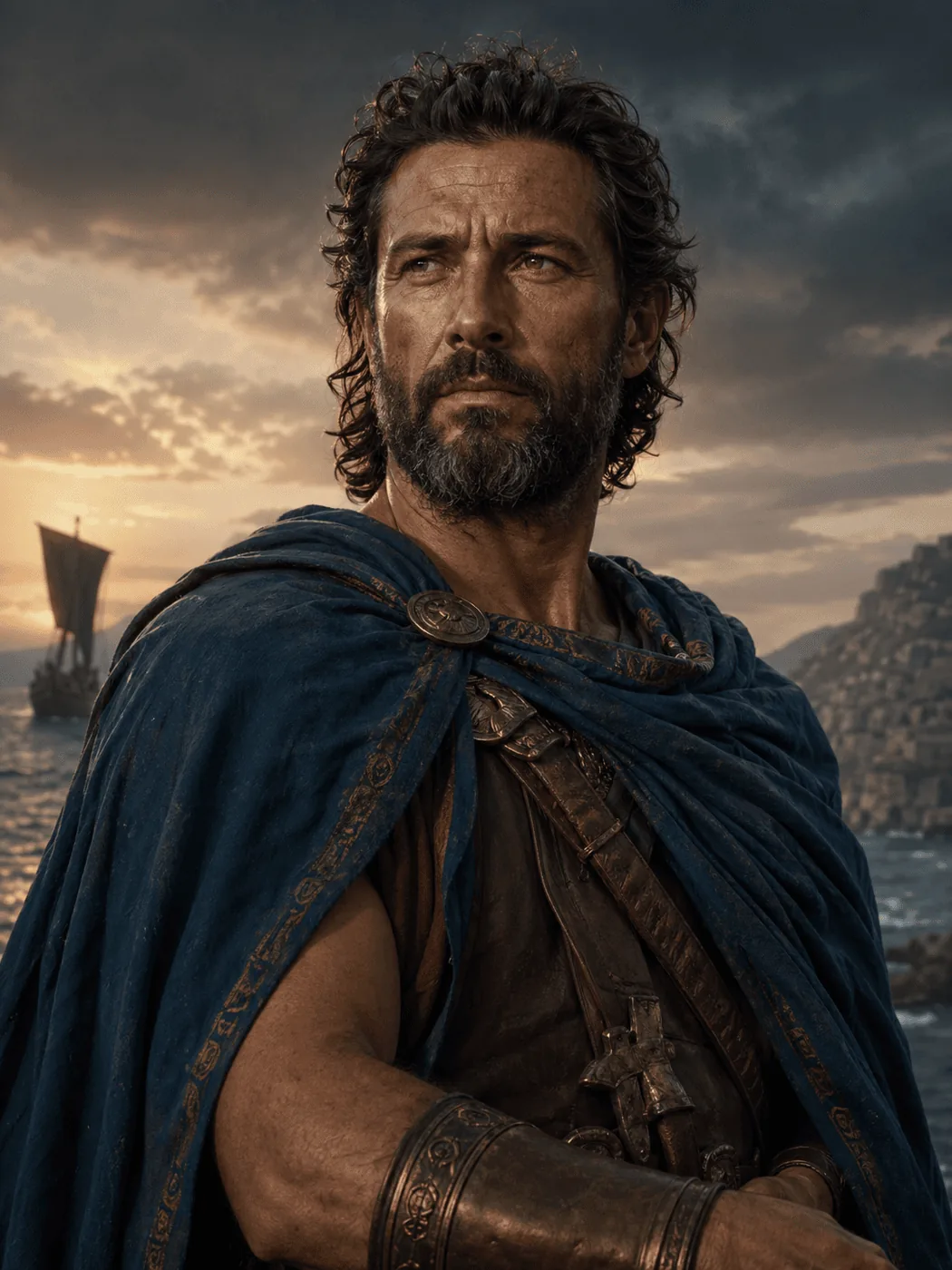
Odysseus is the figure of competence in a state of dislocation. King, warrior, navigator, inspired liar, survivor and awaited husband, he crosses The Odyssey as a man forced to change shape without losing his name.
His greatness does not come from one single force. It comes from his ability to pass from one world to another: battlefield, hostile sea, foreign palace, monster's cave, nymph's island, occupied house. Odysseus survives because he reads places before acting.
A model of strategic survival
His strength is not power, but the adaptation of means to obstacle. He advances by constantly changing register: war, speech, deception, negotiation. This flexibility has a central name: metis. Odysseus knows how to wait, invent a story, hide his identity, recognize the right moment and transform an apparent weakness into an advantage. He does not always win because he dominates, but because he understands the precise shape of danger.
The hero of cunning
The Trojan Horse gives the military version of this intelligence: winning not through direct confrontation, but through detour. In The Odyssey, that logic becomes existential. Odysseus must use cunning to eat, sleep, depart, keep silent, return and be recognized. Yet cunning is never innocent. It protects the hero, but also troubles human relations. The man who knows how to lie in order to survive must then prove that he can still tell the truth to his own.
The flaw of the name
The same metis that saves Odysseus makes him dependent on recognition. He fears defeat and forgetting in equal measure. The Polyphemus episode shows this perfectly. Odysseus wins by becoming "Nobody", then compromises his victory by proclaiming his name. His intelligence knows how to hide, but his pride wants to be seen. This contradiction accompanies the whole return.
The house to reconquer
Return is not a reward; it is the reconquest of his own status as a subject among men. Odysseus does not come back to an intact house. Ithaca has changed, Penelope has resisted, Telemachus has grown, the suitors occupy the royal space. Returning therefore means verifying who remembers, who betrays, who recognizes and who still deserves to live inside the old order.
Between gods, kings and companions
He concentrates the tensions between gods, kings and companions: every intervention upon him reveals a fault line in the old order. Athena admires his cunning, Poseidon pursues him, Calypso wants to keep him, Circe instructs him, the dead warn him. Odysseus becomes the man through whom the mythological world tests its own rules.
The stakes for cinema
The central question remains: can Odysseus enter Ithaca again without reproducing the violences that founded his victory? This is what makes him durable. Odysseus is not only the hero who returns. He is the man who must prove that surviving war has not made him incapable of inhabiting peace.