
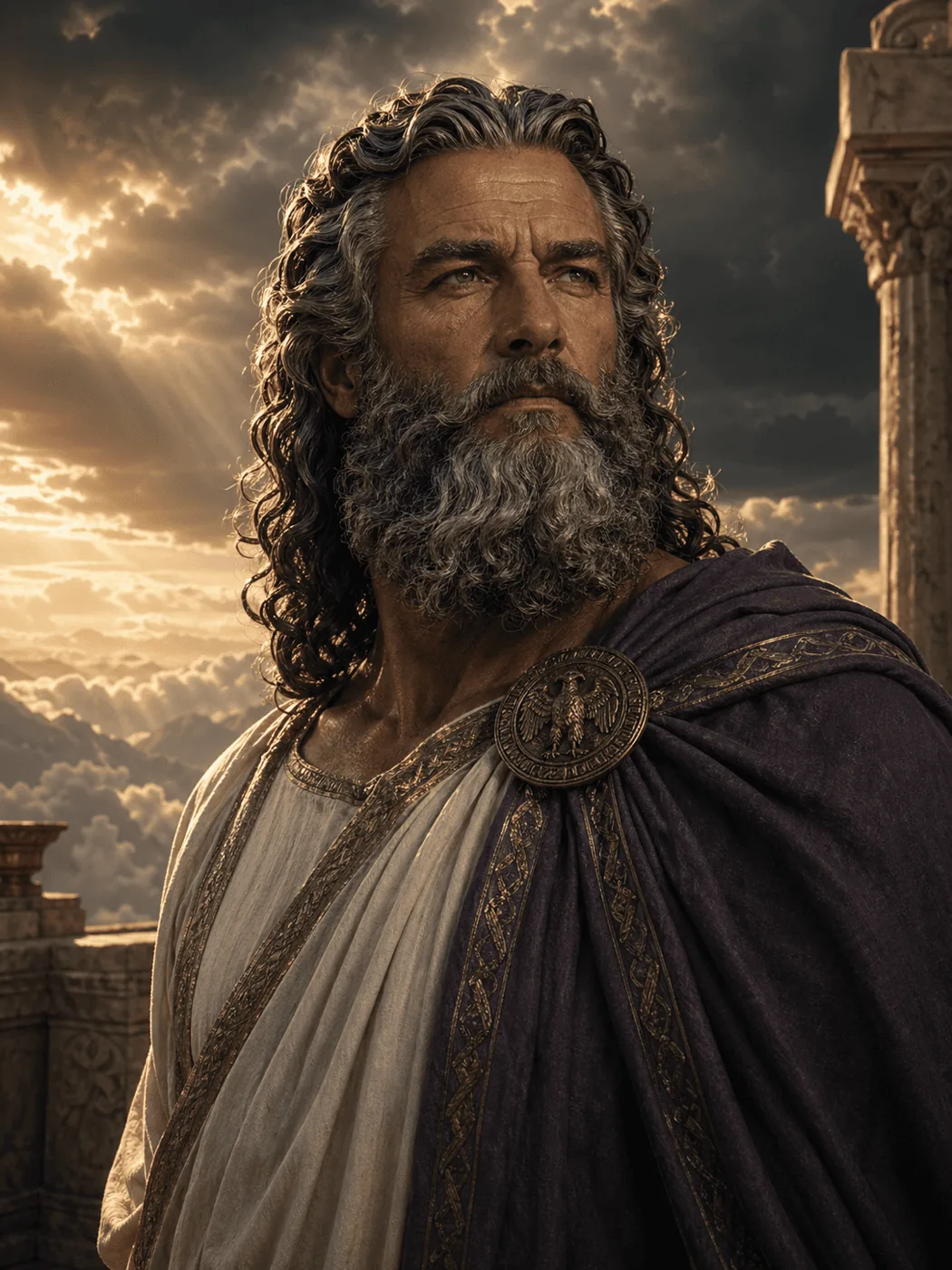
Zeus remains the pivot of a divine system in which no power is absolute without constraint. He does not always intervene directly, but his authority forms the horizon within which the other gods act, protest or negotiate.
In The Odyssey, Zeus is not only the master of the sky. He is the guarantor of a minimum order: the one that prevents the world from dissolving into competing angers of gods and men.
The role of arbitration
Zeus frames the forces at work rather than resolving them. This position makes his action politically legible: what interests him is not peace, but a minimum order. He sometimes allows conflicts to unfold, then fixes a limit. This way of governing can seem distant, but it corresponds to a sovereignty that cannot be everywhere without weakening its own authority.
The logic of limits
In Odysseus' crossing, Zeus tempers the excesses of other gods and imposes boundaries on revenge. Poseidon may pursue Odysseus, Athena may protect him, Calypso may keep him, but none of these powers can claim total autonomy. Zeus recalls that a hierarchy exists above particular conflicts.
Justice, hospitality and sanction
Zeus is also linked to hospitality and justice. Violations of xenia, the abuses of the suitors, faults committed against shared rules all take meaning under his gaze. His justice is not always immediate, nor always comfortable for mortals. It often acts as a reminder: actions eventually return toward those who performed them.
Constitutive ambivalence
Arbiter or accomplice, Zeus appears as the one who knows that absolute disorder also ruins the sovereign. His neutrality is therefore a form of government. This ambivalence makes him essential. He does not represent simple goodness, but a power of regulation. He sometimes authorizes suffering because divine and human balance rebuild themselves through it.
In Odysseus' return
The return indirectly depends on his decisions. When the gods debate Odysseus' fate, Zeus gives Athena's will and Hermes' message effective value. He does not walk beside the hero, but makes possible the frame in which the voyage can resume. His action is rare, but structuring.
The unstable center of Olympus
Zeus is not a follower among gods: he decides, delays, authorizes. These rare gestures structure many scenes. To understand Zeus is to understand that The Odyssey does not simply oppose human freedom and divine whim. The poem imagines a world governed by competing powers, of which Zeus remains the unstable but necessary center.