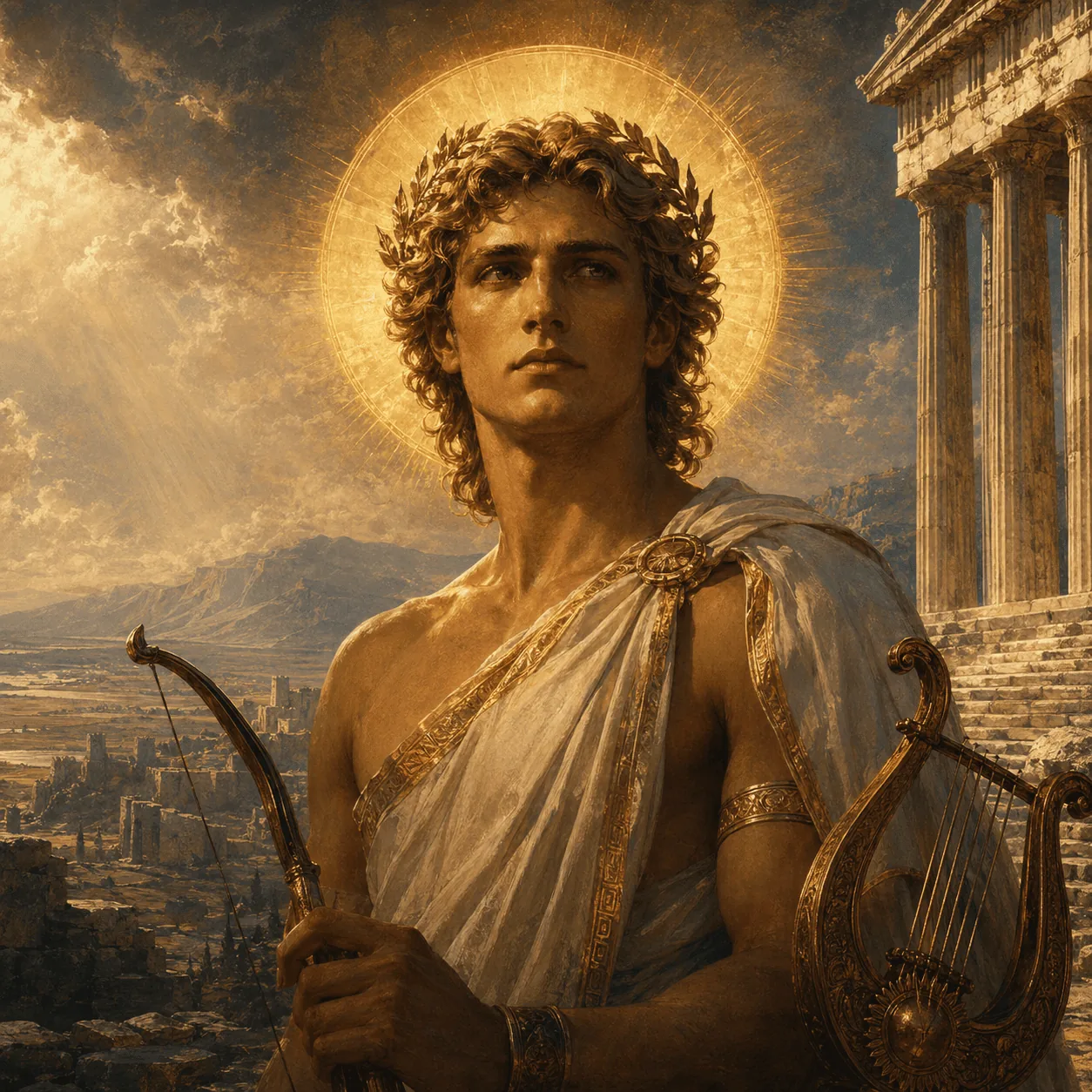
Apollo gives the war a disturbing brightness: order, disease, beauty and distance. He is not only the luminous god associated with music or prophecy. In the Trojan cycle, he is also a power who strikes from afar, protects certain men and imposes respect through plague, bow and oracular speech.
A god close to the Trojans
In The Iliad, Apollo often stands on Troy's side. He protects the city, supports Hector and intervenes against the Greeks when religious order is violated. From the opening of the poem, his role is decisive: because Agamemnon has humiliated Chryses, Apollo's priest, the god sends plague into the Achaean camp. The war therefore begins under the sign of a sacred fault. Men may be powerful, numerous and armed, but they are not free to despise the gods.
Apollo's distance
Apollo is a god of distance. His bow strikes without contact. His light reveals without necessarily warming. His oracles give truth that must still be interpreted. This distance makes him very different from a purely protective god. He helps, but remains above; he illuminates, but can also wound. In the Trojan story, that distance suits Hector's fate. Apollo supports the Trojan hero and sometimes gives him necessary force, but he cannot abolish the end already waiting.
Beauty and danger
Apollo carries a very Greek contradiction: he is beautiful, harmonious, linked to music and measure, but also terrible. His beauty does not cancel his violence. On the contrary, it makes the violence more impressive. When Apollo strikes, it is not confused brutality; it is a clean, almost ceremonial power. This tension matters for understanding The Iliad, where war can be splendid and atrocious at the same time.
Inside the mechanics of the story
Apollo recalls that the gods are not simple symbols. They weigh on the balance of forces, give the camps invisible depth and sometimes transform a human choice into divine response. He is therefore useful for understanding why the Greeks do not win only because they are strong, and why the Trojans resist not only because they are brave. Each camp exists within a network of favors, faults and higher powers.
The light that strikes
Apollo is one of the great gods of the Trojan War because he introduces the notion of sacred limit. He protects the Trojans, strikes the Greeks, supports Hector and recalls that divine beauty can be fearsome. With him, the war takes on a higher, colder, more religious dimension: no army can fight as if the world of the gods did not exist. His page also helps separate light from comfort: in Homeric myth, what illuminates can also wound, judge and keep mortals at a distance, even when it appears harmonious and measured to the eye and ear of warriors and singers. The god's calm brightness therefore never feels innocent.