
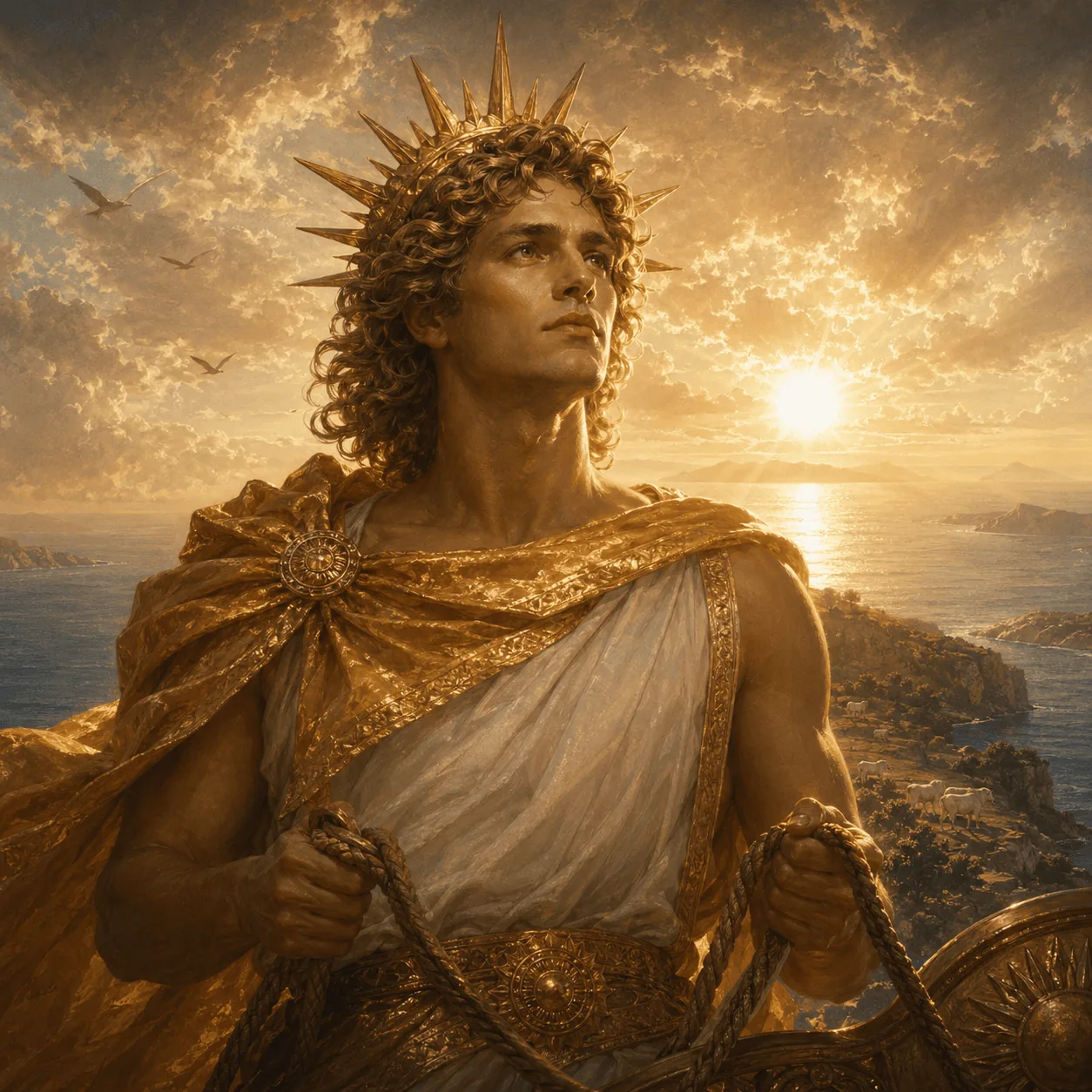
Helios recalls that no fault remains invisible in a world watched by the gods. He does not intervene like Athena through cunning and counsel, nor like Poseidon through continuous maritime anger. His power lies in sight: he sees, he owns, he demands repair.
The sacred cattle
In The Odyssey, Helios is above all linked to the episode on Thrinacia, where his sacred cattle graze. Odysseus knows that these animals must not be touched. The prohibition is clear, repeated, almost impossible to misunderstand. Yet his companions, hungry and exhausted, finally kill the god's beasts. This fault is more than theft. It is sacrilege. They do not merely take food; they destroy what belongs to a god and cross a limit the entire story had made visible.
The gaze of the sun
Helios sees what men would like to hide. The sun passes above the world, lights places and makes gestures visible. In mythological logic, that visibility becomes moral: what is done far from human eyes does not escape divine eyes. The episode is harsh because Odysseus' companions are not guilty only through pride. They are hungry and exhausted. The story does not deny their distress, but shows that human necessity does not always abolish sacred prohibition.
Odysseus facing his men's fault
Odysseus tries to avoid the sacrilege, but he cannot entirely control his men. This failure matters greatly. The hero is cunning, brave and protected by Athena, but he is not all-powerful. His survival also depends on collective discipline, and that discipline finally breaks. After the slaughter of the cattle, Zeus punishes the ship. The companions die, Odysseus survives alone. The return is reduced to radical solitude.
A scene of limit
The episode of Helios is one of the moments when The Odyssey becomes almost implacable. The reader understands hunger, fatigue and temptation. But the world of the poem obeys sacred limits. Some borders, once crossed, no longer negotiate. Helios therefore gives the journey a judicial dimension. The sea is not only a space of adventure; it becomes a place where faults are paid.
The sun as witness
Helios is essential because he shows that Odysseus' return also fails because of men themselves. Monsters, storms and hostile gods are not enough to explain the losses. There is also disobedience, exhaustion and the rupture of the prohibition. With Helios, The Odyssey recalls that survival requires not only courage, but difficult fidelity to sacred limits. The god gives the episode its terrible clarity: the crew knows the rule, knows the owner, knows the risk, and still crosses the line, proving that hunger can undo discipline and dissolve command when waiting becomes unbearable for everyone aboard the ship at sea and ashore. Visibility becomes punishment because everyone understood the command.