
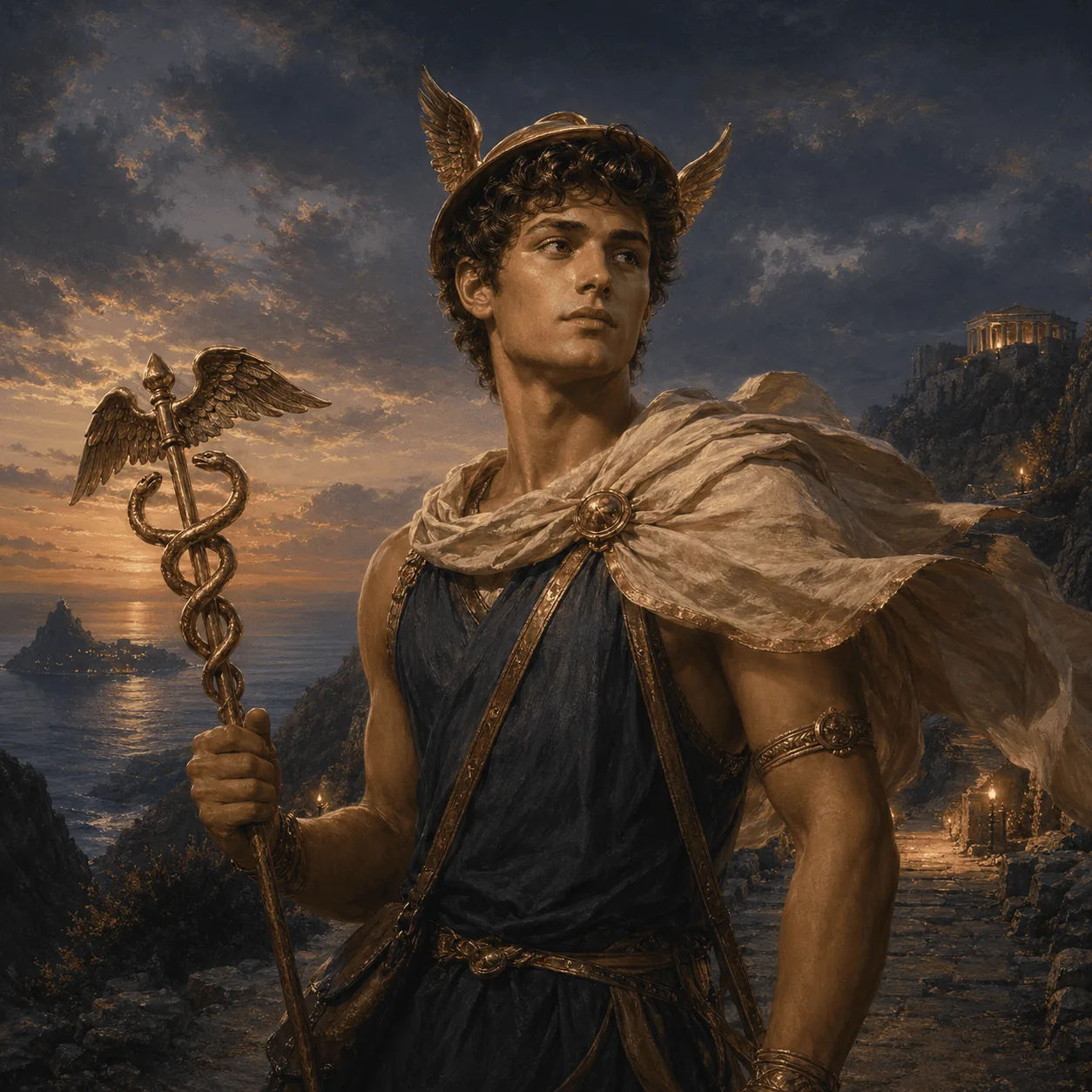
Hermes carries the decisions of Olympus into the blocked spaces of the journey. He is the god of messages, passages, thresholds and rapid movement. In The Odyssey, this role is essential: Odysseus is constantly stopped, held, enclosed or threatened with no longer being able to return.
The god of thresholds
Hermes intervenes when a character must pass from one state to another. He crosses borders between Olympus and earth, between divine decision and human action, between immobility and movement. Where Poseidon closes the sea, Hermes sometimes reopens a way. This role explains his presence in the great moments of blockage. Odysseus does not lack courage only; he encounters places that suspend his return.
Facing Circe
When Odysseus' companions are transformed by Circe, Hermes appears to give the hero the means to resist. He gives him moly, the protective plant, and tells him how to face the sorceress. The god does not fight in his place, but transmits the tool and the knowledge needed. The episode shows the nature of his help: Hermes does not replace Odysseus' intelligence; he makes it effective at the critical moment.
At Calypso's island
Hermes also intervenes with Calypso to transmit Zeus' order: Odysseus must depart. The nymph has held the hero for years in a form of gentle but immobile immortality. Hermes' message sets the story in motion again. The scene is fundamental. Odysseus' return does not depend only on his will. Olympus must authorize departure, the message must arrive, and the closed space must finally open.
Discreet but decisive help
Hermes does not have Athena's continuous presence or Poseidon's spectacular anger. Yet his interventions change the hero's trajectory. He appears rarely, but at the right moment. He carries a word, a remedy, an authorization, and the story can continue. His role gives The Odyssey a clear mechanics: many trials are thresholds. It is not enough to win; one must cross, leave, reach and take the road again.
The message that reopens the route
Hermes is the god of transitions in The Odyssey. He helps Odysseus avoid remaining prisoner of places that want to stop him. Through him, Zeus' orders reach the earth, magical dangers become passable, and the voyage recovers its movement. His strength is not to dominate the story, but to unblock it. Reading him carefully also clarifies the rhythm of the poem: some crises are solved not by spectacle, but by the right message reaching the right threshold at the right time. Passage itself becomes his quiet form of power.