
Film music

Ludwig Göransson makes the epic audible before the image arrives.

For The Odyssey, the announced palette blends bronze gongs, aulos, lyre and bowstring. The sounds evoke antiquity, but they are assembled for a 2026 film — not as a note-for-note reconstruction of a Homeric Greek performance.

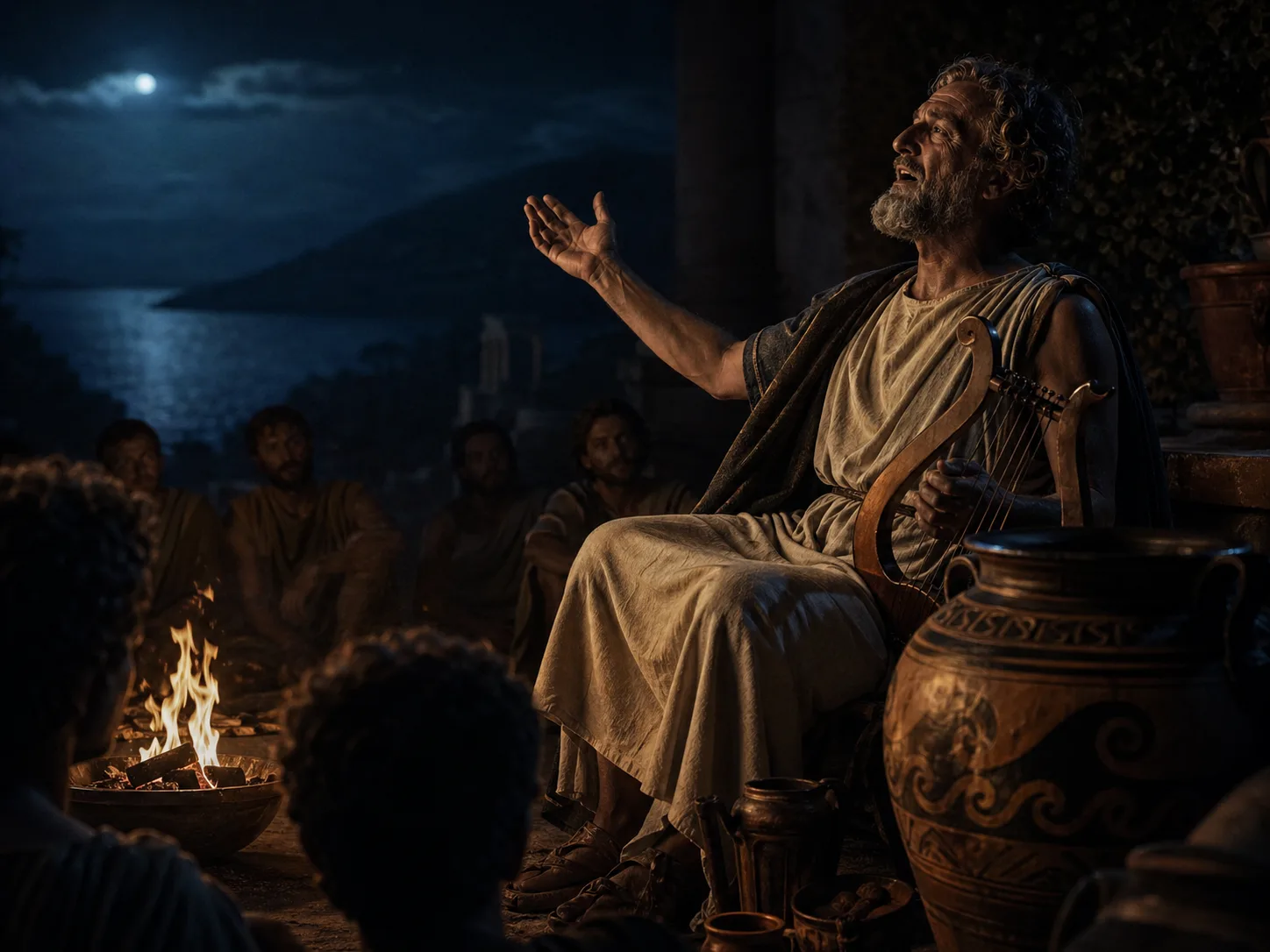
Editorial illustration of a bard singing beside a fire with a lyre
An editorial illustration about Homeric oral tradition — not an official image from the film.

By Published Facts checked

Ludwig Göransson composed the music for Christopher Nolan's The Odyssey.

AP reports the use of bronze gongs, an aulos and a lyre.

A theme has four notes and ends with the pluck of a bowstring.

Physical editions of the soundtrack have been announced by Mutant with Universal Pictures and Back Lot Music.

What is confirmed, without embellishment.

In its July 9, 2026 report on the making of the film, Associated Press describes a tangible sound search: the bronze of the gongs, the breath of the aulos, the strings of the lyre and the final bowstring pluck that punctuates a four-note motif.

Those details are precise enough to reveal a musical direction, but not to narrate the entire score in advance. We do not yet know where every instrument sits in the film or how those colors develop from scene to scene.

Four notes, then the tension of a bow.

The most evocative detail may also be the simplest: four notes, followed by a plucked bowstring. The gesture can naturally recall Odysseus, whose bow is bound to recognition and the return to Ithaca. That is our editorial reading, not an official explanation from the composer.

The idea draws its force from restraint. Rather than covering the epic under an uninterrupted orchestral mass, a small motif can become a trace: something the listener recognizes, anticipates and hears differently as the journey moves forward.

The announced palette

Four sounds, four ways into the myth.

The instruments give us markers. Their real meaning will depend on staging, editing and what the score chooses to leave in silence.

Bronze gongs

A deep, physical material that can give the journey weight without reducing antiquity to a decorative sound effect.

Aulos

A reed instrument associated with the ancient Greek world. Its use in the film remains a contemporary compositional choice.

Lyre

The clearest link to song and oral tradition: the epic returns to a voice, a rhythm and an instrument held close to the body.

Bowstring

The four-note theme ends with its pluck: a brief gesture that may evoke tension, identity and Odysseus' return at once.

From voice to screen

Why the lyre matters in a story born from oral tradition.

The Odyssey comes from a tradition of sung or recited poetry, carried by memory, rhythm and repeated formulas. A lyre cannot reconstruct that lost world by itself, but it creates a perceptible bridge between the bard and the cinema audience.

The bridge becomes more interesting when it stays modest: the film can recall the story's oral roots without claiming that a modern audience is hearing exactly what a Greek listener heard nearly three thousand years ago.

Rights and independence

Analysis, not redistribution.

This page reproduces no music, recording or possible lyrics. To listen to or purchase the soundtrack, use official channels and authorized services.

From Troy to Ithaca is an independent editorial fan site with no affiliation to Christopher Nolan, Ludwig Göransson, Universal Pictures, Back Lot Music or Mutant. Names, trademarks, promotional artwork and musical works remain the property of their respective rights holders.

Official edition

A soundtrack also announced in physical formats.

Mutant has announced physical editions of the film's music with Universal Pictures and Back Lot Music, including vinyl and CD releases. The announcement confirms an official commercial edition; it does not guarantee that every format will be available everywhere, at the same price or for the same length of time.

Stock, prices, shipping territories and schedules may change. The publisher's official page remains the practical reference when placing an order.