Who is it?
Medusa belongs to the Gorgons, ancient figures whose very appearance is enough to produce terror. In the best-known tradition, she is the only mortal member of the group, which makes Perseus' victory possible and gives the encounter a precise dramatic rule.
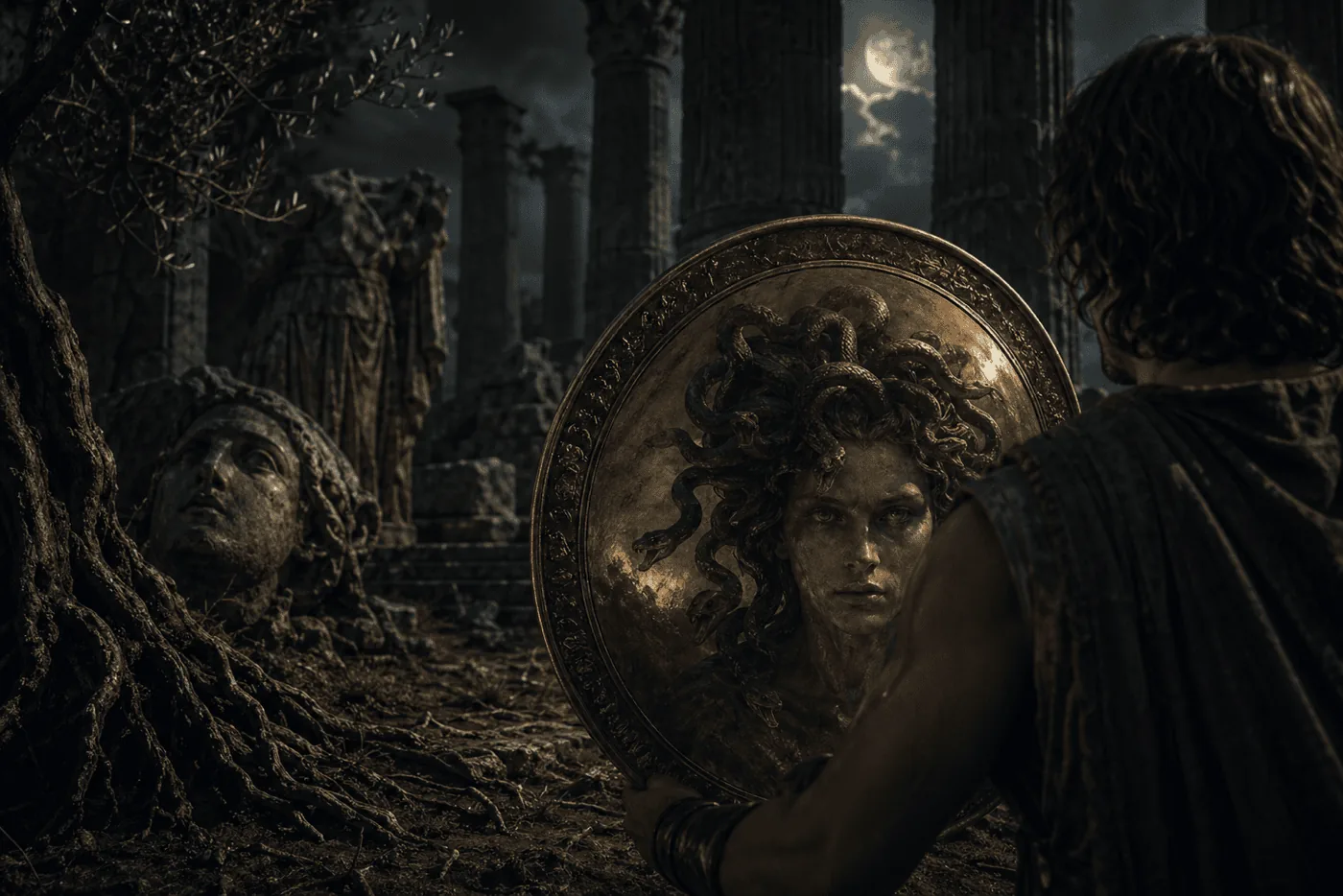
Her power rests on a simple and terrible law: to look at her directly is to be petrified. The monster therefore does not merely attack. She turns perception itself into danger, and forces the hero to invent a disciplined way of seeing.
Link with the story
Medusa is not a direct episode in Odysseus' return, but she clarifies the deep logic of Greek myth: the obstacle is almost never only physical. It imposes a method, a distance, a way of approaching the world without being destroyed by it.
Perseus survives because he does not fight frontally. He uses reflection, distance and objects given by the gods. That intelligence of detour resonates with Odysseus, hero of metis, who often wins by refusing the brutal straight line.
What the monster means
Medusa tells the story of the dangerous power of the visible. She places frontal courage in crisis: sometimes looking the threat in the face is not bravery, but fault. The myth makes control of perception a condition of survival.
She also recalls that the Greek monster is a border. Before her, the hero must learn to frame, filter and mediate reality rather than rush into it. This makes her useful for reading the whole site: the monster teaches a grammar of limits.