
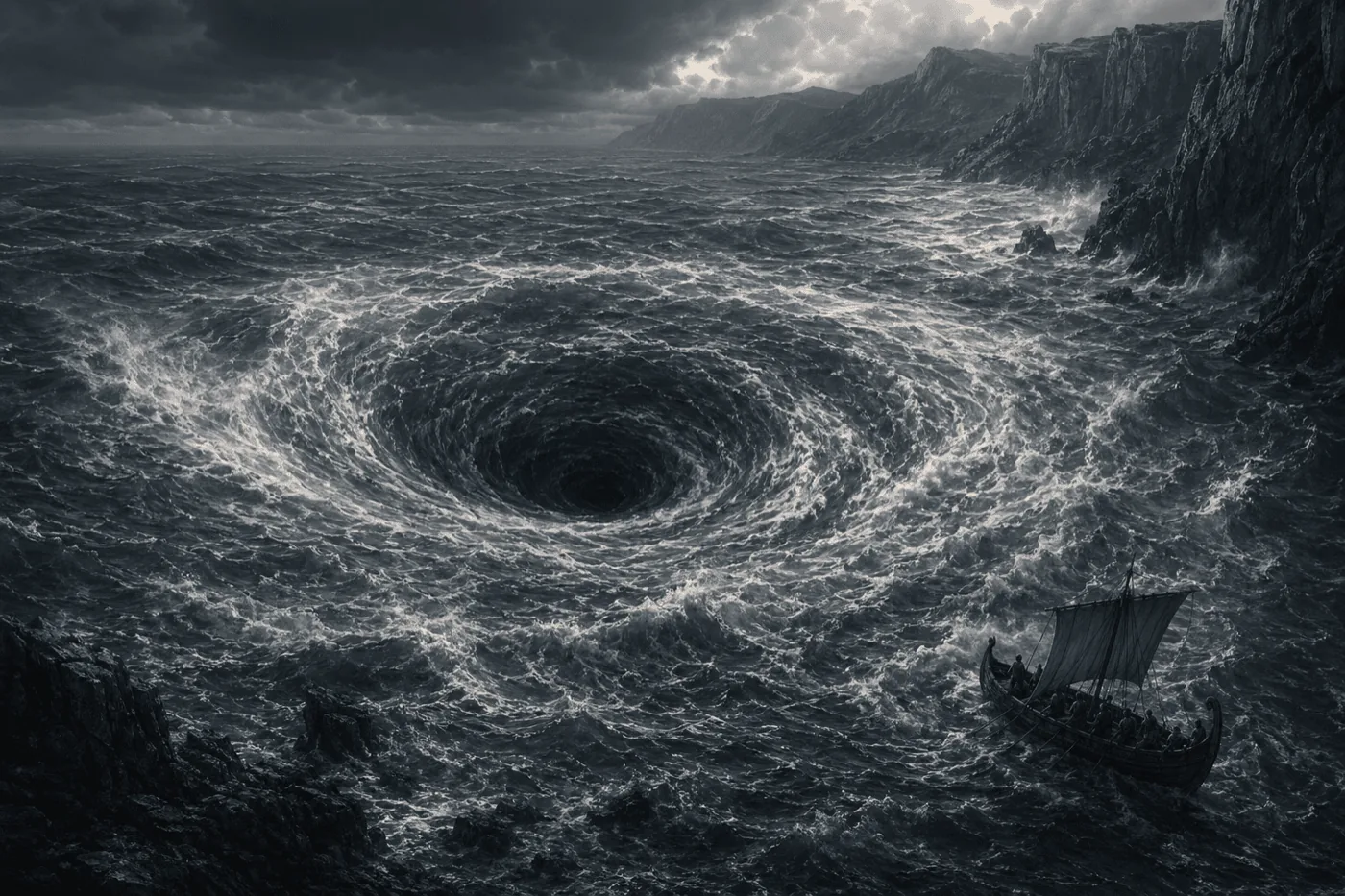
Who is it?
Charybdis is a sea abyss, a movement of suction and release. She does not speak, negotiate or pursue. She swallows. Her danger is not psychological or seductive; it is the terrifying rhythm of a world that can consume a ship whole.
Her force comes from that rhythm. The danger feels cosmic, almost mechanical, as if geography itself had become alive. Charybdis is less a beast than a mythic catastrophe.
Link with the story
Facing Charybdis, Odysseus understands that the ship may disappear. She represents total risk: no survivors, no witness, no story left. That threat makes Scylla cruelly rational.
The passage became a proverb because it gives form to choosing between two evils. There is no clean path, only survival through accepted loss.
What the monster means
Charybdis recalls that the monsters of The Odyssey are not all adversaries to defeat. Some are conditions of the world: winds, currents, abysses, hunger, forgetting. Against them, courage changes form.
She gives the sea its moral dimension. Odysseus' return is never simple navigation, but negotiation with forces beyond human scale. The hero is great not because he controls everything, but because he keeps a route inside what cannot be controlled.