
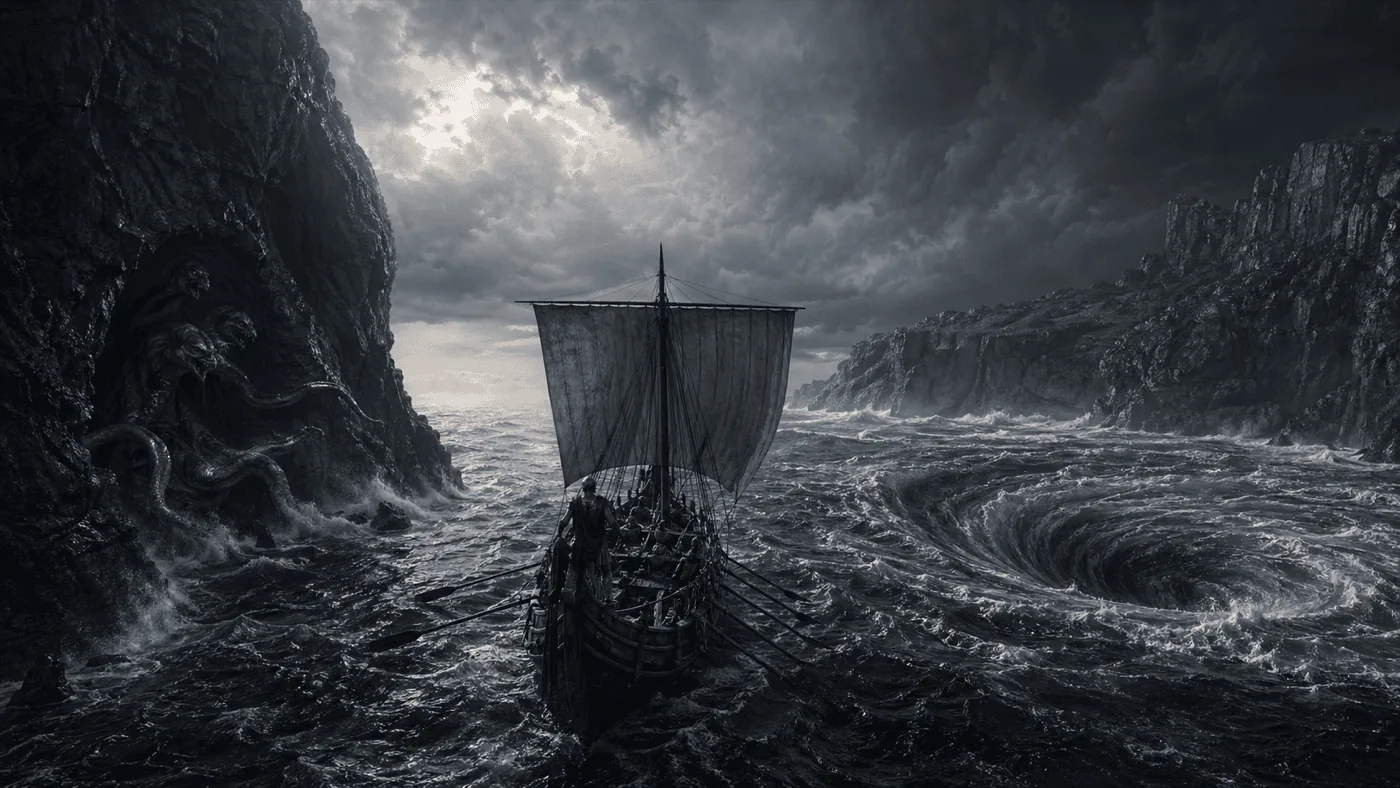
This is one of the darkest hours of command. The ship moves between two deaths: on one side the abyss that can swallow everything, on the other Scylla, hidden in the rock. Odysseus knows he will not save all the men. Still, he must set a course.
The strait with no good choice
The course is constrained between two opposed threats: on one side an engulfing abyss, on the other rocks inhabited by Scylla, who devours part of the crew. Odysseus knows that retreat is worse and advances despite the certainty of losing men. He chooses counted loss over total destruction: six men, in some Greek versions, are not saved, but the ship and the majority of the group survive.
Carrying unavoidable guilt
Scylla and Charybdis show a political truth: the leader must sometimes assume a decision he cannot morally cancel. Failure is not in the chosen action, but in the necessity of choosing itself. The scene changes the reader's or viewer's perception of Odysseus: he is no longer only a strategist, but a man who publicly carries unavoidable guilt.
The scene on screen
The moment can be treated as high-tension decision cinema: the battle is not a frontal fight, but a clock, a direction, an assumed impossibility, a held breath. The monster matters because it forces command to become culpability. The tragedy is measured in survivors as well as dead.