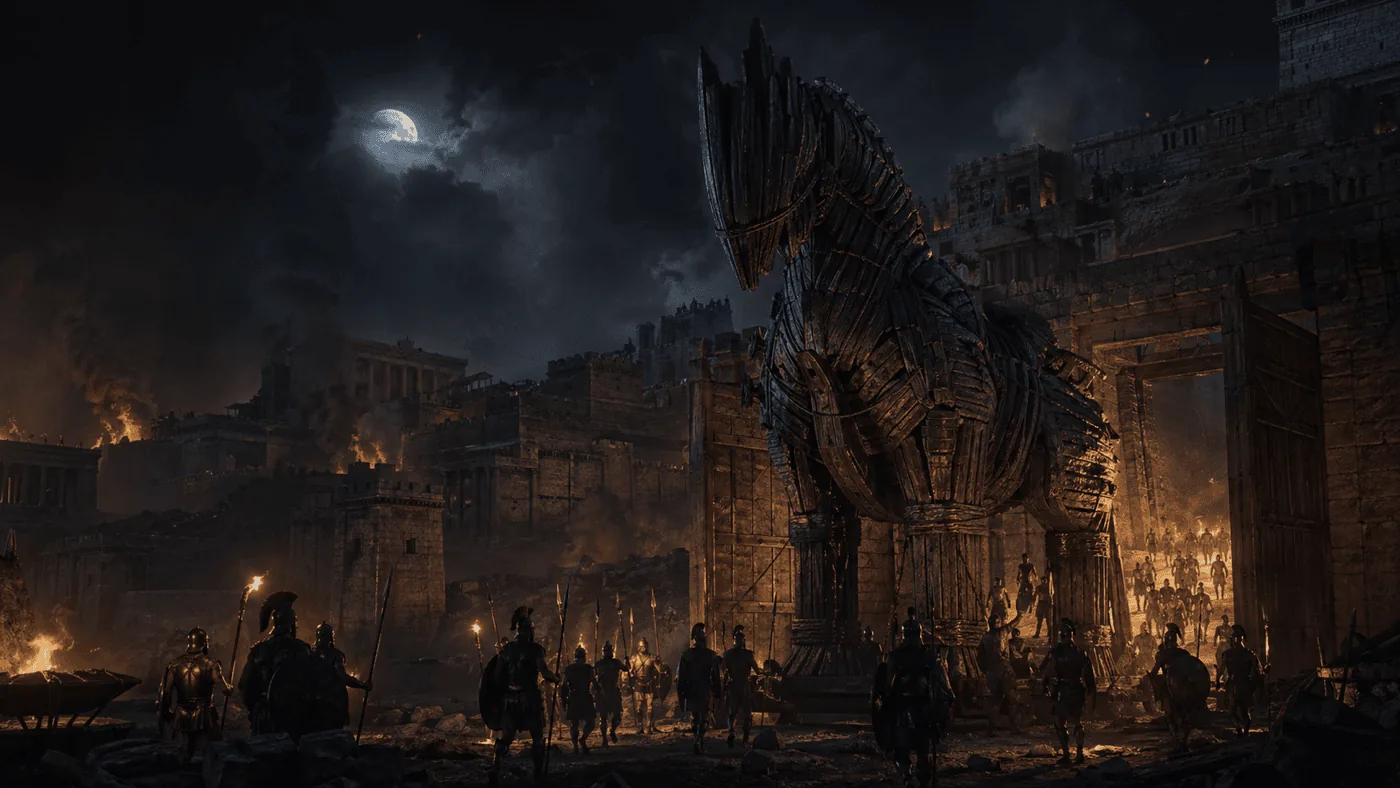
Night falls over Troy, and the city believes it has survived. Before its gates stands a wooden horse, enormous, silent, almost sacred. The Greeks have vanished from the shore. In the streets, rumor runs: the enemies have gone, the gods have returned their favor.
Nothing, however, is settled. In the belly of the horse, men wait. Among them is the shadow of Odysseus: the king of Ithaca, famous less for brute strength than for the oblique intelligence that can turn an object into a trap, an offering into a weapon, a feast into disaster.
By closing the war epic, this scene already sets the logic of The Odyssey in motion: cunning becomes a lasting weapon, and return becomes a debt.
The night the city opens its gates
After a ten-year siege, the Greeks seem to depart, leaving behind a monumental wooden horse as a victory offering. The object looks like a pious trophy, and Troy takes possession of it. But Odysseus' plan rests on a fine reading of cultural habits: victorious pride believes it sees in the horse a sign of ritual salvation, not a mechanical trap. At night, the hidden fighters emerge from the wooden model. They open the gates and reactivate combat inside the city while the Greek army outside returns to the ambush. In a few moments, the city is defeated by a combination of patience, deception and coordination.
The victory that creates a debt
The episode fixes three ideas that run through the whole poem: victory is not only military, it is also a matter of fear, belief and prestige; Odysseus' metis can save, but it is never without consequence; return does not abolish war, it displaces it. Odysseus has won at Troy, but he already enters a new phase in which politics, the gods and his own name will be placed under examination.
The scene on screen
If the sequence is treated as the matrix of the story, it can immediately pose the key question: who controls the narration of an event, the men who won it or the forces that decide what follows? The camera can insist on the almost ceremonial gesture of decision: a gate pulled open, a bolt giving way, a city choosing its loss. The true reversal is not only the sound of weapons; it is the instant when the victors believe they can stop being at war.