
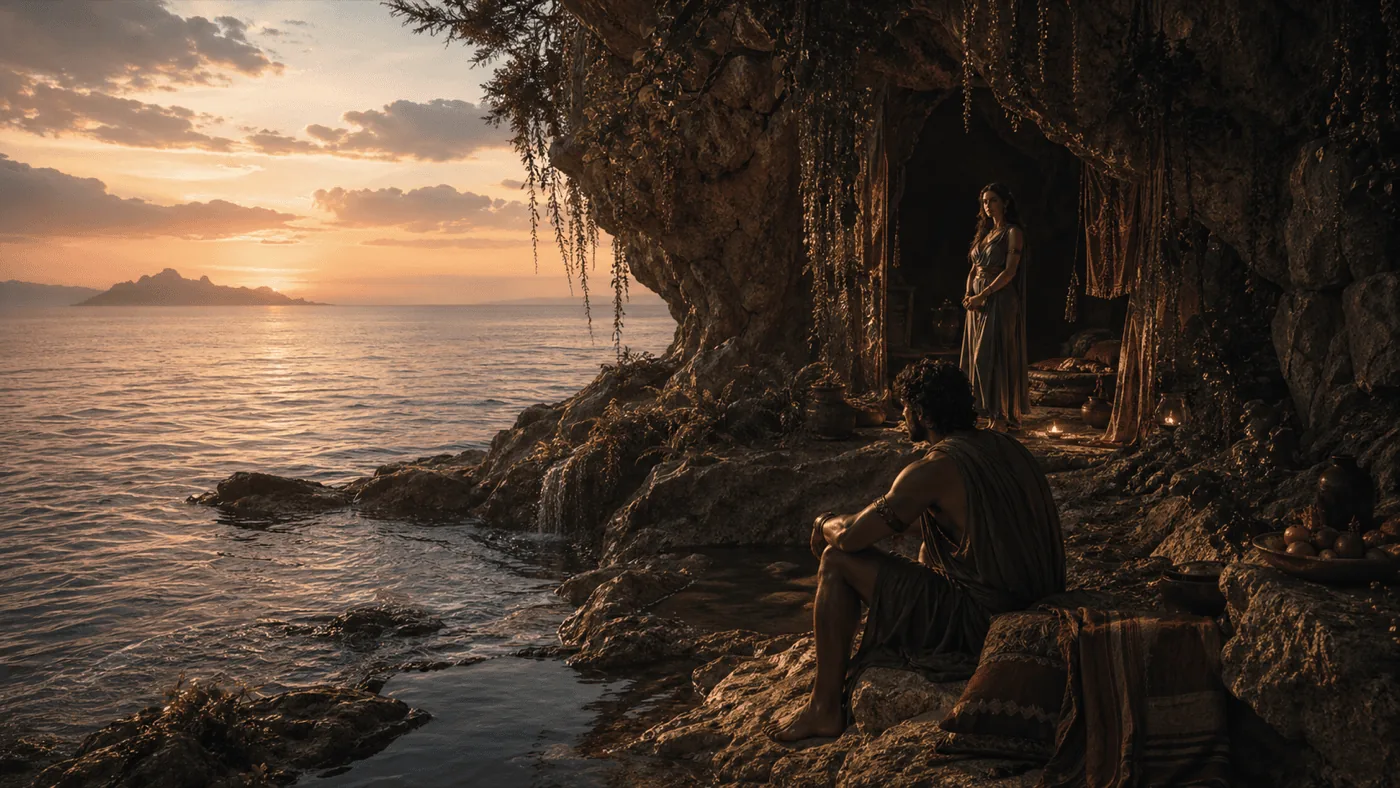
Ogygia could be the end of every hardship. An island, a nymph, a promise of immortality: after so many storms, many men would call it deliverance. Odysseus still looks toward Ithaca. Rest therefore becomes a soft prison.
The island where time stops
Calypso keeps Odysseus, offers him lasting protection and the implicit promise of an existence outside ordinary human time. He lives in an extraordinary intimacy, stable and almost blessed, but fundamentally withdrawn from the world. Departure happens only when Hermes intervenes: the gods recall that the order of the story requires a return to Ithaca, not a permanent fusion with immortality. Liberation is therefore not a victory of force, but a cosmic decision.
Choosing mortal life
The passage clarifies the nature of nostos: it is not only coming back to the place of origin, but accepting finitude and the burden that comes with it. Odysseus renounces paradisiacal forgetting in order to recover an imperfect humanity. The episode is crucial because it asks what time is worth: the longest life is not necessarily the best if it is no longer lived as part of a human story.
The scene on screen
A strong adaptation can make Ogygia feel almost utopian in the senses, then make the decision to leave heartbreaking precisely because it is morally obvious. This is where the story can reach a rare philosophical register in a mythic film: what is the value of a life that no longer has return, aging, memory and responsibility inside it?