
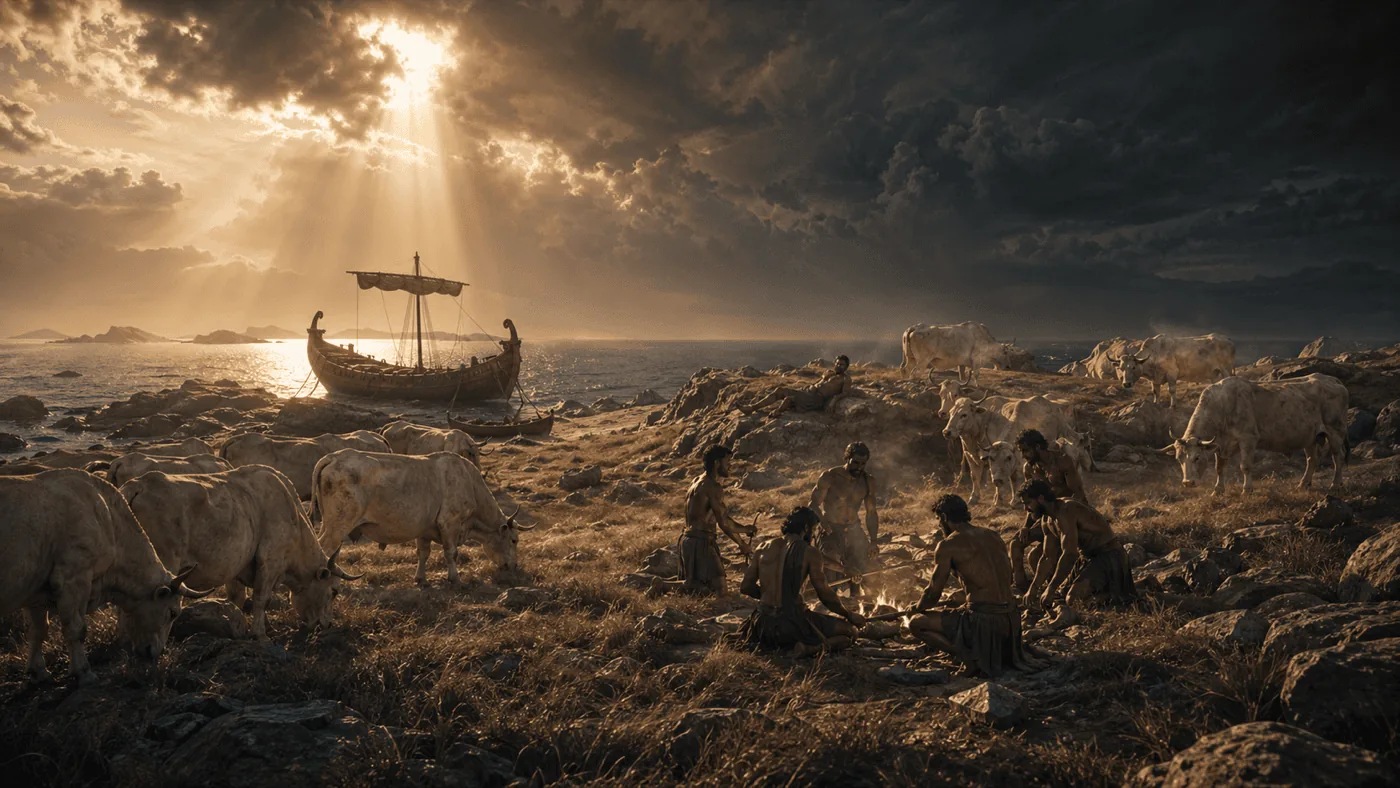
After the Underworld, after the Sirens, after Scylla, one humbler enemy remains: hunger. On Thrinacia, the cattle of Helios graze under the sun's gaze. The prohibition is known. It is not obscure at all. That is precisely what makes the fault terrible.
The prohibition under the sun
On Thrinacia, Odysseus strictly promises not to touch the sacred cattle of the god Helios. The crew resists at first, then under the pressure of scarcity and impatient leaders gives in. The religious taboo is broken. Punishment does not take long to arrive: Zeus sends the destructive storm. The ship breaks, the crew collapses, and Odysseus finds himself almost alone.
Hunger against sacred law
Here The Odyssey immediately connects cosmology, politics and discipline. To transgress a collective prohibition is to break the social contract of the journey itself. Survival has meaning only if it remains oriented; otherwise it produces death in the longer term. The religious character of the prohibition is not a folkloric detail: it structures the fragile conditions of navigation in the poem.
The scene on screen
The sequence could be a portrait of a crowd more than an action effect: hunger as cumulative pressure, then punishment as an existential rupture. It visually prepares Odysseus' isolation before Ithaca and gives the final part of the route its most severe moral narrowing.