
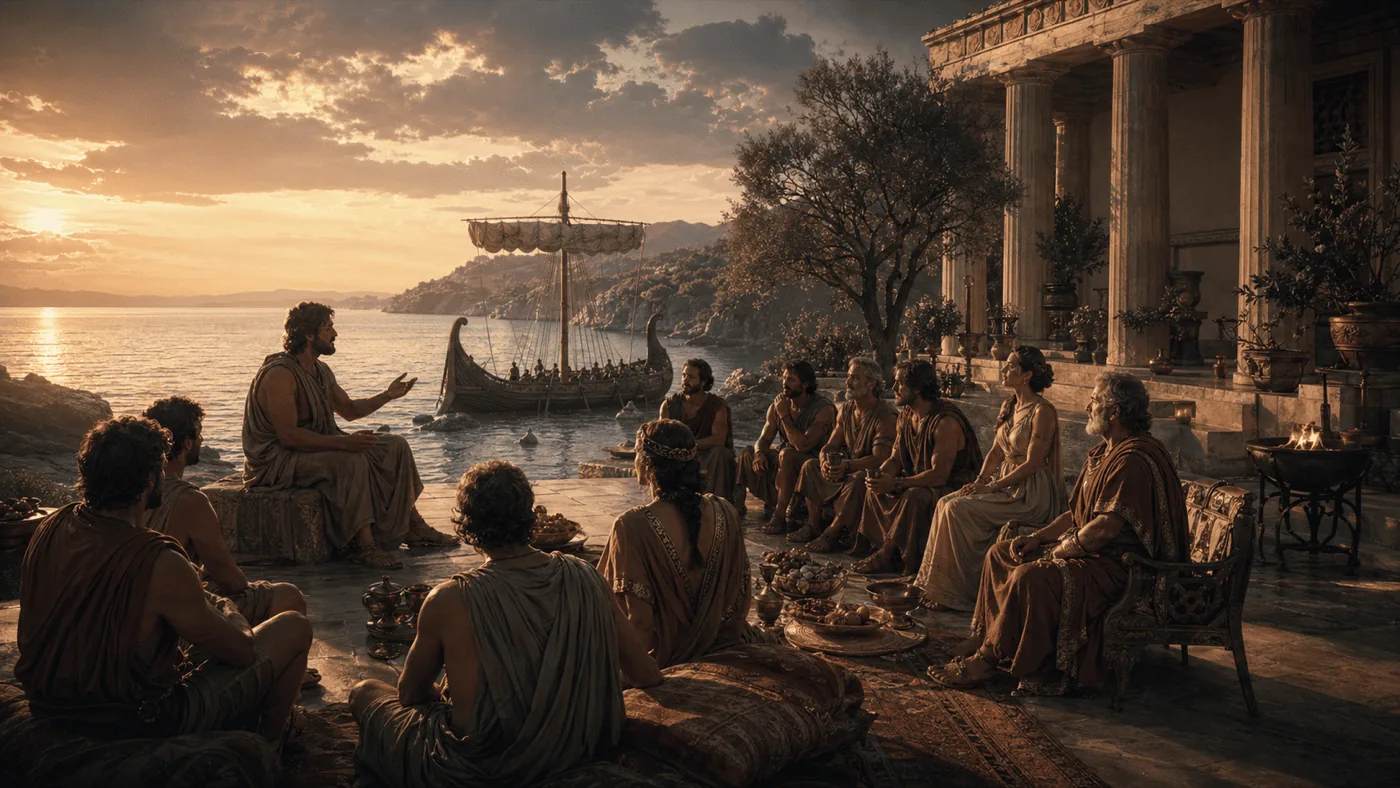
Odysseus reaches the Phaeacians like a man thrown back by the sea. He has almost nothing left: no fleet, no companions, no royal appearance. Yet one decisive force remains to him: telling. Before he returns by ship, he must return through speech.
The guest who tells
Exhausted, Odysseus is found on the shores of Scheria. Nausicaa organizes the first mediation with her court, then Alcinous receives the stranger according to the codes of xenia. After recognition and hospitality, Odysseus recounts the previous episodes in detail. Story becomes the tool that makes him legible again to others and to himself. At the end of this narration, the Phaeacians carry him to Ithaca, completing a return that leaves the register of force and enters that of cultural mediation.
Recovering his name before witnesses
This stage stresses that identity is not given only by birth or force, but also by the ability to tell one's own story. Odysseus recovers a place as subject precisely by assuming his failures and successes before witnesses. The narrative can frame the potential film: what Nolan shows in images may be filtered by a voice that already knows what it has crossed.
The scene on screen
The story-within-the-story allows a rhythm different from action: no longer pursuit, but reconstruction. Images can alternate between present exhaustion and dramatic reminiscence without losing overall clarity. This is the moment when the journey becomes intelligible as memory. The rescue is therefore narrative as much as maritime.