
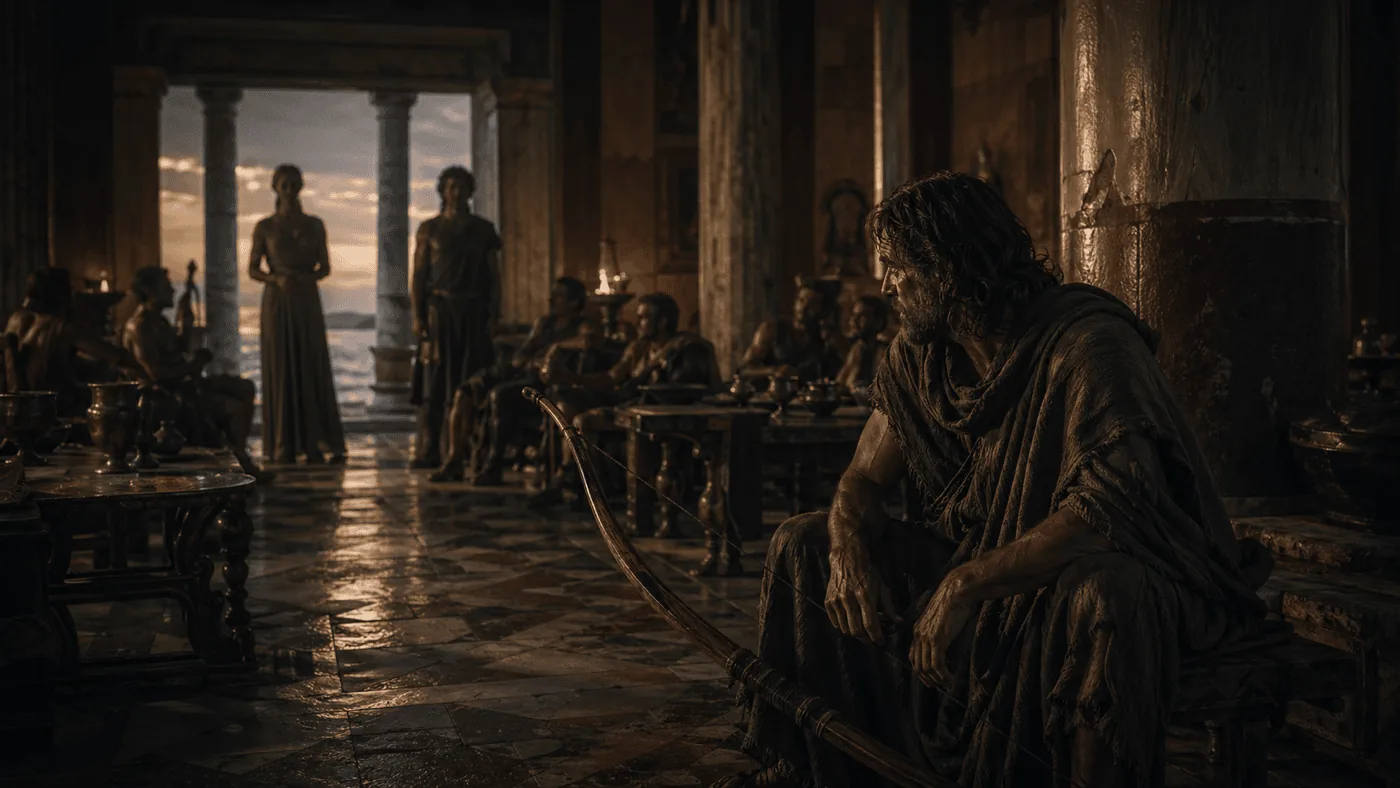
Ithaca does not welcome Odysseus with songs of victory. The palace is occupied, the suitors feast, the servants hesitate, Penelope waits without yielding, Telemachus has grown up in absence. The king comes home like a stranger. First, he has to look.
The king under the mask
Returned in disguise, Odysseus first observes: the palace is occupied by suitors, the loyalty of the servants is divided, Penelope has built defenses of waiting, Telemachus has grown in precarity. Odysseus recomposes alliances, tests people, then gradually reveals his capacity to judge. The final moment is not the heroism of the voyage, but the restoration of a domestic and political order. The suitors are eliminated, the house is cleared of usurped power, and the community can recover its structure.
Recognizing and judging
This scene recalls that heroic identity is not enough without social recognition. Odysseus must be recognized as husband, father and king, that is, as a member of a fabric of obligations, not only as a survivor. The return to Ithaca finally reveals the guiding line of the whole poem: war tests strength, but only return tests justice.
The scene on screen
Nolan can avoid an ending that is too triumphal and insist instead on the unease of restored legitimacy. The vengeance is just, but it reorganizes violence as much as it resolves it. The end of the journey should feel like recognition, judgment and political discomfort at once.