
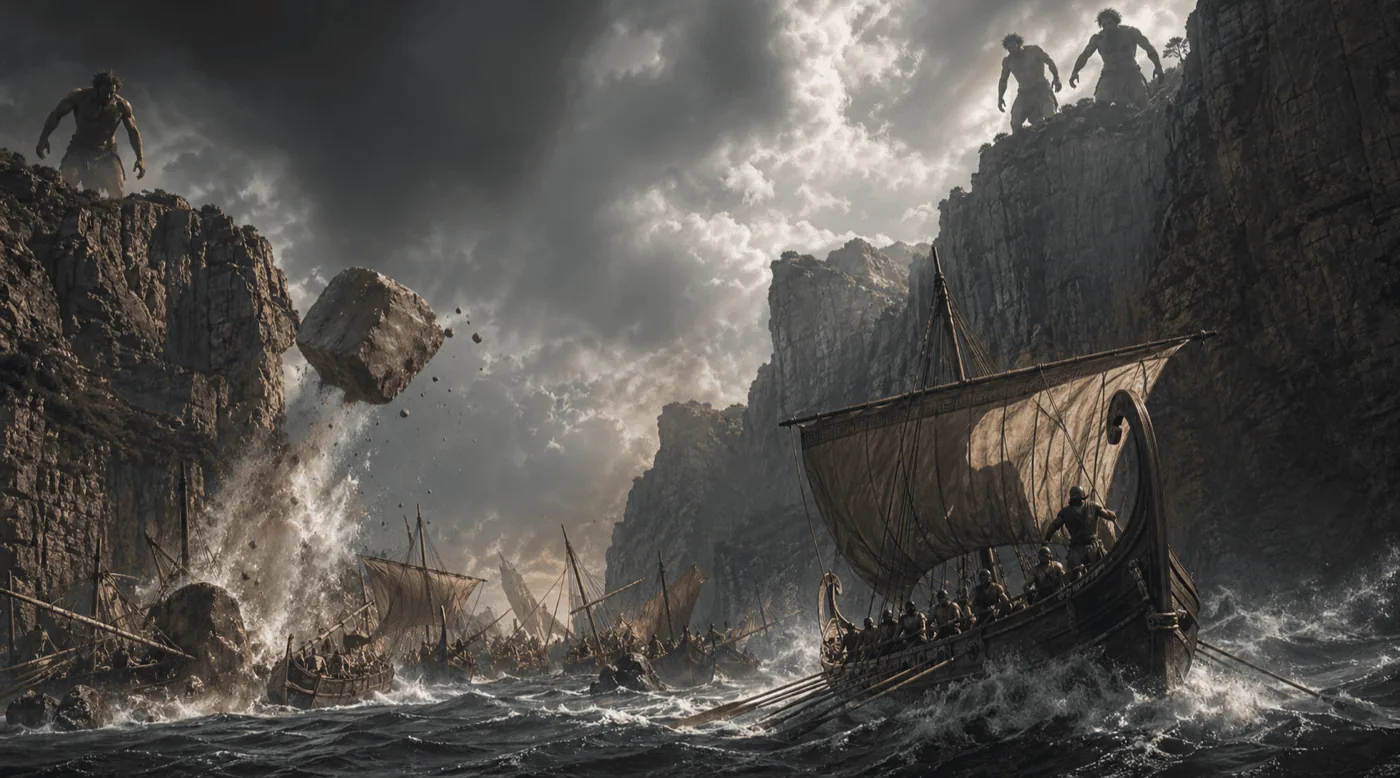
The harbor seemed good. That is often how catastrophes begin in The Odyssey: with the appearance of refuge. The ships enter, the men breathe, then the landscape reveals its true nature. The Laestrygonians do not merely block the route; they crush the fleet.
The false refuge
The group enters a narrow harbor that appears welcoming. The crew's confidence quickly collides with deceptive topography and hostile giants. The Laestrygonians attack from a distance with mechanical violence: rocks, enormous projectiles, immediate annihilation. Odysseus, better placed than the others, perceives in time what will happen to most of the ships. He saves his own vessel and a few men, while the essential part of the fleet is lost.
The end of the fleet
The journey stops being a series of personal tests and becomes a tragedy of numerical reduction. Odysseus is no longer a leader guiding an army; he becomes the responsible man of a remnant. Material loss changes the stakes of every later stage: each decision becomes vital. The motif of the group fractures here. There will be no more secondary detours, only a line of survival.
The scene on screen
Visually, the episode can show Odysseus' greatness without making him stronger than the others. Cunning is no longer first of all attack, but avoidance, preservation of a possible flight, the ability to read a place a few seconds before everyone else is destroyed by it. That small temporal advance is what survival looks like here.