
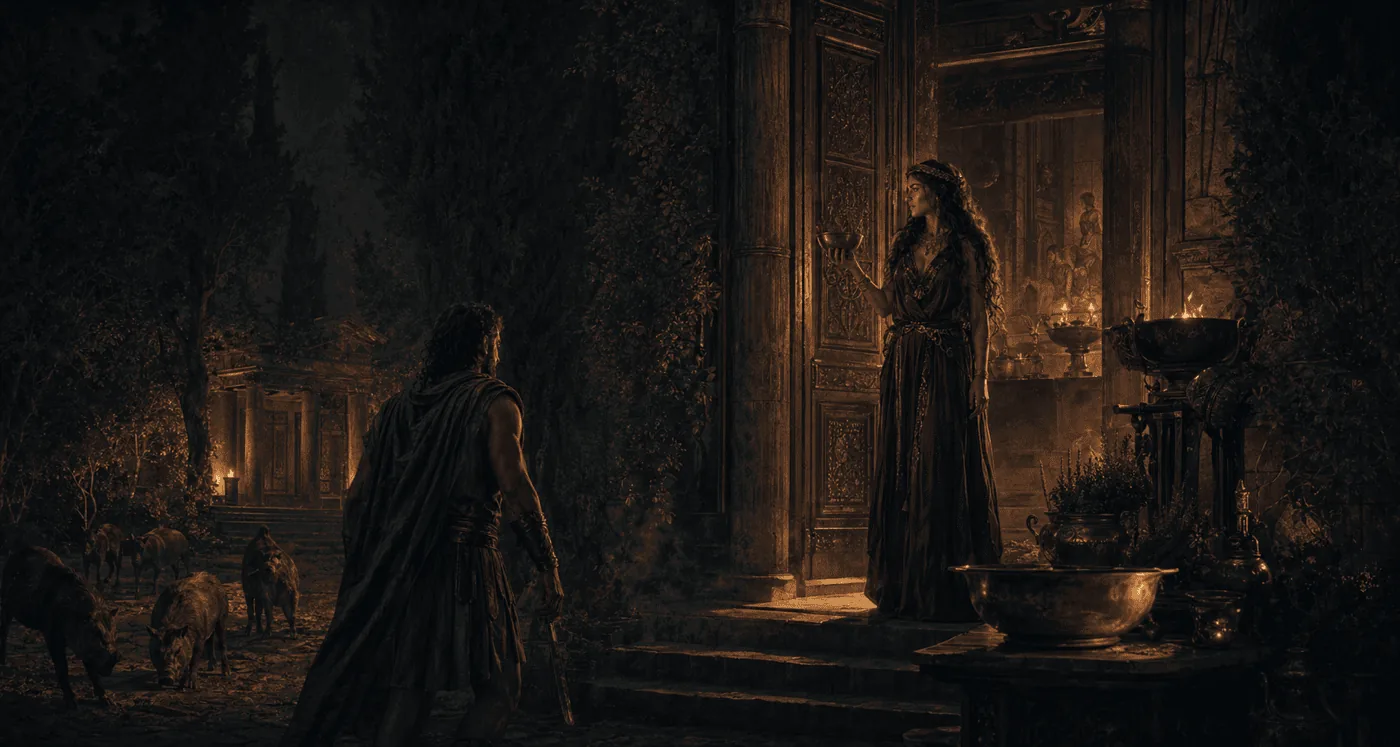
Aeaea does not look like a battlefield. That is exactly the trap. In Circe's house, welcome, perfumes, cups and polished gestures conceal a more intimate trial: a man can lose his shape before he has even understood the law of the place.
The sorceress's house
After the Laestrygonians, the men reach Aeaea. Circe receives them with splendor, then turns some companions into swine. The mythic trap names a crisis of judgment: a man without mastery can lose even his human face. Guided by Hermes, Odysseus resists the charm and imposes a new relation on the sorceress. He forces reciprocity: the end of predation, the release of the men, then a pause before the route resumes.
The threat that becomes a lesson
Here again, the episode is not a simple sequence of supernatural danger. It asks a question of passage: how does one rise again when identity has been shaken? Circe paradoxically becomes a teacher of the journey, giving Odysseus both time and knowledge for what follows. The passage to the Underworld is prepared here, not as a narrative bonus, but as a stage in understanding the border between death, desire and authority.
The scene on screen
Nolan's treatment could mark the difference between esoteric spectacle and character analysis. Showing the inversion, men becoming animals and then recovering speech and memory, would make the scene sharply political: a community loses its form, then has to learn again what human conduct requires.