
- Main issue
- Leaving war without believing cunning has solved everything.
- Main theme
- metis
Route
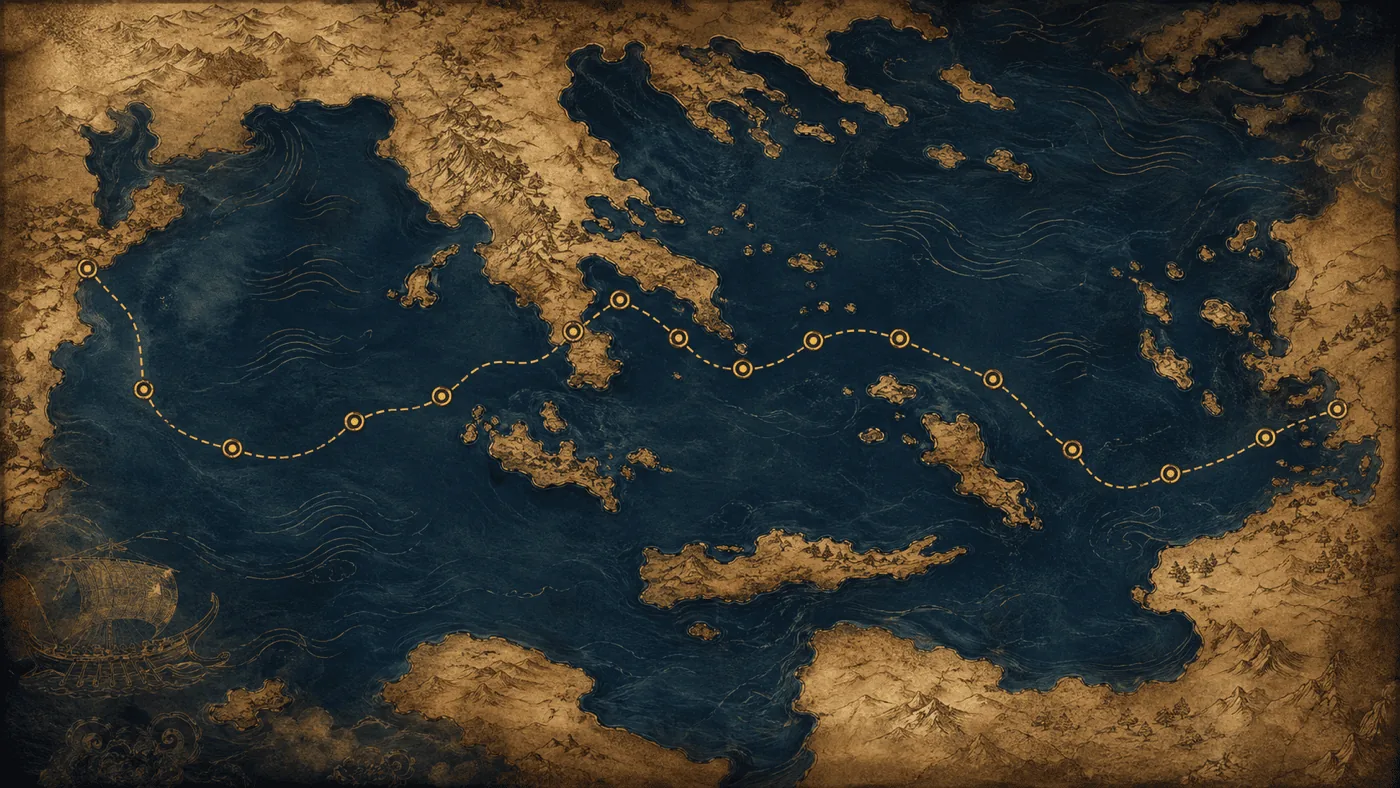
Journey Map
A symbolic map, not a geographical promise: The Odyssey is also a map of temptations, faults and failed returns.
This map follows the story's logic; it is not a definitive reconstruction of the voyage's geography.
FallFaultTemptationMonsterGodThresholdStoryReturn
Read the route as a chain of consequences.
- Main issue
- Learning to leave the logic of war.
- Main theme
- hubris
- Main issue
- Saving the desire to return.
- Main theme
- nostos
- Main issue
- Surviving an anti-house where the host becomes predator.
- Main theme
- metis
- Main issue
- Holding collective trust until the end.
- Main theme
- xenia
- Main issue
- Realizing too late that shelter can be a trap.
- Main theme
- survival
- Main issue
- Crossing metamorphosis without losing the human.
- Main theme
- xenia
- Main issue
- Receiving a route from the world of the dead.
- Main theme
- kleos
- Main issue
- Knowing without being possessed by knowledge.
- Main theme
- metis
- Main issue
- Choosing a lesser evil without making it innocent.
- Main theme
- sacrifice
- Main issue
- Keeping a sacred prohibition when hunger speaks louder.
- Main theme
- sacrifice
- Main issue
- Refusing eternity when it cancels personal history.
- Main theme
- nostos
- Main issue
- Becoming legible to others again.
- Main theme
- xenia
- Main issue
- Turning arrival into true recognition.
- Main theme
- recognition
Reading depth
What this page adds
The map is not meant as a claim of exact ancient geography. It is a reading instrument. The route lets the visitor see how the poem organizes pressure: victory first, then error, forgetting, monsters, divine anger, narration and return.
Used this way, the map helps preserve the logic of the voyage. Odysseus does not simply move from place to place; he loses men, gains knowledge, tests limits and arrives in Ithaca changed enough that recognition has to be earned.