
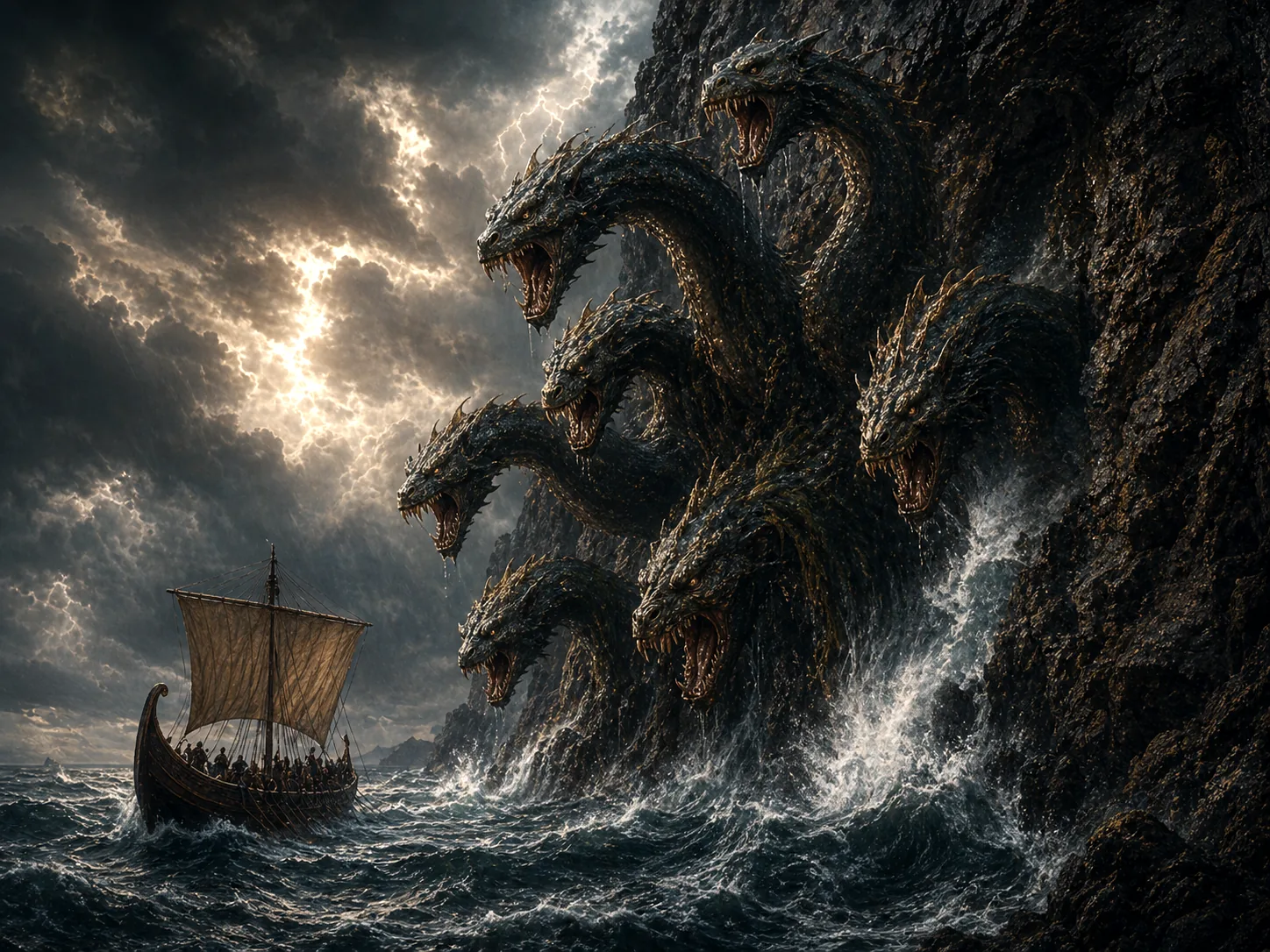
Who is it?
Scylla lives in the rock, strikes from above and snatches those who pass too close. Her threat is attached to place.
She is often described with several heads or mouths. This multiplicity makes her impossible to contain through one heroic gesture. No clean duel solves the problem; the ship must pass under a violence that cannot be fully mastered.
Link with the story
In The Odyssey, Scylla appears with Charybdis. Odysseus must choose the lesser disaster: pass near Scylla and lose men, or risk having the whole ship swallowed by Charybdis. The episode is not a heroic contest but a decision under pressure.
Odysseus does not triumph over Scylla. He crosses despite her, with visible guilt. Command is not glory here, but accepting a loss one cannot make innocent.
What the monster means
Scylla gives mythic shape to the political dilemma. To command, in this moment, is not to produce a beautiful victory; it is to assume a limited loss in order to avoid annihilation. The monster becomes a figure of necessary damage.
She changes the monster into a problem of decision. Danger is not only what attacks; it is also what forces a choice too quickly, too late or without any perfect solution. That pressure reveals Odysseus as leader rather than adventurer.